New Delhi: The Supreme Court on Thursday rebuffed a fresh attempt by a petitioner seeking a stay on the release of the film ‘The Kerala Story, saying that a filmmaker invests a lot of money and time in making a movie and actors also put in a lot of work, and the market will decide if it is not up to the mark.
A bench headed by Chief Justice of India D.Y. Chandrachud and comprising Justices P.S. Narasimha and J.B. Pardiwala said: “One, the CBFC has released the film; two, the Kerala High Court declined to stay the film; and three, yesterday we said we are not going to entertain a petition under Article 32. Now, after these steps have been completed and now for us to hear an application like this is not proper.”
During the hearing on the plea, filed by journalist Qurban Ali, the bench emphasised that before rushing to the court against the movie, a thought should be given about the filmmaker and actors and how many times will this be challenged?
The bench told petitioner’s counsels, senior advocate Huzefa Ahmadi and Shoeb Alam, to look at the filmmaker, he cannot be made to face courts for the release of his film and the Kerala High Court had applied its mind while refusing interim relief of staying the film release.
Ahmadi submitted that a letter was sent to the acting Chief Justice of Kerala High Court, who said that a bench has been constituted.
The registry later informed the petitioner that the bench will not hold sitting on Thursday and also the Kerala High Court is on summer vacation, Ahmadi contended.
However, the apex court refused to entertain the plea against the movie.
The bench pointed out that the petitioner initially tried to challenge the release of the film through an interlocutory application in a pending hate speech case, which was turned down by another bench.
Ahmadi requested the bench to allow him to argue his case in the court before the release of the film.
The Chief Justice told the counsel to work out remedies before the high court.
On Wednesday, the Supreme Court refused to entertain a plea by the Jamiat Ulama-i-Hind seeking a direction to the Centre and others not to allow the screening or release of the movie in theatres, OTT platforms and other avenues, and also that the trailer should be removed from the Internet.
New Delhi: All India president of Democratic Youth Federation of India (DYFI) and Rajya Sabha MP, AA Rahim, on Wednesday alleged that Rashtriya Swayamsevak Sangh (RSS) and Bharatiya Janata Party (BJP) are leading the campaign of defaming Kerala through the upcoming film ‘The Kerala Story’ which is against the secular face of the state.
While talking to ANI, AA Rahim said, “The movie Kerala story is a campaign against Kerala and its secular face. This campaign is led by RSS and BJP.
“Yesterday an organisation which has close links with right-wing groups screened the movie and it is a clear violation of many educational institutional rules. They got the full support from the authority as well. It is really sad to see an institute like JNU where such a movie is screened,” AA Rahim added.
Condemning the upcoming release of the movie, he said, “Today we decided to send a letter to Union Education Minister Dharmendra Pradhan to enquire about the entire incident. Kerala is a state where BJP doesn’t have any base, but they are trying to make inroads by spreading communal agenda. This film is against Kerala. I can say it is a hate campaign against the state. Kerala is a model state. You cannot say it’s a violation of freedom of speech and expression because it is trying to spread communal ideas and hatred towards the Muslim community and also has many factual errors.”
Meanwhile, Kerala General Secretary of Muslim Youth League, PK Firos on Wednesday said that the film ‘The Kerala Story’ should not be screened as it is “insulting to Muslims, Kerala and girls.”
“This film should not be screened. This movie is about the hatred of others towards a particular religion or community. You can be critical and sarcastic. But don’t be a hater. It is insulting to Muslims, Kerala and girls”, Firos said.
Firos further said, “Our intention is to expose the hypocrisy of the film. We have now partially succeeded in that. Because earlier the makers of the movie claimed that 32000 girls from Kerala were converted. Now they have revised it and made it a story of three girls. People of Kerala, India and around the world are convinced this is fake propaganda. They had to turn away from insulting Kerala.”
Firos alleged that the film would create a communal divide within religious groups and inciting hatred and fear in a section is an offence under the Indian Penal Code.
Meanwhile, the Supreme Court on Wednesday refused to entertain pleas seeking a stay on the release of the movie ‘The Kerala Story’ in theatres and OTT platforms and allowed the petitioners to approach the Kerala High Court.
A bench of Chief Justice of India DY Chandrachud and Justice PS Narasimha said a similar plea is pending before the Kerala High Court and asked them to move the High Court with their pleas.
The High Court is scheduled to hear the case against the film on May 5.
Advocate Vrinda Grover mentioned the petition before the bench seeking urgent listing tomorrow saying the film is getting released on May 5.
The petition mentioned by Grover sought a modification in the disclaimer of the film to state that it is wholly fictional.
The bench, however, asked them to approach the High Court where a similar petition is pending.
‘The Kerala Story’ has become a topic for discussion around the numbers being exaggerated in the trailer of the film.
Helmed by Sudipto Sen and produced by Vipul Amrutlal Shah, the film is all set to hit the theatres on May 5, 2023.
‘The Kerala Story’ stars Adah Sharma, Yogita Bihani, Siddhi Idnani and Sonia Balani in the lead roles.
The trailer of Sen’s film ‘The Kerala Story’ came under fire as it claimed that 32,000 girls from the state went missing and later joined the terrorist group, ISIS.
Hyderabad: Like the famous Thousand and One Night (Alf Laila wa Laila) unending episodes, stories from the enigmatic treasure trough of Prince Mukarram Jah keep tumbling out.
One is more intriguing than the previous one.
Alexander Azam Jah, the son of his second wife, Australian Helen, was conspicuous by his absence during his funeral.
He has not shown up in Hyderabad since.
A ceremony was held in Khilwat Palace (also known as Chowmohalla Palace) where perhaps only one of the oldest loyalists of the Nizam family, Kumari Indira Devi Dharaj Girji was seen honouring the Ninth Nizam Azmat Jah on his coronation.
A few days after the ceremony, the traditional family acrimony came out in public. One of the late Mukarram Jah’s cousins said the family members would not give up on the cases that had been filed in the courts of law against the Eighth Nizam. “We will continue the fight against the injustice done to us,” he said firmly.
Still, a few days later, one of the members of the House of Asaf Jah, prompted by a section of Sahebzada’s, Raunaq Yar Khan, declared himself the Ninth Nizam. He now claims that he has some documents to back his “rightful” place.
Mukarram Jah married Jameela Boularous of Morocco in 1992 and divorced her within a year or two. The reasons for this short-lived association are shrouded in stories that cannot be confirmed. However, the couple had a daughter Zairin Unnisa Begum known in short as Zairin. She was born in 1994.
Intriguingly, John Zubrzycki, the Australian who wrote the book The last Nizam, chronicling the life of Prince Mukarram Jah does not acknowledge Jameela as his wife and does not mention Zairin as his daughter. Zubrzycki on the other hand gives the names of four women as the wives of the Prince. Says he, “Jah leaves behind four children – Azmet his eldest son and a daughter Shekhyar by his first wife Ezra; Azam his son by his second wife, Helen; and Nilofer by his fourth wife Manolya Onur…” He skips the mention of the third one, who over she was.
The story of Zairin becomes more intriguing because she and her mother were not there during the funeral of the Prince who was a little less than 90 years when he passed away in Istanbul, Turkey. His body was brought to Hyderabad and given a gun salute by the government of Telangana State before he was laid to rest at the Asaf Jahi graveyard located within the premises of the historical Makkah Masjid.
A few days ago Zairin and her mother arrived in Hyderabad and besides attending numerous functions, held an exhibition of paintings and photographs mainly of Sultan Abdul Majid and the Prince. There were two paintings that caught my attention.
One was a letter purportedly written by the Sultan and the other by the last Nizam Osman Ali Khan.
Syed Ahmad Khan, the editor of Rahnum-e-Deccan an Urdu daily published from Hyderabad, says that he found the letters of Sultan Abdul Majeed and that of Osman Ali Khan in the archives of his newspaper as late as 2021.
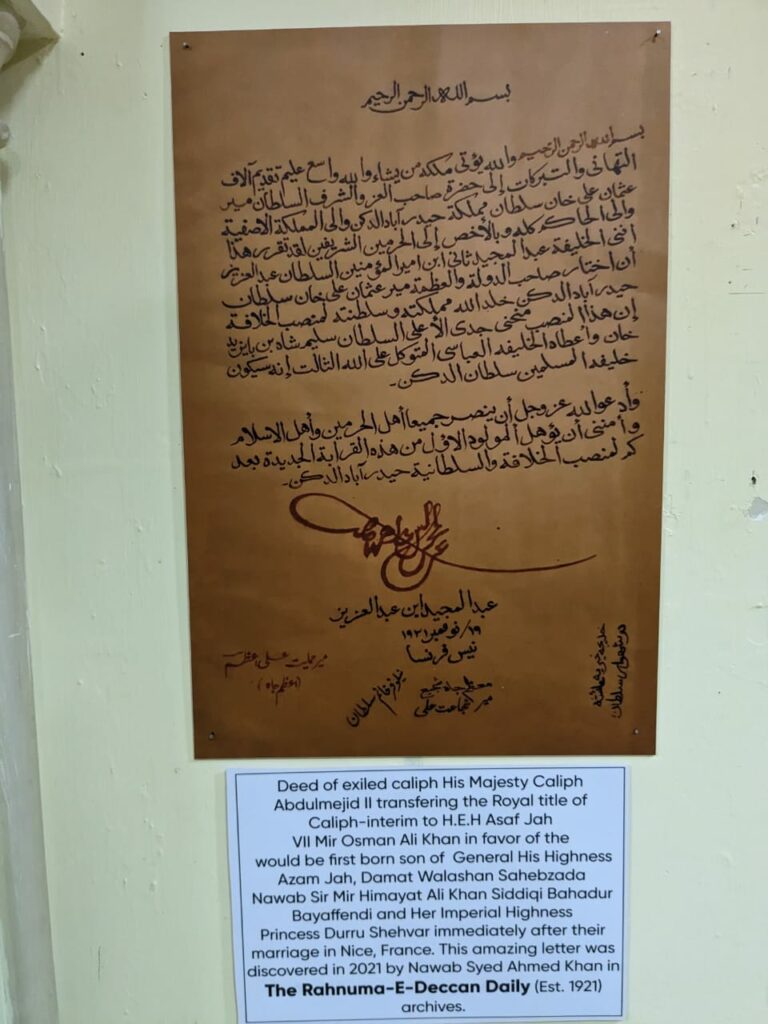
The first letter purportedly written by the Sultan declared Osman Ali Khan as an interim Caliph in his place. The letter was addressed to Osman Ali Khan. It has a date on it. It also has the names of several other people.
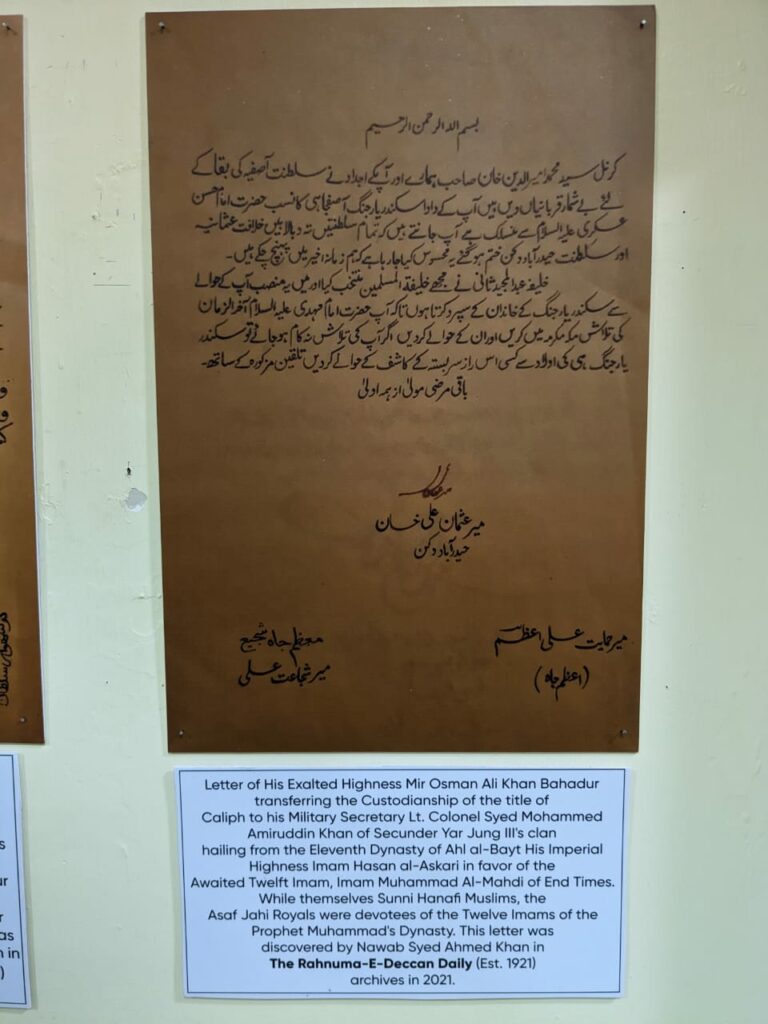
The second letter is written by Osman Ali Khan and addressed to one Col. Syed Mohammad Amir Uddin Khan wherein he tells him how the Caliph has handed him over the caliphate. He also asks him to deliver the letter to the ‘rightful’ successor of Imam Mahdi, whom a section of the Muslims believed would arrive in the last days of this world.
These intriguing letters have brought the entire visit of Zairin and her mother into the circle of more doubts.
Syed Ahmad Khan, says that he discovered the letters some two years ago. He does not explain why he did not disclose their existence to the family of Mukarram Jah or the Hyderabad public. He did not even bring them to the notice of Prince Muffakham Jah, the younger brother of Mukarram Jah who frequently visits Hyderabad. He could have made them public and allowed some experts to scrutinize the documents.
A Hyderabad-based historian who does not wish to be identified said, “The second document has no date. If there was a gap of some years between these letters how is the paper and the ink appear to be the same as if both were written at the same time.”
I have my doubts too. Why is the existence of these letters not known to anyone of some consequence in Hyderabad or anywhere else? For instance, the immediate family members of Mukarram Jah or those who were close to him for decades had no clue about them. My second doubt is this. When Osman Ali Khan had declared that the son born to Azam Jah and Durrushehvar will be entitled to Caliphate why he did not accept the offer given by Abdul Majeed?
I, as a long-standing journalist who is interested in the history, culture, and politics of Hyderabad, demand that a judicious inquiry be held over the authenticity of these letters and that the public be made aware of the results of any such investigation.
I leave the claims of Zairin and her mother to the family and legitimate heir of the late Prince. Intriguingly, no family member of the late Mukarram Jah worth the name has responded to the sudden appearance of Zairin on the Royal horizon of the former Hyderabad State.
Mir Ayoob Ali Khan is a seasoned journalist based in Hyderabad
New Delhi: Senior Congress leader Shashi Tharoor on Tuesday hit out at the makers of the movie “The Kerala Story”, accusing them of indulging in “gross exaggeration” and “distortion” of the state’s reality.
Tharoor’s assertion came in response to those accusing him of double standards over his criticism of the film, referring to his 2021 tweet in which he had said that he had been approached by three Kerala mothers whose daughters are stuck in Afghanistan having been taken there by their misguided husbands.
“The Kerala Story”, starring Adah Sharma, is set to be released in cinemas on May 5. Written and directed by Sudipto Sen, the film is portrayed as “unearthing” the events behind “approximately 32,000 women” allegedly going missing from Kerala.
According to the CPI(M) and the Congress in Kerala, the film falsely claims that the women converted, got radicalised and were deployed in terror missions in India and the world.
In a lengthy Twitter post tagging his 2021 tweet on the three Kerala mothers who had approached him, Tharoor said, “Many are spreading this 2021 tweet of mine as if it undermines my present objections to the trailer and publicity for ‘The Kerala Story’.”
“Yes, I was approached then by three Kerala mothers and was aware of a fourth, and I was open about my concerns about their daughters’ radicalisation. But four cases are a far cry from the 32,000 that the film-makers are alleging,” the MP from Thiruvananthapuram said.
If there really were so many ISIS female members from Kerala, that would mean double the number when you count their husbands, whereas even Western intelligence sources say the number of ALL Indians in ISIS does not approach three figures, Tharoor said.
“This gross exaggeration and distortion of the Kerala reality is what I am objecting to,” he added.
Film’s producer Vipul Amrutlal Shah has said the film is a true story and every scene in the film is true, but it deals with three girls.
“However, we are not changing our stand. If we look at the issue, the number of 32,000 is what we have stated and we are staying by it. But the film is not, so they’re two different things,” he told PTI.
“Since the matter has become sub judice, I would not like to elaborate on that. If we are asked this question… ‘How did we get to this number and everything?’ We’ll answer those questions there (in court),” he said.
Kerala Chief Minister Pinarayi Vijayan had on Sunday slammed the makers of the film, saying they were taking up the Sangh Parivar propaganda of projecting the state as a centre of religious extremism by raising the issue of ‘love jihad’ — a concept rejected by courts, probe agencies and the home ministry.
“The Kerala Story” is backed by Sunshine Pictures Private Limited, founded by Shah, who serves as the producer, creative director and co-writer of the film.
The film’s writer-director Sudipto Sen’s earlier movies are “Aasma”, “Lucknow Times” and “The Last Monk”.
Kochi: A public interest litigation (PIL) was moved in the Kerala High Court on Tuesday against certain statements in the teaser and trailer of controversial Hindi film, ‘The Kerala Story’, and seeking that the court set aside the certificate for public display given to the movie by the censor board.
The high court, after hearing brief arguments, listed the matter for hearing on May 5, the day the film is scheduled to be released.
A bench of Justices N Nagaresh and C P Mohammed Nias also gave time to Deputy Solicitor General of India (DSGI) Manu S, appearing for the Centre and the censor board, to obtain the CBFC’s stand on the PIL before the next date of hearing.
The plea was moved by a lawyer, Anoop V R, who contended that the movie “falsely portrayed” certain facts which had resulted in “insulting” the people of Kerala, and sought a stay on the movie’s impending release.
“‘The Kerala Story’ claims to be inspired from true events. However, the statements in the teaser and trailer of the movie are far distant from the truth,” the petition said.
It contended that it was necessary to stay the release of the movie in its present form and remove “all the incorrect and unverified statements or scenes derogatory to the Muslim community and the state of Kerala”.
The petitioner, in the PIL, urged the court to direct the movie’s director Sudipto Sen, its producer Vipul Amrutlal Shah and the production company Sunshine Pictures to redact or remove, prior to the film’s release, certain statements, particularly the ones that say that the film was inspired by true stories and that 32,000 women from Kerala were converted to Islam and joined the Islamic State (IS).
It also urged the court to prohibit screening of the film without expunging the portions which allegedly have characteristics of hate speech and to set aside the ‘A’ certificate granted to the movie by the Central Board of Film Certification (CBFC).
The petition was opposed by the Centre and CBFC, with DSGI Manu S arguing that the Supreme Court has held in many cases that once the certification was granted by the censor board, the same could not be interfered with by courts.
The DSGI contended that according to the SC verdict regarding the movie ‘Padmavati’, even the fear of a possible deterioration of law-and-order was not a relevant consideration once the CBFC had cleared a movie.
The film’s distributor too opposed the PIL saying that filing it at the last moment was “ill motivated”.
‘The Kerala Story’, starring Adah Sharma, is set to be released in cinemas on May 5 and is portrayed as “unearthing” the events behind “approximately 32,000 women” allegedly going missing from Kerala.
According to the CPI(M) and the Congress in Kerala, the film falsely claims that 32,000 women got converted and radicalised and were deployed in terror missions in India and the world.
Mumbai: Actress Adah Sharma has shared that her upcoming film ‘The Kerala Story’ has not shown Kerala in a “derogatory light”.
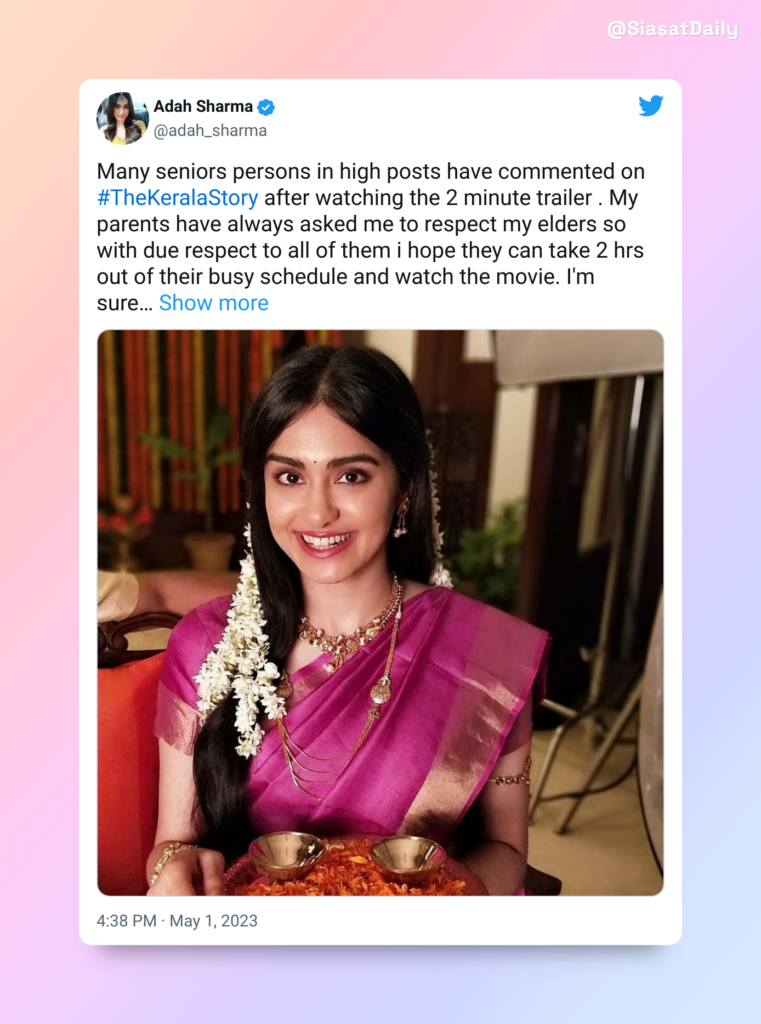
Adah took to Twitter, where she shared a selfie of herself in a pink saree with gajra in her hair.
She said: “Many senior persons in high posts have commented on #TheKeralaStory after watching the 2 minute trailer.”
“My parents have always asked me to respect my elders so with due respect to all of them i hope they can take 2 hrs out of their busy schedule and watch the movie. I’m sure they will see that we haven’t shown Kerala in any derogatory light. Jai hind.”
In ‘The Kerala Story’, actress Adah Sharma is playing the role of Fathima Ba, a Hindu Malayali nurse, who is among the 32,000 women who went missing from Kerala and were then recruited to the ISIS (Islamic State of Iraq and Syria) after being forced to convert to Islam.
Directed by Sudipto Sen, the film tells the story of four women and how from being regular college students in Kerala, they became part of a terror organisation.
The film has courted controversy for portraying itself as a real story and for making false claims that thousands of women from Kerala are being converted to Islam and recruited into ISIS. It faces allegations of promoting the Sangh Parivar’s agenda.
Thiruvananthapuram: Kerala Chief Minister Pinarayi Vijayan on Sunday slammed the makers of ‘The Kerala Story’ film, saying they were taking up the Sangh Parivar propaganda of projecting the state as a centre of religious extremism by raising the issue of ‘love jihad’ — a concept rejected by the courts, probe agencies and even the Union Home Ministry.
Vijayan said that the trailer of the Hindi film, at first glance, appears to be “deliberately produced” with the alleged aim of creating communal polarisation and spreading hate propaganda against the state.
He said that despite the issue of ‘love jihad’ being rejected by probe agencies, courts and the MHA, it was being raised in connection with Kerala as the main premise of the film only to humiliate the state in front of the world.
The CM, in a statement, said that such propaganda films and the alienation of Muslims depicted in them should be viewed in the context of Sangh Parivar’s efforts to gain political advantage in Kerala.
He also accused the Sangh Parivar of trying to destroy the religious harmony in the state by “sowing the poisonous seeds of communalism”. A couple of days ago, both the ruling CPI(M) in Kerala and the opposition Congress hit out at the controversial upcoming movie ‘The Kerala Story’, saying freedom of expression was not a licence to spew venom in society, and the film was an attempt to destroy the communal harmony of the state.
‘The Kerala Story’, written and directed by Sudipto Sen, is portrayed as “unearthing” the events behind “approximately 32,000 women” allegedly going missing in the southern state. The film falsely claims they converted, got radicalised and were deployed in terror missions in India and the world.
Thiruvananthapuram: The ruling CPI(M) and opposition Congress in Kerala on Friday lashed out against the controversial upcoming movie ‘The Kerala Story’, saying freedom of expression was not a licence to spew venom in society, and the film was an attempt to destroy the communal harmony of the state.
‘The Kerala Story’, written and directed by Sudipto Sen, is portrayed as “unearthing” the events behind “approximately 32,000 women” allegedly going missing in the southern state. The film falsely claims they converted, got radicalised and were deployed in terror missions in India and the world.
In a strongly-worded Facebook post, Culture and Youth Affairs minister Saji Cheriyan said the movie was part of the Sangh Parivar propaganda to implement “their tried-and-tested method of creating unrest” among the communities by spewing venom in society.
“Kerala is a state which is known for communal harmony… This movie could be seen as an attempt by the Sangh Parivar to destroy the secular fabric of the state… This is a conspiracy to divide and create unrest in society,” Cheriyan said.
The Congress party urged the government not to give permission to screen the controversial movie as it aimed to create “communal divisions in society through false claims”.
Leader of Opposition in the State Assembly V D Satheesan rejected the claims of the movie makers and said it was clear that the intention of the upcoming movie was to tarnish the image of the state at the international level.
“Permission should not be given to screen the film which falsely claims that 32,000 women in Kerala have been converted into Islam and became members of ISIS,” the Congress leader said.
‘The Kerala Story’, starring Adah Sharma, is set to be released in cinemas on May 5.
Cheriyan said freedom of expression was not a licence to spew venom in society. “We will consider legal action against such fake propaganda,” he added.
Satheesan also said this was not an issue of freedom of expression but part of an attempt to implement the Sangh Parivar agenda of creating divisions in the society by casting aspersions on minority groups.
“No one should think that Kerala can be divided by spewing the poison of communalism,” he said, adding that the state would stand united — as has been its tradition — against this “deliberate move to foster religious rivalry”.
The Democratic Youth Federation of India (DYFI), the youth wing of the ruling CPI(M), also lashed out against the film and said its trailer itself hurt religious sentiments.
The DYFI in a Facebook post alleged that the medium of cinema was being misused by the makers of the movie to create communal divisions in society and to tarnish the image of the state.
The Left outfit also sought stern action against the film.
In a press note issued earlier this week, the filmmakers announced the release date with a poster that shows a burqa-clad woman with a tagline “Uncovering the truth that was kept hidden.”
The film’s writer-director Sudipto Sen’s earlier movies are ‘Aasma’, ‘Lucknow Times’ and ‘The Last Monk’.
‘The Kerala Story’ is backed by Sunshine Pictures Private Limited, founded by Vipul Amrutlal Shah, who serves as the producer, creative director and co-writer on the film.
For Ed Sheeran, the release of a new album usually means a confident sweep to No 1 and steady dominance of the Top 40 over the subsequent months. But there is more at stake than usual for the 32-year-old songwriter when he releases his fifth album, – (Subtract), next Friday (5 May).
The record documents a series of events last spring that Sheeran has characterised as the most challenging period in his life. His wife, Cherry Seaborn, was diagnosed with a tumour that couldn’t be operated on until after the birth of their second child. His best friend, music entrepreneur Jamal Edwards, died aged 31 after taking cocaine. Sheeran was also subject to a high-profile UK court case in which he faced claims he had copied a pair of songwriters’ work in his 2017 smash hit single Shape of You.
Sheeran won the case – but this week finds himself in US court defending the claim that his 2014 single Thinking Out Loud infringes on the copyright of Marvin Gaye’s 1973 hit Let’s Get It On, the verdict of which may arrive on Subtract’s release date. The lawsuit is being brought by the heirs of Gaye’s co-writer on Let’s Get It On, Ed Townsend, and alleges that Sheeran and co-writer Amy Wadge copied an ascending four-chord sequence, and its rhythm.
His previous victory doesn’t guarantee success, said entertainment lawyer Gregor Pryor. “In the UK, Sheeran could probably trust the judicial process a bit more. In the US, with trial by jury – that is harder.” In a string of recent pop copyright cases, including the likes of Katy Perry and Taylor Swift, Sheeran is “one of the highest-profile targets, so it’s got a whiff of the US celebrity lawsuit about it”.
He may also be harmed by what the prosecution has called a “smoking gun” – a live clip of Sheeran segueing from his song into Gaye’s. “It’s very unfortunate,” said Pryor. “You could argue that it illustrates his case that many songs are written on the same chord progressions, but I don’t think it helps.”
Adding to the pressure on Sheeran this week is the question of whether fans of a pop everyman who has built his career on relatability will engage with a deeply personal record that pivots from his usual spread-betting genre fare to focus on a single, melancholy sound.
The lead single from Subtract, Eyes Closed – the album’s poppiest outlier – charted at No 1 at the end of March, ending Miley Cyrus’s 10-week reign at No 1 with Flowers, propelled by a signed CD single that retailed for 99p. Its second single, however, the subdued Boat, was at 38 in this week’s midweek charts.
Subtract is the final album of Sheeran’s mathematical symbols series, following + (2011), x (2014), ÷ (2017) and = (2021). He made the album with Aaron Dessner of US indie band the National – best known to pop fans as the co-producer of Taylor Swift’s two lockdown albums, Folklore and Evermore. Sheeran and Swift are old friends: when she asked Dessner to work on the re-recording of her 2012 album Red, which features two duets with Sheeran, she encouraged them to work together.
‘Struggling emotionally with some really serious headwinds of loss’ … Sheeran in a press shot for Subtract. Photograph: Annie Leibovitz
For Dessner, the potential of the collaboration lay in bringing out “the vulnerability and emotion in [Sheeran] to make music that would not normally be his inclination”, he said. Initially, Sheeran wanted to sideline his trademark guitar; Dessner convinced him to make a “really naked, avant garde but still guitar-oriented record”, and began sending him musical sketches to write to remotely.
Sheeran is known for a playing style in which he uses the body of his acoustic guitar as a percussive instrument. “His right hand is like a drum machine,” said Dessner. While he still wanted the songs to have rhythm, “I didn’t feel the need to try to make pop music.” Once Sheeran started responding to the sketches, songs came thick and fast. “One day, he sent me 14 ideas in response to a track,” said Dessner.
When they met on the Kent coast to record late last spring, they wrote 32 songs in a week, 14 of which feature on Subtract. “It was a vulnerable time,” said Dessner. Edwards died in the middle of the sessions, and Sheeran “was struggling emotionally with some really serious headwinds of loss”. He would ask Dessner if the lyrics were too heavy, detailing grief; how the birth of his first daughter prompted him to kick a “bad vibes” drug habit; sitting in the doctor’s waiting room with Seaborn – who underwent successful surgery – and asking whether this pain signifies “the end of youth”.
“There were times when he tracked vocals that were almost unusable because he was so emotional,” said Dessner. “There’s this raw, visceral beauty to a lot of it.”
During the Shape of You trial, Sheeran said the allegations had prompted him to start filming every recording session to avoid similar situations. There were documentarians in Kent, said Dessner, for creative security and to capture footage for a four-part Disney+ documentary launching on 3 May.
But filming sessions “can’t protect [Sheeran] against everything”, said Pryor. “It’s advisable. It clearly shows, ‘I wasn’t listening to Marvin Gaye and then I came up with this’, but it doesn’t irrefutably prove that he hasn’t heard the Gaye song and not copied it.”
skip past newsletter promotion
after newsletter promotion
Subtract has a misty, limpid sound, charged with distortion and glimmering electronic touches. The Kent coastline influenced Sheeran’s songwriting, said Dessner, with songs on Subtract referencing salt water, deep blues and natural imagery. “The waves won’t break my boat,” Sheeran sings on Boat, the fragile opening song.
Ed Sheeran: Boat – video
Dessner recorded Sheeran’s voice through old tube microphones, creating a different, more vulnerable effect from his biggest hits. He singled out the song Borderline. “He sings in this very high, virtuosic voice – the only other person I think is capable of that would be Justin Vernon [AKA Bon Iver]. It was really moving, like [it’s] hanging out over a cliff. Rather than support it by building immaculate pop arrangements around it, I went in a totally different direction, supporting his voice harmonically without trying to fill every space with instant gratification.”
The effect is not a million miles from one of Sheeran’s formative influences, Damien Rice’s 2002 album O, nor, indeed, the National.
Sheeran is a commercial darling – the most listened-to artist in the UK in 2021, and second only to Harry Styles last year – but rarely a critical one. In a recent interview with Rolling Stone, he balked at the idea that snobby indie fans might like this album because of Dessner’s presence. “Someone who’s never liked my music ever? And sees me as the punchline to a joke? For him to suddenly be like, ‘Oh, you’re not as shit as I thought you were?’ That doesn’t mean anything,” he said.
Dessner said he didn’t care about the potential cultural implications of their collaboration. “He’s made giant pop records that are easy to criticise, but on a human and artistic level, he’s so gifted and lovely. It couldn’t have been more natural, fun and rewarding to feel him jumping off the cliff with me. Over time, I’ve tired of the ‘what’s cool?’ debate.” The pair would continue to work together, Dessner said, and have made more than 30 new songs since Kent. “I’m even more excited about those – I feel we’re getting better.”
For Guardian music critic Alexis Petridis, the collaboration “doesn’t strike me as necessitating a huge leap of faith on the part of the public. Sheeran is an acoustic singer-songwriter, it’s not like he’s been making techno.” What would be interesting, he said, is learning the depth of fans’ investment in a famously relatable musician, who even in superstardom has written songs about the joys of cheap takeaways and is married to his childhood sweetheart. “Do you actually buy into the person, or just the person as a cipher for a normal, nice bloke?”
[ad_2]
#emotional #story #Sheerans #album #copyright #trial
( With inputs from : www.theguardian.com )
A Pizza Express in Woking. The inability to sweat. A tendency to be “too honourable”. Prince Andrew’s 2019 Newsnight interview was a bonanza of bizarre excuses – in which he disastrously tried to defend himself from allegations that he had sex with a 17-year-old girl trafficked by his friend Jeffrey Epstein. Greeted with a riot of disbelief, anger and meme-making by the public, it was the most explosive royal interview of the decade. But how on Earth did it happen in the first place?
A new documentary, airing as part of Channel 4’s alternative coronation coverage, is lifting the lid on this remarkably misguided interview. But Andrew: The Problem Prince kicks off with an entirely different TV appearance. It’s 1985 and the prince is primarily known as a pin-up, playboy and the Falklands hero who risked his life for his country. He is also known as Randy Andy, a nickname referenced by his interviewer on this occasion, a giggling Selina Scott. Andrew shrugs it off with remarkably easy charm and humour. The audience howls in approval. “It was a badge of honour then – the idea of this young prince cutting a swathe through the aristocratic women of London was something to be admired,” says James Goldston, former president of ABC News and one of the documentary’s producers. “There was zero conversation at the time about: are there ethical or moral issues involved in this?”
Fast-forward three decades and Sam McAlister, a guest booker on Newsnight, receives an email from a PR company offering an interview with Prince Andrew about his charity work. She declines on the grounds that it sounds like a puff piece, but the exchange prompts months of negotiations about a more wide-ranging interview, which is again rejected by McAlister because the palace has a single stipulation: all questions about convicted paedophile and financier Jeffrey Epstein are off the table.
But then Epstein is found dead in his New York prison cell. Until that point, the man Newsnight’s Emily Maitlis describes as “America’s Jimmy Savile” had been a peripheral figure in the public consciousness: now he is centre stage, and the prince’s friendship with him is under the media’s microscope. Eventually, Andrew’s team change their minds. McAlister – whose book Scoops: The BBC’s Most Shocking Interviews from Steven Seagal to Prince Andrew, was the inspiration for this documentary – can barely believe her luck.
Emily Maitlis. Photograph: Channel 4
It only gets weirder from there. Andrew brings his daughter Beatrice to a meeting with McAlister and Maitlis. He seems delighted after the interview, inviting the Newsnight team to stick around for a cinema night at Buckingham Palace. It’s only when the Queen receives the transcript, and Andrew receives a “tap on the shoulder” from the palace (according to Maitlis), that the catastrophe becomes clear to him. The interview then prompts Virginia Giuffre – who claims the prince had sex with her on several occasions when she was 17 – to pursue Andrew legally. The lawyers interviewed for the documentary “are very specific”, says Goldston. “What he said opened the door to bringing that legal action which ultimately destroyed him.” In 2022, Andrew settled out of court.
Andrew: The Problem Prince is expressly not a “hatchet job”, says Sheldon Lazarus, another of the programme’s producers. Instead, it’s an attempt to anchor Andrew’s behaviour and decisions within the broader context of his life: despite his status and knack for making headlines, Lazarus believes there has never been an in-depth documentary about him before. We hear how the Queen indulged him as a child, and how Andrew’s finances meant he could never afford the lavish life he had become accustomed to. While Charles had an annual income of £20m, Andrew had to make do with a yearly allowance of £249,000 from the Queen. “By most standards that’s a lot of money, but to live a royal lifestyle, it’s obviously not enough. You feel that he’s being set up for failure,” says Goldston.
Queen Elizabeth II with her sons: Prince Edward next to her, and Prince Charles and Prince Andrew behind, in 1976. Photograph: Anwar Hussein/Getty Images
One of the most notorious moments in the Newsnight interview sees Maitlis ask Andrew whether he regrets consorting with Epstein. No, he replies, because the opportunities he got from it “were actually very useful”. According to Lazarus, the producers found themselves asking a question: “If he had been wealthier, would he have made better decisions, and not got into this crowd in order to keep up with the Joneses – or the Windsors?”
Tonally, the documentary team had to tread carefully. While the Newsnight interview was inescapably comic in content, its subject was a set of extremely serious and disturbing crimes. “I think you can use humour in the most serious of circumstances, as long as it’s done appropriately,” says Goldston, whose other job at the time was overseeing the coverage of the January 6 committee hearings in Washington DC.
skip past newsletter promotion
after newsletter promotion
After all, much of what goes on with the royals veers between farce and something far more troubling. One of the standout moments from the documentary is an interview with the former – yet still palpably annoyed – deputy British ambassador in Bahrain, who recounts Andrew’s freewheeling and ultimately very damaging input as a trade envoy in the early 2000s. “I love the line that ultimately his boss is the Queen – there was just no accountability,” says Lazarus. The diplomat also tells of how the prince refused to stay in ambassadorial residences, instead hiring out luxury hotels to house his thank-you letter-writer and valet.
The Problem Prince isn’t just about the titular royal, however. It’s “a celebration of the power of journalism,” says Goldston, who admits to feeling “kind of jealous” about the Newsnight scoop at the time. It’s also an insight into a rather mysterious job: that of the celebrity booker. “I’ve worked in journalism for 30 years and been involved in a lot of big gets: presidents, prime ministers, celebrities,” he says. “The art of the booking has always fascinated me – how does that happen?” Goldston ran Good Morning America “at the height of the morning wars and watched these bookers go after these things every day. It’s a phenomenal feat of endurance.”
It’s a world Lazarus is also familiar with, having started his career booking guests for Paula Yates’s On the Bed segment on Channel 4’s The Big Breakfast – a job he admits wasn’t beholden to the same journalistic ethics as Newsnight. “I definitely wouldn’t have said no to Andrew,” he says. “He could have come and juggled – he could have done whatever he wanted!”
The documentary provides an intimate insight into the big-name interview, but its headline question – why Andrew decided to appear on Newsnight in the first place – is ultimately left unanswered. Maitlis suggests it may have been an attempt to clear his name for his daughters’ sake, while Goldston thinks the media pressure meant “he was going to have to confront it head on and that’s how they end up saying yes”. That, however, doesn’t explain why he went against the guidance of trusted advisers, including media lawyer Paul Tweed, who claims in the documentary that he warned Andrew not to do it.
Instead, you come away with the sense that it was driven by a heady cocktail of yes-men-powered delusion and extreme naivety (he was “not intellectual”, according to royal biographer Andrew Lownie, while Tina Brown’s The Palace Papers claims that Epstein called the prince “an idiot”). Yet this cluelessness wasn’t limited to Andrew himself. Goldston recalls McAlister telling him that as the interview concluded, a member of the prince’s staff leaned over to her and muttered, “‘Isn’t he marvellous?’ That lack of understanding of what had just happened was pretty profound.”
The documentary ends with a portrait of an underemployed Andrew living in the shadows. And yet Tweed, who appears in the documentary with the blessing of the prince and his family, suggests something that seems currently unthinkable: the idea that the prince might make a return to public life. Is there any world in which this could happen?
“I think they live in hope that they can still turn this round, which is actually a very interesting idea,” says Goldston. “[Tweed] has seen a lot of these cases. Who knows?” Never say never, but if the royal family wants to survive until the next coronation, it seems that Andrew – utterly tone-deaf, entitled beyond belief and morally dubious, at best – is everything it must leave behind.
[ad_2]
#Set #failure #wild #story #car #crash #interview #destroyed #Prince #Andrew
( With inputs from : www.theguardian.com )