Hyderabad: The preparations for the National Eligibility cum Entrance Test (NEET) undergraduate entrance examination have been completed in the state of Telangana. This year, approximately 70,000 candidates from Telangana have applied for the 2023 NEET UG exam. To facilitate this, a total of 24 centers have been set up across the state, including Hyderabad, Warangal, Khammam, and Nizamabad.
Telangana has a total of 6,615 MBBS seats in 17 government and 24 private medical colleges. Of these, 2,815 are available in government colleges, while the remaining 3,800 are in private medical colleges. It is expected that more MBBS seats will be added before the admission process begins.
The NEET exam is scheduled to take place on May 7 from 2 pm to 5 pm. Last year, Telangana received 61,207 applications for the NEET UG exam, but only 59,296 candidates appeared for the examination, out of which 35,148 qualified.
NEET UG is conducted in 13 languages, including Telugu, through which admission is granted to 10 courses, including MBBS. The hall tickets for the 2023 NEET UG exam have already been released, and the National Testing Agency (NTA) has also released the admit card for this examination. The examination will be conducted under the pen and paper system at 499 locations across the country.
To download the hall ticket, students can visit the official website and enter their application number, date of birth, and security pin. The NTA has instructed all candidates to carry a printout of their admit card, along with any necessary documents and photographs, to the examination center.
With these preparations complete, candidates from Telangana are all set to appear for the NEET UG exam on May 7, in hopes of securing a coveted MBBS seat in one of the many prestigious medical colleges across the state.
Hyderabad: The Haj Committee of India has recently announced that they will no longer be providing 2100 riyals to the hajj pilgrims for the 2023 Hajj season. Instead, the pilgrims will have to arrange the riyals on their own for their travel expenses while in Saudi Arabia. The Chief Executive Officer of the Haj Committee of India, Mohammad Yaqoob Shaikh, has written to all state Haj committees, advising them to inform the pilgrims about the purchase of riyals on their own.
According to Shaikh, each pilgrim will be allowed to carry a maximum of 1500 Saudi riyals. If any pilgrim carries more than the allowed amount, they will be subject to the rules and regulations of the Reserve Bank of India and customs officials. Meanwhile, the Ministry of Minority Affairs has selected the State Bank of India to provide Riyal to the pilgrims. The supply and insurance of Saudi Riyal will also be done by SBI.
SBI will make arrangements for the supply of riyals to the pilgrims, which will be available at Hajj training camps and application points. The bank will also appoint a nodal officer for each state to oversee the arrangements for the supply of riyals. The state Hajj committees will guide the pilgrims regarding the purchase of riyals.
In addition to the new policies regarding riyals, sub-committees comprising members of the Hajj Committee have been formed for effective arrangements during the Hajj camp. These committees will be responsible for food, transport, maintenance, and volunteers. Two members of the Hajj Committee have been included in each committee to ensure that the pilgrims are provided with the best possible facilities and services.
The Haj Committee of India has been working to ensure that all aspects of the Hajj pilgrimage are properly taken care of, and these new policies are just one step towards that goal.
SRINAGAR: On Thursday, the army destroyed around half a dozen explosive landmines on the Line of Control which were originally their own landmines but had drifted, posing a risk to the lives of army personnel.
Official sources stated that six anti-personnel landmines were detected by army troops who were patrolling the area and were part of their own minefield but had drifted near the troops.
They added that a special team of the Indian Army’s bomb disposal squad destroyed the six mines through a controlled mechanism.
The shells were destroyed in the forward area of the Balakote sector on the Line of Control. (KNO)
The Adani Group, one of India’s leading conglomerates, has been in the news for a while now, thanks to the Hindenburg Research report that was released on January 24, 2023. The report levels allegations against the group causing a massive dip in the stock prices of the Adani Group companies.
However, the shares recovered significantly after the initial dip, but they still require a huge rally to revisit their pre-Hindenburg levels.
Nifty 50 index recovered
The recovery in the broader market was much quicker, with the Nifty 50 index crossing the January 24 level of Rs. 18118.30. However, two of its constituents from the Adani Group, namely Adani Enterprises Limited and Adani Ports & Special Economic Zone Ltd, are yet to recover fully. The shares of these companies are still trading below their pre-Hindenburg levels.
As of May 4, 2023, the share prices of Adani Enterprises Limited and Adani Ports & Special Economic Zone Ltd were Rs. 1911.25 and Rs. 679.75, respectively. While this is a significant recovery, the shares still fall short of their pre-Hindenburg levels of Rs. 3442 and Rs. 761.20, respectively.
List of Adani shares, their pre-Hindenburg and current levels
The recovery of Adani shares has been fast as the group has taken several steps to address the concerns raised in the Hindenburg Research report.
Here’s a list of Adani shares and their pre-Hindenburg and current levels:
Adani Group companies
Pre-Hindenburg levels (Share prices on January 24)
Share prices on May 4
Adani Enterprises
Rs 3442
Rs 1911.25
Adani Ports & SEZ
Rs 761.20
Rs 679.75
Adani Green Energy
Rs 1916.80
Rs 945.55
Adani Power
Rs 274.65
Rs 238.15
Adani Transmission
Rs 2762.15
Rs 1011.55
Adani Total Gas
Rs 3891.75
Rs 930.20
Adani Wilmar
Rs 572.65
Rs 399
Ambuja Cements
Rs 498.95
Rs 388.30
ACC
Rs 2335.7
Rs 1766.30
NDTV
Rs 284
Rs 183.35
Though, the Adani Group shares have recovered significantly, but they still require a massive rally to reach their pre-Hindenburg levels. It remains to be seen how the Adani Group will continue to perform in the coming months.
SRINAGAR: Amid forecasts for mainly clear weather with a chance of a brief spell of rain and thunderstorms in the evening, night temperatures continued to remain below normal in Jammu and Kashmir on Friday.
A meteorological department official stated that rain was expected at many places from May 6-8, and from May 9-12, the weather was expected to be mainly dry. The weather conditions were also favourable for spraying and harvesting, and farmers can take advantage of this on May 9-12.
Regarding temperature, Srinagar recorded a low of 9.6°C, which was 0.1°C below normal for the summer capital, compared to the previous night when it was 10.3°C.
Qazigund recorded a low of 7.8°C, which was below normal by 0.7°C for the gateway town of Kashmir, compared to 7.2°C on the previous night.
Pahalgam recorded a low of 3.6°C, which was 1.3°C above normal for the famous tourist resort in south Kashmir’s Anantnag district, compared to 2.0°C on the previous night.
Kokernag recorded a low of 7.0°C, which was 1.4°C below normal for the place, compared to 6.7°C on the previous night.
Gulmarg recorded a low of 2.2°C, which was 2.1°C below normal for the world-famous skiing resort in north Kashmir’s Baramulla district, compared to 3.8°C on the previous night.
In Kupwara town, the mercury settled at 7.4°C, which was 1.0°C below normal for the north Kashmir area, compared to 9.6°C on the previous night.
Jammu recorded a low of 17.3°C, which was 5.3°C below normal for J&K’s winter capital, compared to 17.6°C on the previous night.
Banihal recorded a low of 7.7°C, which was below normal by 2.4°C; Batote 9.7°C, which was 2.8°C below normal; Katra 15.1°C, which was 4.1°C below normal, and Bhaderwah 8.0°C, which was below normal by 1.2°C.
Ladakh’s Leh and Kargil recorded a low of minus 0.2°C and 5.4°C, respectively, the official added. (GNS)
Hyderabad: Bomb threat on Madhapur’s private office proved hoax
Hyderabad: A hoax bomb call at a private company in Madhapur created panic as an unidentified person called up and informed that a bomb has been planted within the office’s premises.
Upon receiving the threat, the officials took immediate action and called anti-sabotage teams and the bomb disposal squad to search for the bomb.
The search teams rushed to the office and conducted a thorough search before declaring it a hoax.
During the search operation, employees were evacuated from the building as a precautionary measure.
However, no bomb was found bringing relief to the employees.
Police have registered a case after the company officials raised a complaint against the unidentified caller.
Also, the cops suspect that a former employee of the office might be the person who passed the fake information to cause panic in the office.
Hyderabad: Telangana’s minister for industry and information technology K.T. Rama Rao has condoled the death of Army jawan Pabballa Anil in the helicopter crash.
The minister said in his message that it was painful to lose a young jawan in the mishap. He conveyed his heartfelt condolences to the bereaved family and assured them that the government will stand by them.
Meanwhile, northern army commander Lt Gen Upendra Dwivedi paid his tribute to Anil.
#WATCH | J&K: Northern Army Commander Lt Gen Upendra Dwivedi pays tribute to Craftsman (Avn Tech) Pabballa Anil, who lost his life in a helicopter crash in Kishtwar yesterday. pic.twitter.com/OjJhaJ379R
Telangana Planning Commission vice-chairman B. Vinod Kumar and Telangana Pradesh Congress Committee (TPCC) president Revanth Reddy have also condoled jawan’s death.
Indian Army’s aviation technician Pabballa Anil from Telangana was killed in the helicopter crash in Jammu and Kashmir.
The 29-year-old hailed from Rajanna Sircilla district of Telangana. Two pilots were also injured when the Advanced Light Helicopter (ALH) of the Army crashed in the remote Marwah area of Jammu and Kashmir’s hilly Kishtwar district on Thursday.
Anil hailed from Malkapur of Boenpalli mandal of the district. A pall of gloom descended on the village after the shocking news of the young technician’s death.
Anil had been serving in the Army for the last 11 years. He is survived by his wife and two sons. According to family members, he had come to the village only a month ago. Anil had participated in the birthday of his younger son and also took part in a local fair in in-laws’ village Korem.
Family members were shocked that Anil, who was with them till 10 days ago, is no more. The mortal remains of Anil are likely to be brought to the village on Friday evening.
Former Punjab Assembly Speaker Charanjit Singh Atwal joins BJP
New Delhi: Charanjit Singh Atwal, former Speaker of the Punjab Assembly, joined Bharatiya Janata Party (BJP) in the presence of party national president JP Nadda, in Delhi.
On April 19, Atwal resigned from the primary membership of Akali Dal. Atwal was born on 15 March 1937, was the Deputy Speaker of the 14th Lok Sabha of India from 2004 to 2009.
He represented the Phillaur constituency of Punjab in the 14th Lok Sabha and was a member of the Shiromani Akali Dal (SAD). He was also the Speaker of the Punjab Assembly twice.
It is noteworthy, Charanjit’s son Inder Iqbal Singh Atwal along with several others from Punjab, joined the Bharatiya Janta Party (BJP) in New Delhi on Sunday.
They were formally inducted into the BJP in the presence of senior BJP leaders at the party’s national headquarters in the Capital on Sunday.
Mumbai: Popular American boy band Backstreet Boys performed in Mumbai on Thursday and it was truly a star-studded affair.
From Malaika Arora to Shraddha Kapoor, several celebrities from tinsel town were spotted at the concert.
Jacqueline Fernandez, Meezaan Jafri, Varun Dhawan’s wife Natasha Dalal, Diana Penty and Rohit Sharma’s wife Ritika also arrived at Jio Gardens, BKC, Mumbai to witness the Backstreet Boys’ live performance.
All our B-town stars were dressed in casual and comfy clothes. Take a look.
Several images and pictures from the concert were circulated online. The band started the nearly two-hour gig with the hit song ‘I wanna be with you.’ and continued to enthral the desi audience with tracks like ‘The Call’ and ‘Don’t want you back’ among others.
In the middle of the over two hours concert, the band’s member Nick Carter remarked someone should have warned the band about how hot it is in India. He added, “It is not the weather that is making it hot, it because of all you. We had no idea we had so many BSB fans here, but we now see it and we love it. It’s our second time in India and we were waiting from a very long time to come to Mumbai.”
The band performed in India after almost 13 long years. The boys landed in Mumbai on Wednesday. Band member Nick Carter shared a video showing how the boys received a warm welcome at a hotel in Mumbai.
“What cool surprise arriving at the hotel here in Mumbai India. The hotel staff had a full out Bollywood style dance prepared remixing all our songs. I guess we really do have fans all over the world,” he captioned the clip.
What cool surprise arriving at the hotel here in Mumbai India. The hotel staff had a full out Bollywood style dance prepared remixing all our songs. I guess we really do have fans all over the world.
The Backstreet Boys have AJ McLean, Brian Littrell, Nick Carter, Howie Dorough, and Kevin Richardson in the band, and they are in their fifth year of touring the world.
The boys are now scheduled to perform in Gurugram on Friday.
As otherwise abundant bird species get rare in the cities, experts hold electromagnetic radiation responsible for the mess. The faster communication technologies will add to the stress of the birds and impact an ecological balance, reports Umaima Reshi
Migratory Birds Flying-high-in Hokersar Wetland
With the 5G already becoming popular, the debate about its possible impact on different life forms is back to the table talk. There are reports that bird populations are getting impacted by the radiations emitted by the base tower stations (BTS), a key infrastructure for all kinds of mobile telephony.
BTS is vital in communication. It is an electromagnetic device with pernicious radiation. It is a fixed transceiver in all mobile networks, which connects mobile devices to the network. It sends and receives radio signals to mobile devices and converts them to digital signals. Besides, it passes on the network to route to other terminals in the network or to the internet. The quantum of radiation depends on the number of sensors installed on a BTS. Its power potency changes with distance.
The BTS Networks
Electromagnetic fields and radiations are usually pervasive. People already live with a variety of electromagnetic radiations that power the radio, television, and cell phones. Unlike all others, however, BTS are the major sources of electromagnetic field and radiation in any environment. Cell phone technologies have densities mostly between 800MHz and 3GHz and BTS antennae have a frequency of 900 or 1800MHz, pulsed at low densities, generally known as microwaves (300MHz–300GHz). The use of cell phones has helped in the spread of BTS and it has converted most of the space into an electromagnetic field immensely.
BTS, the cell phone tower station.
Unlike all earlier BTS, the ones used for the 5G network are reportedly impacting the ecology more. The 5G network emanates high-density signals on the scale of 30 GHz to 300 GHz. This is being seen as the source-adverse impact on the surrounding. In an appeal to the European Union, 180 scientists and doctors from 36 countries warned that there are assuredly legitimate concerns regarding the 5G technology.
Birds Hit
In comparison to humans, birds have a considerable body-to-weight ratio, which is why they captivate more radiation. The liquid form, like blood, platelets, and plasma in the anatomy of a bird is subordinate, and so it turns feverish promptly. Magnetic exposure from the tower hinders the navigation skills of the birds. When birds are exposed to EMR; they get adrift and muddled and start to fly erratically. Besides, a copious number of birds succumb due to clashes with telecommunication masts, annually.
The diversity of bird species is said to be at risk due to various causes including strong electromagnetic fields. In Kashmir, many bird species like sparrows, pigeons, and swans are gradually disappearing from the cities and many people link it to the strong electromagnetic fields around.
According to the Cellular Operators Association of India (COAI) report of 2016, specifically, 16764 BTS are installed at 8554 sites across Jammu and Kashmir. In Kashmirm there are 4000 Base transceiver stations (BTS), increasing with the number of users.
The Lolab Survey
Attempts were made to understand the repercussions of mobile tower radiation on birds at different sites and villages of Lolab Valley in Kupwara in 2019. It was jointly carried out by zoology scholars of Dr CV Raman University, Kota Bilaspur – Tawseef Ahmad Bhat, and Dr R K Singh.
In the course of the evaluation, a sum total of 17 groups of birds were listed at particular sites. The number of birds documented within a 200-meter radius of the mobile tower was comparably less than that embarked exterior to a 200-meter radius.
The survey suggested that the birds are afflicted more within this range as the expanse and reverberations of electromagnetic radiations effused by mobile towers are inversely correlated to the stretch from the tower as per ICNIRP (International Commission on Non-Ionizing Radiation Protection).
The birds that were found within as well as outside the radius of different sites were Common Myna, Rock Pigeon, Steppe Eagle, House Sparrow, Jungle Crow, and Eurasian Jackdaw. The distribution of birds outside the radius included Slatyheaded Parakeet, Grey Bushchat, Eurasian Hoopoe, European Turtle Dove, Himalayan Bulbul, Yellow-billed Magpie, Himalayan Woodpecker, White Wagtail, Spotted Forktail, and Phimbeous.
Radiations from cellular towers cause exasperation among the birds; making them depart to other areas where the impact of radiation is low, which layouts a signal for their disappearance from towns. The survey concluded that birds are highly affected by electromagnetic radiation. “Behaviour of birds may be changed when exposed to such radiations. They may lose the power of orientation, natural navigation and fly in any direction,” it said.
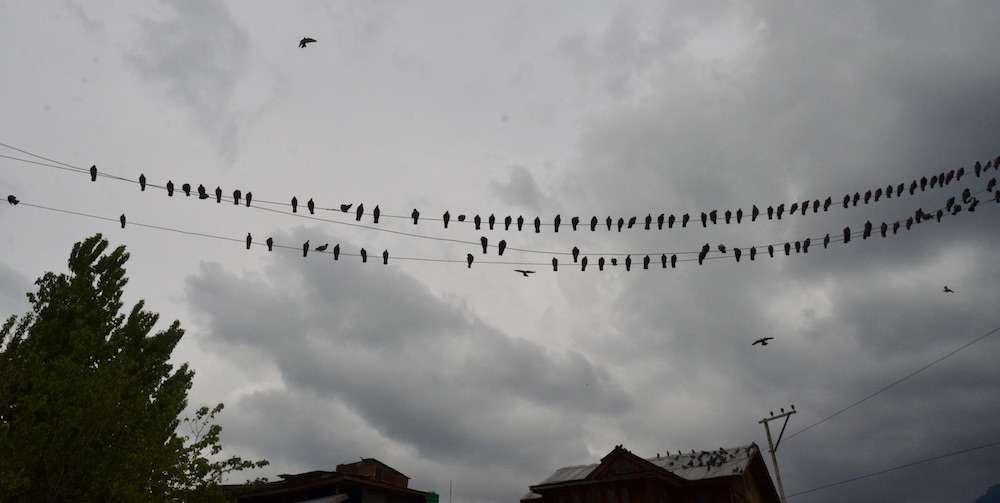
A flock of birds on a low-tension power distribution line. KL Image: Bilal Bahadur
“The electromagnetic radiation grimly affects the generative achievement of birds due to which the conceiving success is reduced. Contemporary scientific testaments reveal that protracted vulnerability to electromagnetic radiation can also strike immune system activity. Magnetic fields can impact the advancement and occurrence of deformities in the fertilization of embryos and at the same time, an agitated immune system also escalates the proneness of birds to ill effects and diseases,” one of the avian fauna veterinarians said. “Feather loss is the very first ailment of deteriorating health in birds. There are many other symptoms and susceptibility to radiation because the exposure depends upon genetics and the physical condition of the impacted creatures.”
10 Species
The depletion of ten species of avian fauna, commonly found in the city was recorded. The situation was quite the same in the consolidated areas of the territory. Now they are nowhere to be seen. The vanishing of house sparrows and crows has been majorly reported. The cause behind that is microwaves (300 MHz to 300 GHz) emitted by cell phone towers and handsets, are damaging eggs and embryos of sparrows.
Though the Telecommunication industry has introduced protective guidance for human beings vulnerable to wireless radiation; there is no analogous protective clue for living organisms.