SRINAGAR: Dozens of villages falling near the Line of Control (LoC) in northern Kashmir get disconnected from the rest of the valley during every winter due to the heavy snowfall leaving them in severe shortage of the essential commodities due to the blockade of roads.
With snow capped mountains, pristine rivers running down the villages, serene nature and heart-warming people, Gurez valley is one of the such isolated place where winter for residents means settling into their homes with a stockpile of canned goods, dried vegetables and firewood or coal, and waiting patiently for spring to arrive.
Razdan Pass, which is the gateway to Gurez mountainous valley and Sadhna top, connecting border town of Tangdhar with Kupwara records around 10-15 feet snow during winter months and becomes the main reason for the closure of the roads, thereby making the area inaccessible during the harsh conditions of winter months.
“The long months of isolation for the Gurez which is picking up swiftly as one of tourist destination residents are passed by working on handicrafts for sale the following summer, listening to Shina and Kashmiri music, feeding cattle and visiting each other,” says Bashir Ahmad, a local health worker.
During the heavy snowfall, Bashir and his friends contribute money and assemble in the house to sing the traditional songs, besides folk tales are being told.
However the greatest concern over the long winter, other residents say, is health care as the snow-clad region comprising 15 sub villages remains cut off from the rest of the world during winters due to heavy snowfall which led to multiple administrative problems and created panic among the locals.
Critically ill patients have no choice during winter but to airlift from here to other hospitals,” the residents of Karnah said, adding that due to continuous snowfall, the situation is sometimes so complicated that the villagers of the valley cannot reach the sub district hospital. This winter, they said that the situation was so tough that they could not even bring the corpses to their native areas for four several days.
The snowfall which had draped the pristine Gurez and Karnah regions since the last three months has forced the administration to press choppers into service for winter to manage medical emergencies of the people living in the region.
Hoping that the road will be re-opened very quickly this year, people said that they don’t want to depend on chopper service during the emergency period. “If the weather is unfavorable then it can’t operate at that time either,” Abdul Rasheed, a Tulail resident said.
“During the winter months, nearby roads might not be in the best shape or not be as well maintained as urban roads,” Aziz said, adding that in some cases you may not even be able to spot your neighbours at all due to heavy snowfall because things may no longer remain as rosy as they seemed to be in summer.
The government in Gurez valley has installed diesel generators in the villages. A single generator feeds a village of about 60 households and provides regular 5-hour electricity daily from 7 PM to 11 PM besides two-hour electricity from 5 AM to 7 AM.
“As the villages are scattered and settled at high altitudes facing immense hardships in winter, in the form of connectivity, electricity and health emergency, Masoor Ahmad a resident of Karnah says people also lose daily earning due to unavailability of work around.
The closure of the road coupled with harsh weather conditions forces many residents to migrate to other parts of the valley, he said while citing harsh weather conditions, shortage of essential commodities and the health emergency as main reasons for migration.
“Everyone has to keep a huge stock of firewood and essential food items including rice, oil and dried vegetables which we use during winters when our area remains under several feet of snow and remains cut off with the rest of the valley,” he said.
The locals of duo snow bound regions said the tunnel at the high altitude tops would facilitate round the year traffic movement on the only surface link connecting the towns with district headquarters.
Recently people in the Karnah region have registered a protest demonstration to press their demand regarding the construction of the Tunnel while the same demand is also being raised by the residents of Gurez.
Quoting officials the news agency KNO reported that the critically ill patients of these areas in the winter season were airlifted from their respective areas to the city hospital on priority basis through chopper service with the help of administration. Besides the students in need of evacuation also availed the service.
They said that a Snow clearance operation has started on a massive scale to clear the Gurez-Bandipora and Karnah-Kuwara Roads. “It is being ensured that both roads will be opened as soon as possible,” the officials said.
SRINAGAR: Former All India Congress Committee (AICC) President Rahul Gandhi (MP) Sunday chaired a meeting of Party leaders of Kashmir and exhorted them to work for the betterment of people.
Gandhi expressed serious concern over the difficulties confronting people in absence of the democratic system in J&K while slamming the Govt for snatching the rights of people.
Rahul Gandhi in a meeting with the party leaders of Kashmir expressed serious concern over the current situation in Jammu and Kashmir while slamming the Centre Govt for failing people on all counts.
Gandhi said J&K was divided into to UTs against the wishes of the people besides they are being abandoned of their democratic rights by the BJP aiming to hide its (BJPs) wrong policies and utter failure on all fronts, but the Congress shall continue to fight for the democratic rights of the people and ensure justice to them, he said.
Gandhi slammed the current eviction drive in J&K terming it BJP’s deliberate move to divert attention of the people from real issues especially rising unemployment, unprecedented price hike and other developmental issues concerning people.
Gandhi also expressed confidence that people especially the youth are joining the Congress party given its pro people policies urging Party leaders to keep their doors open for those wishing to join Congress and encourage them to work for the wellbeing of the people.
Gandhi told the Party leaders that he (RG) will continue to visit J&K as that he feels their pain and anguish, he will leave no stone unturned to ensure justice to people of J&K, who have undergone enormous hardships due to the wrong policies adopted by the BJP Govt towards J&K, Gandhi added.
Speaking on the occasion AICC General Secretary Priyanka Gandhi urged the party leaders to work hard to strengthen the Congress party at grass roots and perform their legitimate role to resolve people’s issues, for the fact, Congress Party is an instrument of service to the people.
AICC Incharge Rajni Patil (MP) and JKPCC President Vikar Rasool Wani briefed Shri Rahul Gandhi about the organizational affairs and activities in J&K.
SRINAGAR: Five houses were damaged by landslides in J&K’s Ramban district on Sunday, officials said.
Officials said landslides hit Duksar Dal village of Sangaldan area, 45 km from Ramban district headquarters.
“The incident occurred nearly a fortnight after 19 residential houses, a mosque, and a girls religious school had developed cracks due to land sinking at Nai Basti village of Doda district.
“The affected families have been shifted and provided tents, ration, utensils and blankets as an immediate relief,” an official said. (IANS)
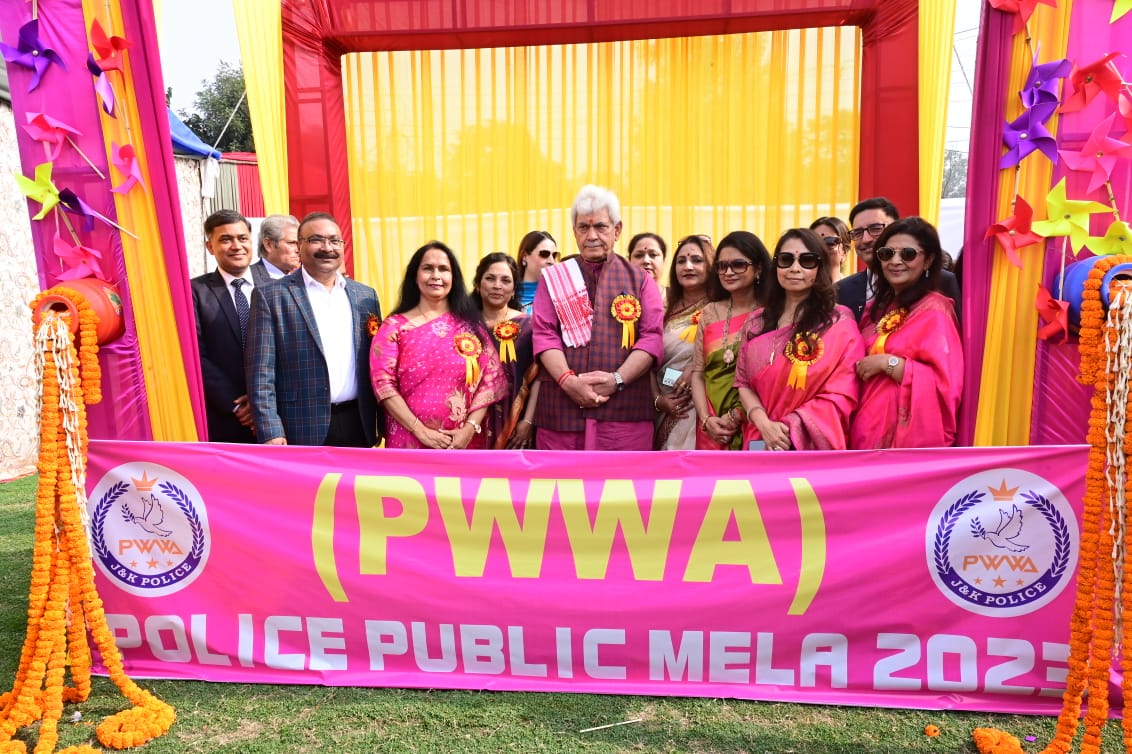
JAMMU: Lieutenant Governor Manoj Sinha inaugurated the 33rd Police-Public Mela at Gulshan Ground on Sunday.
Lt Governor Manoj Sinha inaugurated 33rd Police-Public Mela at Gulshan Ground on Sunday
The Lt Governor said, the Police-Public Mela has emerged as a powerful platform for police officers & public to interact and celebrate the shared heritage.
The Lt Governor commended the Jammu & Kashmir Police Wives Welfare Association ( JKPWWA ) for carrying out numerous initiatives all round the year to address the concerns of the families of martyrs and serving personnel.
JKPWWA is doing exceptional work in promoting welfare measures for JKP Jawans and their families, he added.
The Lt Governor paid tributes to the martyrs of Jammu Kashmir Police who devoted their lives to serving and protecting the nation.
We will forever be grateful to our Bravehearts and their families who made supreme sacrifice for the sovereignty and integrity of the country, said the Lt Governor.
The Lt Governor went around the stalls put up by various Police establishments, Districts, JKRLM and also interacted with the police families.
Dilbag Singh, DGP and Dr Rubinder Kaur, Chairperson PWWA briefed the Lt Governor about the extensive arrangements made for the Police-Public Mela and the activities undertaken for the welfare of families of J&K Police personnel.
SRINAGAR: The Jammu and Kashmir administration has halted the anti-encroachment drive that snowballed into a major controversy. The drive has already evicted thousands of people who had been cultivating and residing on government land.
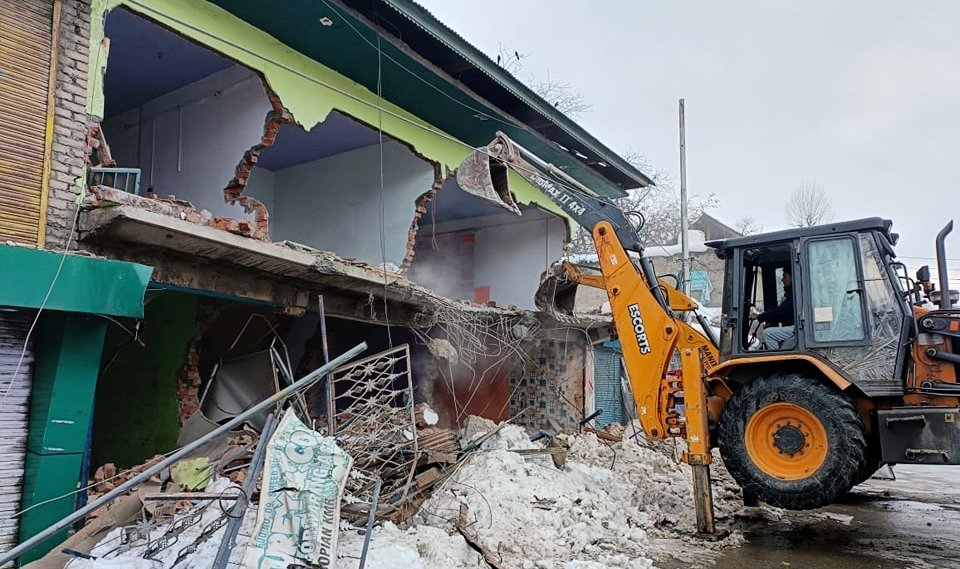
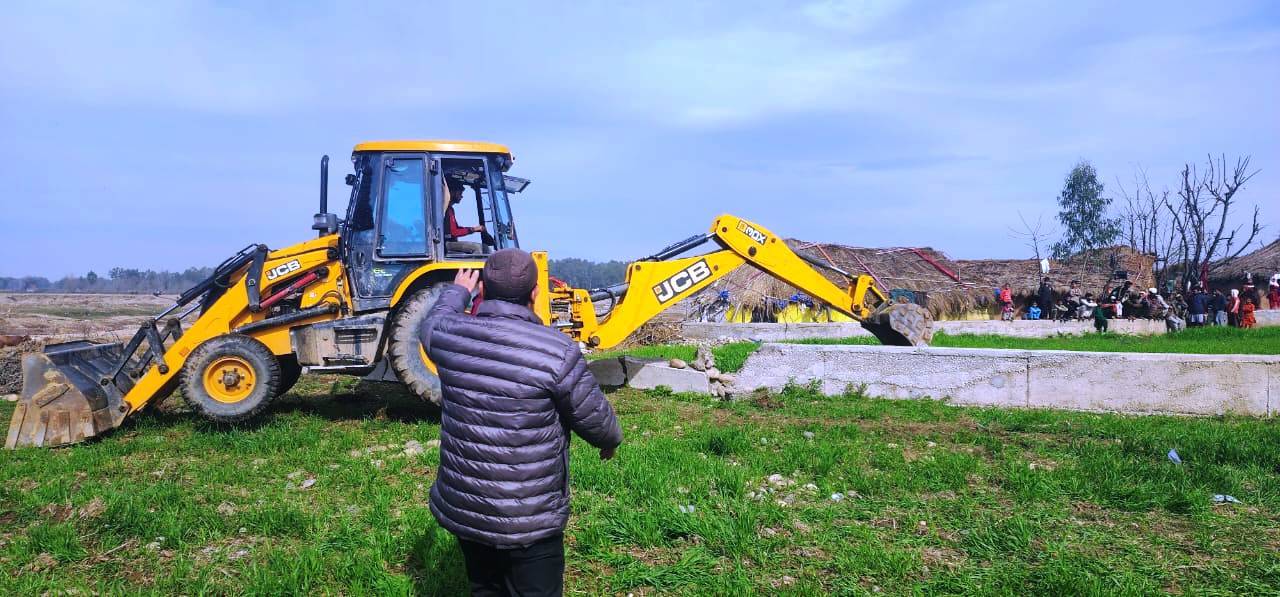
Bulldozers were used to remove encroachments of 20 Lakh kanals (2.5 lakh acres) of land across 20 districts of Jammu and Kashmir. Besides retrieving land, many structures have been demolished.
Quoting sources NDTV reported that the government is coming up with a policy to protect small landholders and till that time officials have been asked to stop the anti-encroachment drive.
“Yes, the anti-encroachment drive has been put on hold. This has been done to factor in and consolidate what has been achieved so far in the drive,” NDTV quoted a senior Revenue official as having said.
Officials say large tracks of state land that was occupied by people for decades have already been retrieved. Now the Revenue officials have been directed to furnish the status report of the land retrieved so far.
The officer said it was never the government’s intention to take away the land of small landholders or of those who have built a home.
He added the aim of the drive was to retrieve large tracks of land encroached by rich and powerful people.
“In every meeting, Lt Governor has made it clear that no common man should be touched during anti-encroachment drive,” he said.
The officer admitted that there were complaints that in some places common people have also suffered due to the drive.
The opposition claims bulldozers are being used on communal lines and that the government is taking away the livelihood of people.
The drive, which started in January, was meant to retrieve state land allegedly encroached on by many, including politicians and senior state officials. When the order set off an outcry, J&K Lieutenant Governor Manoj Sinha and officials of his administration said only the encroachments by the “high and mighty” will be targeted in the drive. But in absence of any formal order or amendment of the original order, a mass eviction drive is being carried across the Union Territory.
SRINAGAR: Jammu and Kashmir Disaster Management Authority (JKDMA) Sunday issued avalanche warning for four districts of Kashmir division in upcoming 24 hours.
The JKDMA, as per news agency GNS, issued the warning above 2500 metres over Ganderbal, Bandipora, Baramulla and Kupwara districts.
People living in the specified areas have been advised to take precautions and avoid venturing in the avalanche prone areas till further directions.
SRINAGAR: Union Home Minister Amit Shah said that stone pelting has stopped in Kashmir and now there are theaters running and tourists visiting the Valley.
“There used to be stone pelting and violence in Kashmir but now these things have stopped. There are theatres running and 1.8 crore tourists have visited the Valley in a year,” he said while speaking at an event in Nagpur, Maharashtra.
Shah said when Article 370 of the Constitution of India granting special status to Jammu and Kashmir was abrogated, speeches were made in Parliament that blood will flow in Kashmir. But no one even pelted a single stone, leave aside the pool of blood, he asserted.
The Home Minister said the country has seen an 80 per cent reduction in violence in Kashmir, insurgency in the Northeast and left-wing extremism under the Narendra Modi Government.
“Today, I can say that there has been an 80 per cent reduction in violence in Kashmir, insurgency in the Northeast and left-wing extremism under the Modi Government,” he said.
The Home Minister said visiting of 1.8 crore tourists in the Kashmir Valley in one year is a “big thing”.
There had been investments worth Rs 12,000 crore in Kashmir in 70 years but under the Modi Government, it has got Rs 12,000 crore in just three years, he said.
“Each home in Kashmir has been provided with tap water and electricity, which is a huge change,” Shah said.
Insurgency has significantly come down in the Northeast, he said, stressing that the Armed Forces (Special Powers) Act (AFSPA), a controversial statute, has been withdrawn from about 60 per cent of the area in the Northeast.
PM Modi’s vision is to see India at the top in the world, said the Minister. Explaining the three big aims of ‘Amrit Kaal’, the 25-year period culminating in the centenary of India’s independence, mooted by PM Modi, Shah said the first goal is to showcase the sacrifices of freedom fighters before the present generation.
The second aim is to bring before the people the progress made by the country in the past 75 years, while the third aim is to ensure that India reaches the top in all sectors in the next 25 years, said the Home Minister.
He said India is becoming “atmanirbhar” in defence production – with 70 per cent self-reliance – and asserted that the country is turning into a manufacturing hub in the world under Modi.
The Government has been taking decisions that are beneficial to the people, he said, adding that India will be leading the world in hydrogen production in two to three years.
“Similarly, India will be way ahead in the field of satellites in four to five years,” he said. Indian start-ups are also proving their mettle to the world, he said.
SRINAGAR: Weather was cloudy and dry in J&K during the last 24 hours as the MeT office said on Sunday that rain/snow is likely in Kashmir Valley while light rain is expected in Jammu division during next 24 hours.
“Weather is likely to remain generally cloudy with chances of light rain/snow in the Valley and light rain in Jammu division during next 24 hours,” an official of the MeT department said.
Srinagar recorded 6.7 degree Celsius, Pahalgam 2.1 and Gulmarg 2 degree Celsius as the minimum temperature on Sunday.
In Ladakh region, Kargil witnessed minus 5.2 degree C and Leh minus 1.2 as the minimum temperature.
Jammu registerd 14.1 degree C, Katra 13.6, Batote 9.6, Banihal 5.8 and Bhaderwah 7.3 as the minimum temperature. (IANS)
In an apparent overdrive to reclaim the landed assets, encroached upon over the years, the Jammu and Kashmir administration moved bulldozers and created a series of images redefining the writ of the state. Within days more than half a million kanals were reclaimed including some patches from the influential and powerful. The scale of the operation triggered fear, chaos and a ferocious reaction. Masood Hussain reports the campaign, its consequences and the unseen flip side
A septuagenarian, Ramzan is one of the respected village elders. Considered a wise man, residents usually seek his advice on almost everything from village welfare to the marriages of their wards. Owing to orthopaedic problems, he rarely comes to pray at the mosque during winter. However, the 2023 Chilai Kalanwas proved different – he never missed the Jamaat, the join prayer.
“He is somehow managing to join prayers because he is in panic. His last purchase was a piece of land, a steep slope that he converted into a fine apple orchard,” one of his distant cousins, said. “Now, he is told that the man from whom he purchased the piece of land on a ‘power of attorney’ basis has been an encroachment on land by its earlier owner, somewhere in the late seventies.”
Apprehensive that he may book losses in the last major decision of his life, Ramzan barely misses a post-prayer sitting in the mosque Hamam. He listens to every bit of information that youth extract from their cell phones. He has visited the patwari many times but the apprehensions remain.
Unlike the panic in the city and towns is somehow getting to the small and big screens, the crisis that has inflicted the villages is like invisible cancer stem cells. In Poonch’s Surankot, a resident was reported dead from a heart attack a day after he was served an eviction notice.
“The revenue department issued a public notice on encroachments and I was shocked to see my 2.7 kanal patch of land in it,” a medical doctor from a south Kashmir village said. “When I visited the office with documents conclusively proving that the piece of land belonged to my family for at least a century and that we have been paying land revenue even decades before the partition of India, the officials said sorry. One senior official said they were in a panic because they were under tremendous pressure from high-ups to issue the list. They assured of correction but a week has gone by and the list is still in circulation.”
This doctor, who has served the government and society for almost half a century is facing the same crisis that Safia Abdullah, Dr Farooq Abdullah’s daughter, talked about after a “list” sent her to approach the High Court, only to be told that it was “fake”.
“For weeks we have been vilified in the public domain as encroachers,” Safia later said. “I went to court against the government and all I wanted was for our valid live lease to be acknowledged and for our three homes to be taken off the encroachment list. I achieved my aim.” Unlike Safia’s lease, the doctor has the inherited property land but may never go to court to get the same relief.
Roshni: Applications, Land, Transfer
Land Regularised
District
Applications (No)*
Land Involved (Kanals)*
Kanal#
Marla
Amount Recived (Rs Lakhs)#
Rajouri
25628
348300
6529
71.79
Ramban
8281
120242
18383
18
103.58
Reasi
8676
174357
13380
1
29.69
Kishtwar
6821
42169
10048
16
16.26
Samba
7539
78443
2537
7
213.6
Udhampur
10033
152416
10614
10
131.86
Doda
14212
145306
35425
2
59.94
Poonch
22700
129523
6597
5
6.63
Jammu
25009
164385
44912
12
1597.01
Kathua
18530
121843
10023
11
33.52
Total Jammu
147429
1476984
158448
2263.88
Anantnag
17069
33710
962
19
36.697
Srinagar
14467
39069
375
10
5217.21
Budgam
14403
4007
1929
39.688
Ganderbal
5725
12028
579
11
5.849
Pulwama
14145
47457
745
16
41.73
Baramulla
11950
52220
382
19
15.56
Kulgam
5283
14577
433
3
6.768
Shopian
5462
13180
386
2
5.54
Bandipore
7150
29488
6415
11
25.51
Kupwara
10701
31322
1520
9
32.64
Total Kashmir
106355
277058
13726
5427.192
Jammu Kashmir
253784
1790105
172244
7691.07
* Revenue Ministry in Jammu and Kashmir assembly on February 19, 2014
# Revenue Ministry in Jammu and Kashmir Assembly on January 30, 2018
The Campaign
Preventing encroachments and evicting encroachers has been a permanent feature of all successive governments. However, there was no total focus on it ever.
The ongoing campaign actually started in Pulwama in early 2020. As if in war, the administration would move with a bunch of bulldozers to specific markets, assemble the shop-owners, get them to empty their shops constructed on state land, and demolish them in a tight cordon of police and paramilitary forces. In one drive, 29 shops were razed to the ground for paving way for widening the road. In another one, that took place at 6:30 am on March 4, 2020, 50 shops were demolished in Tral. On November 10, as many as 17 structures were razed to the ground in Awantipora. All the shops were constructed illegally but no one got any chance to negotiate or justify the possession.
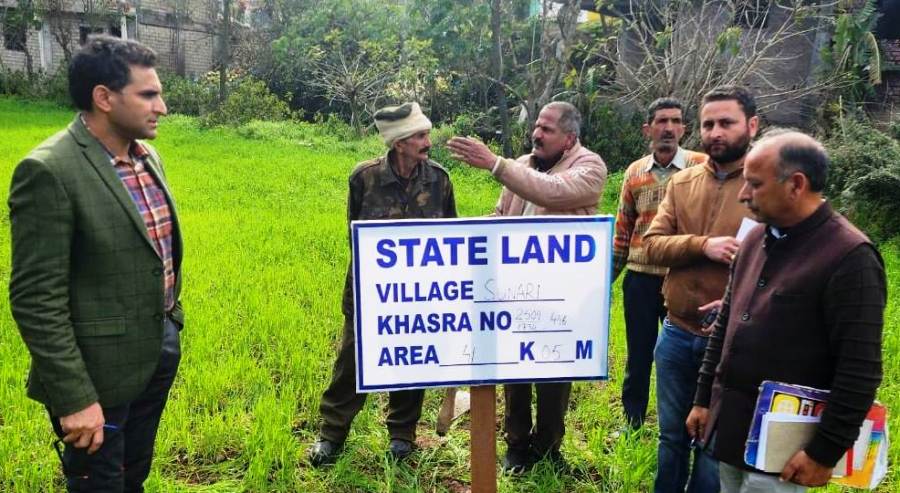
In Udhampur, a field with standing crops has now a state land sign broad installed. Image DIPR
The campaign, however, froze in Pulwama apparently after the security grid detected tensions having the potential of escalating around. Though demolitions are routine for the Lakes and Water Management Authority (LAWMA), the evictions and demolitions were revived at a much bigger scale only in December 2022 when the Jammu and Kashmir administration decided that all encroachments on state land will be removed within three months.
Directions were finally issued on January 9, 2023, asking the revenue officials to ensure full retrieval of encroached land by January 31, 2023. They were asked to submit daily reports so that the government will have a clear picture of the progress of the initiative. All allied departments were asked to help revenue officials to ensure the campaign’s success. The irrigation department and the Evacuees Department which also owns substantial land patches were also asked to reclaim their assets.
The directions came days after two specific exercises were carried out by the revenue department. In the first exercise, the landed properties in possession of the major separatists were scrutinised. In the second one, assets owned by unionist mainstreamers across Jammu and Kashmir were examined by revenue officials at ground zero.
The campaign got a huge morale booster on January 31, 2023, when a Division Bench of the Supreme Court comprising Justices MR Shah and BV Nagarathna refused to grant any relief to petitioners seeking a halt to counter encroachment campaign. “If we protect your possession, it will affect the entire Jammu and Kashmir encroachment!” the court observed.“At the most, we can grant you reasonable time to relocate.”
Waste Lands In Jammu and Kashmir
District
Kanals
Rajouri
125174
Ramban
27395
Reasi
39852
Kishtwar
99470
Samba
114445
Udhampur
204857
Doda
46548
Poonch
31219
Jammu
14314
Kathua
448272
Total Jammu
1151546
Anantnag
100824
Srinagar
0
Budgam
109136
Ganderbal
62488
Pulwama
71512
Baramulla
239736
Kulgam
0
Shopian
51664
Bandipore
0
Kupwara
410504
Total Kashmir
1045864
Jammu Kashmir
2197410
Source: Revenue Ministry Jammu and Kashmir response in assembly on March 8, 2012
The Outcome
Nobody in Jammu and Kashmir is offering details about the net outcome of the campaign so far. One newspaper report on February 6, reported that 15 lakh kanals of state and kahcharie land including seven lakh kanals from Kashmir has been retrieved even as seven lakh more is to be cleared in the coming days. A day later, another newspaper reported that only 3.89 lakh kanals of land – 2,16,683 kanals of state land and 1,72,907 kanals of Kahcharai – was retrieved from the encroachers mostly politicians, their relatives and retired bureaucrats from across Kashmir valley and 2.74 lakh kanals – 1,41,587 kanals of state land and 1,31,459 kanals of Kahcharai land is yet to be retrieved.
Regardless of the quantum of land retrieved, the names that appeared were only of those who are in public life. On the eve of Republic Day, NC leader Ali M Sagar’s Humhama mansion’s annexe housing his security detail was demolished. His wife owned 3.18 kanals but had encroached upon 2 kanals that the family did not own.
In January 2023, a bulldozer was in operation in Shopian where a shopping complex owned by an erstwhile minister was demolished. Authorities said it was illegal construction and the land was owned by the state.
On January 28, authorities demolished a 4-shop commercial complex owned by former lawmaker Ghulam Hassan Khan in Shopian. A day later, Kashmir economist and last finance minister, Dr Haseeb Drabu’s 15-kanal patch of land was retrieved. “How is it possible? I don’t know of any land in Shopian. There is something amiss. I don’t have any land — orchard or no orchard — in Shopian,” Drabu said. “If there was any land registered in my name, the government had to first send me an eviction notice. We would have checked the revenue records. I would have responded to their notice.” He called the officials who admitted there was no land in his name. They promised to make corrections but did not do anything.
On the same day, 3.14 kanal was retrieved from former lawmaker Prem Sagar Aziz in Plahi (Kathua), 9.15 kanals in Plakh from District Development Council Chairman, Kathua Col (retd) Mahan Singh, 6.8 kanals in Pretha from the son of a retired government servant. In Shopian 40 shops were sealed.
On January 30, the district administration in Anantnag took over an illegal commercial structure that NC lawmaker, Majid Larmi, had constructed over Shamilat land on the national highway. Part of the complex having 60 shops was demolished and the rest was taken over by the authorities.
Newspapers were told that another NC lawmaker, Altaf Kaloo (Pahalgam) had managed to temper with land revenue records for taking over more than 100 kanals of Shamilat land and rented it to the army for a garrison at Ashmuqam. He has been taking rent from the armed forces and now investigations are underway. The garrison spread over 458 kanals has only 51 kanals as the proprietary land and the rest is shamilat and Kaloo clan is taking the rent for more than 150 kanals.
On January 31, Baqar Hussain Samoon, an SSP rank officer, living in Humhama watched the bulldozer retrieving 1.18 kanals of Kahcharie from his possession.
On February 1, one kanals of land was retrieved from Congressman Peerzada Mohammad Sayeed at Arad Khoshipora after demolishing the boundary wall. In Dooru, 2.7 kanals of Shamilat land were retrieved from the possession of PDP leader Syed Farooq Andrabi at Shistergam. Around 15 kanals of Shamilat land was retrieved from the heirs of pre-1975 Chief Minister, Syed Mir Qasim.
In Pahalgam, authorities took over Green Acker, a guest house at Laripora that Bashir Ahmad Dar, Ex-EO MC Pahalgam and Manzoor Ahmad, ex-Secretary MC Pahalgam had constructed.
The same day, authorities moved bulldozers to the vast Nedoo’s Hotel premises and claimed retrieval of 40 kanals of land that had been encroached upon by the family of Micheal Adam Nedou, who introduced the first hotel in Srinagar in Gulmarg in 1900 after having one in Lahore. It proved to be a visual story as the family resisted with documents. Of the hotel’s 153 kanals of land, officials said 40 kanals were illegally occupied state land and the rest was leased land. They demolished a shed and the boundary wall.
State Land Encroachment
Kahcharaie Encroachmnet
District
Kanal
Marla
Kanal
Marla
Rajouri
392247
3495
13
Ramban
109629
15
514
10
Reasi
71201
8
2730
1
Kishtwar
62327
13
2648
5
Samba
25015
10
853
8
Udhampur
90089
5
9131
5
Doda
116174
362
Poonch
64552
2
4122
1
Jammu
32995
6
6609
18
Kathua
57215
17
3553
7
Total Jammu
1021444
34017
Anantnag
33710
13
25189
17
Srinagar
36394
16
23640
8
Budgam
27947
39534
Ganderbal
24533
16473
Pulwama
41011
12
33233
5
Baramulla
93426
5
40396
15
Kulgam
29114
23940
Shopian
34752
39136
Bandipore
47763
4
15647
13
Kupwara
55721
53743
16
Total Kashmir
424371
310931
Jammu Kashmir
1445815
344948
Source: Response of revenue ministry to assembly on March 6, 2012
In Karan Nagar, 12 kanals were retrieved from ML Dhar.
On February 2, Qazi Yasir’s double-storey complex was hit by a bulldozer. While the shop line was taken over by the municipality, the second storey was destroyed. Yasir is the son of Qazi Nisar and was dubbed a separatist leader.
In Qazigund, officials said they retrieved 1.18 kanal of land from the kin of NC leader, Peerzada Ghulam Ahmad Shah in Kurigam. From Mahataba, the widow of HD Dewegowda’s junior home minister Maqbool Dar, two kanals of land were retrieved from Nowgam (Shangus).
In Shopian, officials were sent in a snow-bound Sedow belt to retrieve 13.16 kanals of forest land grabbed by erstwhile lawmaker Taj Mohiuddin.
Earlier, the government said it retrieved 23.9 kanals from BJP’s former deputy chief minister Kavinder Gupta in Ghaink village. Authorities have issued notice to BJP’s Abdul Ghani Kohli Apni Party’s Zulfikar Chowdhary, both former lawmakers. Chowdhary claimed he had purchased nearly 12 kanals in 2006, and that the three kanals of it now claimed to be state land in Chowdi had exchanged hands 14 times earlier. It has been retrieved.
In Handwara’s Kachiwara on February 6, almost five kanals of land were retrieved from Zahoor Ahmad Watali, a top businessman who was earlier arrested by a federal investigator, NIA in a terror funding case.
Authorities did not use bulldozers everywhere. In most cases, the built-up properties were sealed and in certain cases, the constructions were taken over. In one district, a senior officer distributed the retrieved land among various departments for building their own infrastructure. A district retrieved a vast patch of land and gave it to horticulture for conversion into an orchard.
Mighty, Influential
Responding to the mass fear, the administration at different levels asserted that the move is aimed at the influential and the powerful who abused their authority to grab land.
“I want to assure the people that the administration will safeguard the habitations and livelihoods of the common man. Only influential and powerful people who misused their position and violated the law to encroach upon the state land would face the law of the land,” LG Manoj Sinha said after inaugurating Civil Services Officers Institute (CSOI) in Jammu. CSOIs are a sort of club for which the former MA Road residence of the erstwhile Chief Minister has been set aside in Srinagar. “Only those people who have grabbed land illegally are facing eviction. I have personally directed the deputy commissioners and senior superintendents of police to closely monitor (the drive) and ensure no innocent person is affected in any manner,” Sinha added.
Jammu Administration bulldozer at work on February 2, 2023. Pic DIPR
On February 3, Chief Secretary Arun Kumar Mehta directed the Deputy Commissioners to safeguard the habitations and livelihoods of the poor and downtrodden.
Kumar’s insistence came a day after Ghulam Nabi Azad met Home Minister Amit Shah in Delhi in which he was assured that small landholders will not be harassed. The campaign, he said in a statement, has the potential of triggering “serious unrest and uncertainty”. His immediate concern was the mounting tensions in areas of Jammu. He said the successive governments have provided road connectivity, supply of water and electricity, schools, Anganwadi centres and other welfare schemes including health-related facilities to these houses which implicitly indicate these habitations to be “recognized constructions.”
Assurances apart, the law and the constitution, as Omar Abdullah pointed out later, do not make a distinction between influential and non-influential. This was visible on the ground as well. Put together, all the lands retrieved from the influential and the powerful do not make even 2000 kanals. So who had occupied more than half a million kanals of land that the administration claims it has retrieved?
Aftaab Market Case
In Srinagar, February 3, was interesting as the authorities sealed the Aftaab market comprising a score-odd 20 shops, mostly dealing with white goods, in Lal Chowk. The closure came amid reports that the property was snatched away from a rightful owner illegally.
Srinagar was shocked as the city’s up-markets including Lal Chowk operate from leased lands. There were symbolic protests and emotional scenes dominating social media. A day later, the shop owners visited the officials and proved conclusively that they have been legal tenants of the Srinagar Municipal Corporation (SMC) for decades. Convinced officials broke the seals and the market burst back to life.
Had the officials met the shop owners before implementing a decision, the question of sealing might have never arisen. Did they? If not, why not? This explains how officials operate in a war-like environment permitting a “misunderstanding” to pave way for sealing a market!
Sunjwan Bathindi Case
Post 1990, Jammu expanded in length and breadth as it witnessed huge immigration from Kashmir. Apart from Kashmiri Pandits who migrated en masse, there were Muslims, Sikhs, a section of employees, traders and a section of people who wanted to raise their families away from a seriously disturbed home. Similar migrants took place from Chenab and Pir Panchal regions. These migrants invested their savings to make Jammu their second home. This led to the creation of various satellite habitations – Sunjwan and Bathindi after Sidhra, which are mostly Muslim localities.
“Notices were issued to a few houses asking them to vacate as their constructions are on state land,” a Jammu reporter privy to the developments, said. “All these families have some connection with politics.”
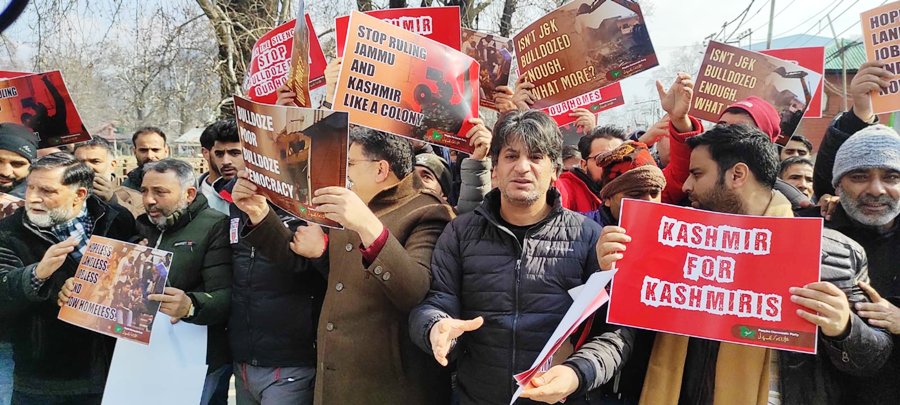
PDP actoivists protest against demolition drive in Srinagar in February 2023. KL Image Bilal Bahadur
As the news spread, the localities decided to support the families and went into a mass protest. “They believe that if the government somehow destroys the particular constructions, this will push the bulldozers in,” the scribe said, insisting that there is a firm belief among residents that these housing settlements are disliked by a section of the population.
Interestingly, the housing settlements of Bathindi, Sunjwan, Chanta, Ragura, Sidhra with almost half a million population were excluded when almost a score odd similar colonies were regularised by the government. Residents allege these localities are being singled out simply because a particular community lives there.
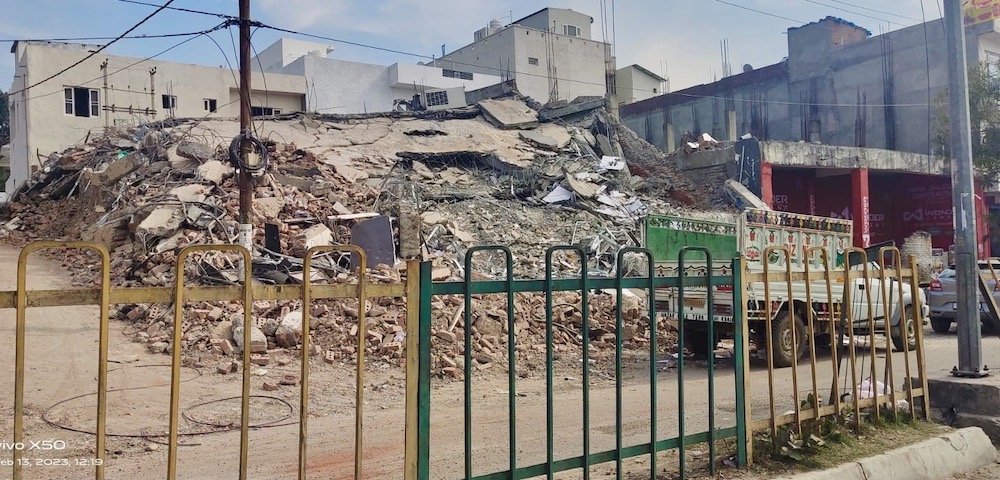
The tons of rubble and debris at the spot where MG Hector showroom exists in Malik market Jammu. After initial resistance, authorities made arrests and later sealed the area and undone the encroachment on state land in February 2023. KL Image: Special Arrangement
The Malik Market
On February 4, a number of bulldozers reached Jammu’s Malik Market and started demolishing a multi-storey showroom MG Hector. Hundreds of people watched the demolition and after some time it led to a serious law and order situation in which some cops survived injured. Cops fired tear smoke shells to stop stone pelting that had led officials to leave the bulldozers and flee to safety.
The showroom belongs to a Kashmir resident Sajad Ahmad Baig, whose family started a business in Jammu in 1990. He admits that part of his construction is on state land and he is willing to give propriety land in exchange.
The incident dominated social media and led the police to act. A case was registered and eight people including the showroom owner were arrested and many more are being questioned. However, it has halted the rolling bulldozers for the time being. Authorities in Jammu had to make extra efforts to ensure the tensions do not escalate.
“During the ongoing anti-encroachment drive, no landless person, family and small commercial units shall be targeted,” Jammu Divisional Commissioner Ramesh Kumar was quoted as saying. “But big encroachers will not be spared. People are requested to cooperate.” DC Jammu, Avny Lavasa added: “I want to clarify that the government has no intention to disturb the houses and small commercial properties of poor people on which their livelihood is dependent.”
Poor and Landless
Every time officials respond to the ongoing campaign, the poor population is a mandatory reference. How many people in erstwhile Jammu and Kashmir are poor?
The 2011 census suggests that 3064 families comprising 19047 people had no house. This means around 0.32 per cent of the population in Jammu and Kashmir and Ladakh are houseless. Anybody lacking a house is automatically landless.
Jammu and Kashmir’s below-the-poverty-line (BPL) population has always been in dispute for one or the other reason. It was 10.35 per cent in 2017-18 – almost half of the national average. Now in 2020-21, it is 12.58 per cent.
Even the people owning lands exhibit an interesting trend that makes Jammu and Kashmir distinct in the entire subcontinent. In 2015-16, there were 1416509 land holdings registered with the government. Of them, 905792 (63.95 per cent) land holdings comprised an area of less than 10 kanals of land. The survey suggests that in Kashmir, these marginal holdings form 72.90 per cent of all holdings. If seen across Jammu and Kashmir, more than 64 per cent of the small holdings are in Kashmir. Interestingly, in Jammu alone, 1176 people have land possession exceeding the limits set by the erstwhile Agrarian Reforms Act.
The survey found 281095 land holdings (19.8 per cent) having 10 to 20 kanals; 159988 (11.29 per cent) had up to 40 kanals; 43698 (3.08 per cent) had somewhere between 40 to 60 kanls; 14404 (1.02 per cent) holdings comprised between 60 to 80 kanals; 5579 (0.39 per cent) were up to 100 kanals; 4424 (0.31 per cent) holdings fall in 100-150 kanal category; 995 (0.07 per cent) holdings had 200 kanals; 426 (0.03 per cent) were up to 20 hectors and only 108 (0.01 per cent) had more than 400 kanals of land.
Efforts to get the landless population data in Jammu and Kashmir failed. “If you have a very small homeless population among natives, it means some of them may be having land but might be lacking resources to construct a home,” one officer, who knows Jammu and Kashmir’s numerical sphere for a long time, said. “Still, I will try to locate if the number was ever generated.”
Encroachments: A Reality
This, however, does not mean that there have not been encroachments upon state land. Reasons apart, encroachments on state land, kahcharie and nazool land has been a perpetual feature almost everywhere. At least one government had to get bulldozers out to reclaim the main roads in Srinagar.
Data available with TheNewsCaravan suggest that almost 2107230 kanals of land were in unauthorised occupation of people in 2014. Earlier on March 6, 2012, the government informed the Jammu and Kashmir assembly that 1790763 kanals of land stands encroached upon across the state of which 1055461 kanals (59 per cent) stands in Jammu and 735302 kanals in Kashmir. While Jammu has more stand land in possession of unauthorised people, in Kashmir, it was the case in kahcharie. By 2014, when the same detail was tabled in the house, the land under occupation had gone up despite the counter-encroachment campaigns by successive governments.
On the same day, the government said 23002 people were in illegal possession of 9469.49 hectares land in 16 forest divisions of Jammu as 15408 individuals held 3890.6 hectares illegally in Kashmir. This meant 13360.1 hectares of forest land were occupied by 38410 individuals.
In March 2013, the government revealed that a total of 25948 kanals of land belonging to the Evacuees’ Property stands encroached upon. It included 8065 kanals of EP land in Kashmir and 12444 in Jammu.
Kahcharie in the twin cities of Srinagar and Jammu is called Nazool land and it is 25948 kanals of high-value commercial land. Jammu has 18049 kanals of Nazool land. Of Srinagar’s 7899 kanal, the BSF has already been given 5548.15 kanals at Pantha Chowk. Of the balance land, 1089 kanals are residential (189 kanals unauthorised); 1041 kanals are commercial (250 kanals unauthorised) and 220 kanals are with institutions mostly legal occupations.
Besides, there are a lot of wastelands that fall under diverse names in revenue records – Banjri QAdeem, Bajr-e-Jadeed, Gair Mumkin Khud, Zeri Saya, Bhedzar, Safedzar, Tootzar, Kaap, Ghairmumkin Khul. There are more than two million kanals across Jammu and Kashmir – 1084096 in Kashmir and 1151546 kanals in Jammu’s 10 districts. Only in a few cases has part of this land been used for any developmental activity but this is key to certain vital distinctions in horticulture production across the erstwhile state.
Roshni Racket
Part of these occupations was fresh and partly for 50 to 100 years. It was against this backdrop that the Jammu and Kashmir government in 2000 decided to regularise the occupation on a market rate basis and create a corpus of funds that will help JK Power Development Corporation (JKSPDC) to take up major power projects. The government expected no less than one lakh from every single kanal of land in unauthorised possession – a sum of Rs 20,000 crore.
Less than five years later – when a complete system was in place for raising these funds, the then Chief Minister, Ghulam Nabi Azad was advised by a group of officials, who were part of his kitchen cabinet, to bestow the ownership of these lands on people free of cost. The idea was to make him emerge as towering over Kashmir’s land-to-tiller initiator, Sheikh Mohammad Abdullah. It reduced a scheme into a racket that is now detailed by CAG and various court orders.
Informing the assembly about the follow-up of the messed up scheme in March 2018, the government said that 253784 people had applied for regularisation of the encroachments they had made over 1790105 kanals – 313121 kanals in Kashmir (17.49 per cent) and 1476984 kanals (82.50 per cent) in Jammu’s 10 districts.
Eventually, the government approved the regularisation of only 172244 kanals – 13732 kanals (7.97 per cent) in Kashmir and 158512 kanals (92.02 per cent) in Jammu. The Jammu and Kashmir government raised Rs 76.91 crore from these regularisations.
Kashmir paid Rs 54.27 crore at an average of Rs 39522 per kanal. In Srinagar, it cost Rs 1391256 per kanal.
In Jammu, Rs 22.63 crore were raised by the sale. By an average, it cost Rs 1428 per kanal. In case of Jammu city where 44912 kanals – three times more than Kashmir’s 10 districts – was regularised, the average returns per kanal was Rs 3555.
With the entire Roshni scheme shelved and declared illegal by the administration and the court of law, it remains to be seen how will the government manage to compensate the people who availed a legal process to acquire property, invested in that and added to the State Domestic Gross Product (SDGP). The scheme was implemented in 2001 and discarded on October 9, 2020.
Motive and Method
After changing land laws, identifying issues with the land leases of recent years and opening the land resource for development and inviting investors, the Jammu and Kashmir administration finally announced that it will retrieve every inch of the land under unauthorised occupation. On expected lines, there was a fierce reaction.
Apart from protests that have been there in Srinagar, Jammu and Delhi, the political class has been talking tough. Civil liberty watchdogs also jumped in. While Amnesty International India called for an immediate halt in the demolitions, its UK Chapter even called the bulldozer maker company, JCB to invoke its rights and prevent abuse of the machine in Kashmir.
“Jammu and Kashmir was the only state or union territory where people did not sleep on the road, where people did not stand in line for free rations. Ever since the BJP came, the people living above the poverty line have also come below it. They want to make Jammu and Kashmir like Palestine and Afghanistan,” Mehbooba Mufti said. “Palestine is still better. At least people talk. Kashmir is becoming worse than Afghanistan the way bulldozers are being used to demolish homes of people.” She took the protests to Delhi where she was arrested.
Ms Mufti said the administration is hoodwinking the public. “They say that they are only targeting the rich and not touching the poor. But on the ground, even houses on three-marla land and under tin sheds are being demolished. Even people who have papers from Maharaja’s time are not being considered.”
Upholding the administration’s right to reclaim its assets, Omar Abdullah pointed out that due process is not being followed and bulldozer has become the first response to evict people from the lands they have been occupying.
“Due process has to be followed. Without issuing a single notice, they are directly sending bulldozers. If someone has occupied any property, issue them a notice, give them time to respond and then take action,” Omar said. “Bulldozers should be a measure of a last resort, not the first option.”
Comrade MY Tarigami said sees the anti-encroachment drive as a “war” against the people. “The ongoing so-called anti-land encroachment drive and eviction have generated fear psychosis among the common masses at the ground level in Jammu and Kashmir,” Tarigami said. “The selection of areas and individuals for bulldozing creates doubts regarding the real intentions of the administration. The eviction campaign seems selective and discriminatory.”
Terming the drive as “drama” of the Jammu and Kashmir administration, Apni Party leader, Altaf Bukhari said his party is aware of the intentions and motives. “There are no land sharks in Jammu and Kashmir,” Bukhari said. “Everyone who is behind the demolitions will be made accountable one day.”
Sajad Lone said he has no idea why the bulldozers are rolling. “Do they want to retrieve land or humiliate people? I think humiliation is more important to them,” Lone said. “I appeal to my Prime Minister. I had a misconception that you are everybody’s Prime Minister. Please tell me who my Prime Minister is. Who is the Prime Minister of the poor people you are bulldozing.”
Post Script
Authorities finally erased the Jammu showroom amid impressive security arrangements. In Srinagar and Jammu, authoroties issued notces to many localities asking them to vacate from the lands they have illgally occupied. In peripery of Kashmir, there are instances in which people have been asked to clear the lands from poplar, willow plantatons. There are instances in which people are volunatrily vacating from ceratin patches of land.
The current budget has allocated a higher share to capital expenditure which is a step in the right direction. Besides, the recent budget is optimistic about meeting its fiscal target in the coming year.
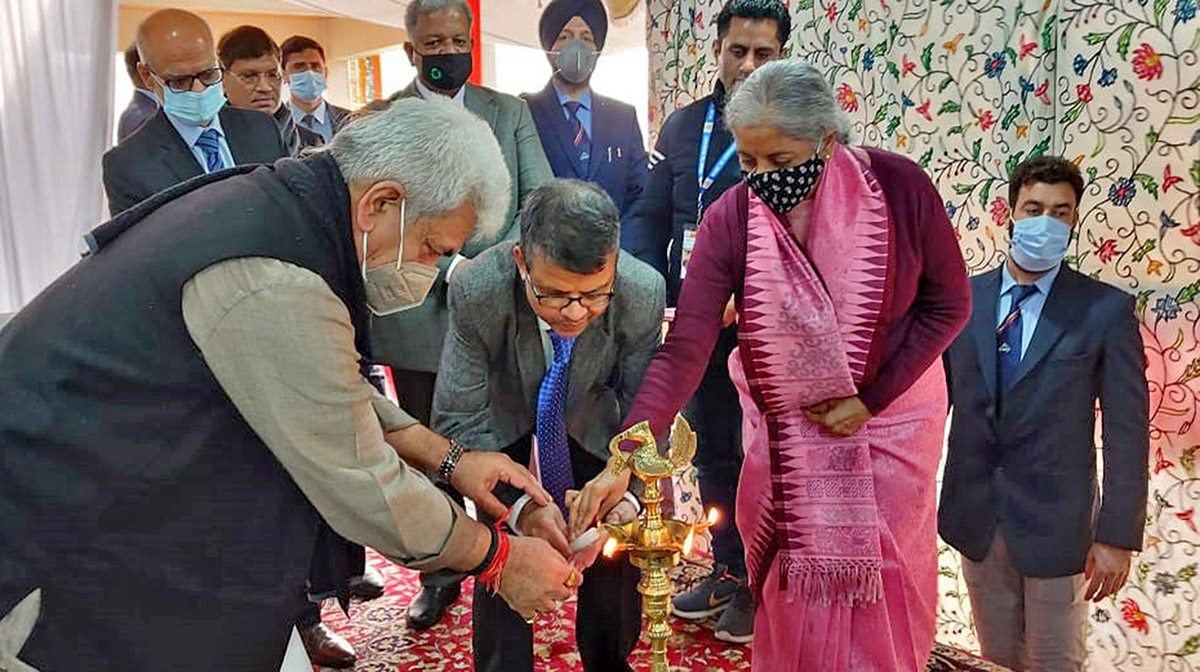
Union Finance Minister Nirmala Sitharaman along with Jammu and Kashmir Lt Governor Manoj Sinha lit a lamp during the inauguration of the new Income Tax Office ‘Chinar’, in Srinagar on Monday, November 22, 2021. KL Image by Bilal Bahadur
In a developing country like India, the role of the state is more nuanced. On one hand, the state must meet the development aspirations of the diverse population, but it also has to ensure macroeconomic stability to avoid situations like the 1991 crisis or the more recent 2013 fragile five. Striking a balance between the two remains not only a critical question but also imperative for a state like India.
After the disintegration of the USSR, there emerged a kind of consensus that markets are the primary drivers of prosperity and economic growth. This, however, does not mean that there is no role for the government, which continues to play its role through regulatory, monetary, and fiscal policies. But the government’s intervention in the monetary sphere should be transparent. In light of this view, rule-based policies started gaining traction in both monetary and fiscal aspects.
In the fiscal sphere, broadly four main types of rules exist- the expenditure rule, the revenue rule, the budget balance rule, and the debt rule. The countries either adopt all four rules or a few among them. While the budget balance rule focused on the balance between total revenues and expenditures, the debt rule imposed an explicit limit on public debt. The expenditure rule placed a limit on overall spending. The revenue rules are primarily concerned with the appropriate use of excess revenues.
India adopted the Fiscal Deficit and Budgetary Management (FRBM) Act, 2003 (balance budget rule) on the recommendations of the Sarma committee. The act specified three main objectives- ensure intergenerational equity, fiscal sustainability and transparency in fiscal operations.
To achieve these objectives, the act proposed that the fiscal deficit be progressively reduced to 3 per cent of GDP for each central and state government. The rule did indeed help to contain the fiscal deficit, which was 6.2 per cent of GDP in 2002-03 but decreased to 4 per cent (of which the central government deficit was 2.54 per cent) at the end of 2007-08. The global financial crisis disrupted the fiscal consolidation plan and subsequently, the fiscal rules were suspended until 2011–12. As a result, the combined fiscal deficit in 2009-10 increased to 9.3 per cent. In 2010–11, it declined to 4.8 per cent but again increased in the next year to 5.91 per cent.
The Vijay Kelkar committee(2012) was constituted to recommend mid-term corrections and reforms for medium-term fiscal consolidation. The committee recommended the fiscal deficit of 4.8, 4.2, 3.6 and 3 per cent targets for the next four years starting from 2013-14 onwards. In 2013-14, the fiscal deficit was within the target as laid down by the fiscal consolidation plan. But a closer look reveals that it was more of an arithmetic trick than actual consolidation. The fiscal deficit target was achieved by reducing planned expenditures and deferring the payment for oil subsidies to the next fiscal year.
From 2014-15 to 2017-18, the fiscal position improved considerably due to improvements on the revenue side also. The income tax-to-GDP ratio witnessed an increase from 2.1 to 2.6 per cent. Moreover, the sharp decline in crude oil prices enabled the government to find a new way to raise money by raising the excise taxes on petrol and diesel. Further, the subsidies, on diesel were reduced. It was due to these measures that the fiscal deficit in 2017 declined to 3.46 per cent as reported to Parliament. However, the Comptroller and Auditor General (CAG) notified the Finance Commission that the fiscal deficit (centre) in 2017-18 was 5.85 per cent. The government has relied on off-budget borrowings to contain the fiscal deficit.
The fiscal rules have also undergone changes as it was felt that a single rule cannot help to achieve various objectives like fiscal sustainability, economic stabilisation and size of government debt. To keep pace with best international practices, Finance Minister in 2016, while presenting the budget, informed the parliament that there was a need for a review of the FRBM Act, saying, “While remaining committed to fiscal prudence and consolidation, a time has come to review the workings of the FRBM Act, especially in the context of the uncertainty and volatility that have become the new norms of the global economy. I, therefore, propose to constitute a committee to review the implementation of the FRBM Act and give its recommendations on the way forward”.
Subsequently, the committee under NK Singh was constituted. The committee recommended using debt as the primary target of fiscal policy, with a debt-to-GDP ratio of 60 per cent (40 per cent for the centre and 20 per cent for states) to be achieved by 2022-23. It also suggested reducing fiscal and revenue deficits to 2.5 per cent and 0.8 per cent, respectively, by the same period, with an escape clause for temporarily relaxing or suspending the target, but with clear specifications and restrictions on government notifications.
Then, the COVID-19 pandemic struck, and governments all across the world adopted expansionary fiscal policies, including India. The fiscal deficit (centre) again increased and reached an all-time high of 9.18 per cent in 2020–21; it is now on a declining trend but still higher than the combined target of 6 per cent. The government is mentioning the much-touted “glide path”. Yet, throughout the past two decades, such a glide path has been nowhere in sight. Instead, the path looks more erratic, like the snake and ladder game, except that here the snake (bad times) takes you higher and the ladder (good times) helps you to come down, but nowhere to the target.
Similarly, the unequal targets for states and the centre for debt but with a similar target for deficit are creating tensions, as highlighted by Roy and Kotia. This has made the debt sustainability of states an issue. This is evident from the current debt levels. Except for Maharashtra (17.9 per cent), Gujarat (19.0 per cent) and Odisha (which is 18.8 per cent), every state has a higher than 20 per cent debt-GDP ratio, with the highest ratio in Punjab (53.3 per cent ). The current central government Debt-GDP ratio is 56.7 per cent and that of the general government (centre and state combined) debt-GDP ratio is 84 per cent. Therefore, there is a need to address this anomaly on an urgent basis and in consultation with states.
Conclusion
The containment of fiscal deficit targets can be achieved by cutting unnecessary expenditures. Also, fiscal consolidation can be realistic and meaningful only when revenues are increased. Otherwise, as stressed by the Sarma Committee (2000), without this golden rule, fiscal consolidation could lead to a disproportionately large compression of capital assets.
The under-reporting of the fiscal deficit needs to avoid, as it gives a false sense of security. Additionally, it conveys the wrong message to foreign investors for being uncertain and opaque on key policy measures. The current budget has allocated a higher share to capital expenditure which is a step in the right direction. Besides, the recent budget is optimistic about meeting its fiscal target in the coming year. Only time will tell whether these targets are overly optimistic or achievable.
(Authors are research scholars at the Department of Economics, Jamia Millia Islamia, New Delhi. The opinions expressed in this article are those of the author and do not purport to reflect the opinions or views of TheNewsCaravan.)