Tag: debate

  • What Administration Must Keep In Mind While Reclaiming State Land?

    [ad_1]

    by Lateef U Zaman Deva

    Charges the occupants with the cost of land based on a 100 per cent increase on the stamp duty rates provided the proposed use comports with the land use under the master Plan, land use.

    At the outset, the long overdue sustained drive for retrieval of illegally occupied state and community-oriented Shamilat lands is welcome and gratifying. In the event of its fruition, the campaign in rural areas would pave the way for not only revival but also the sustainable rejuvenation of agro-based enterprises in the pristine ecosystem.

    While  all sections of Society have exhibited their disinclination in joining status quoists  for throwing a spanner in the endeavours of the government on this behalf, the following types of cases need the attention of the authorities in order to prevent the momentum of the campaign from  getting derailed:

    Before independence and thereafter, the peasantry and small farmers in cultivating possession or occupation of state land were granted tenancy rights followed by ownership rights more particularly under LB-6 and 7 of 1958 and S-432 of 1966. However, the actual beneficiaries of these initiatives were mostly from the affluent classes, bureaucrats, politicians and those having access to the corridors of governing bodies.

    The purposes visualised transfer of land to downtrodden and toiling masses actually cultivating the state land but due to the menace of corruption and poverty of the prospective beneficiaries they have not been conferred with rights under relevant orders.

    It is in this background that the land under their cultivating possession continues to be recorded as state land and is now being served with notices for surrendering the possession notwithstanding the fact that irrespective of attestation of the mutations or otherwise in their favour the rights have accrued in their favour which cannot be, after 65 years, aborted at this stage.

    The government should Institute inquiry for finding out how people on the basis of their socio-economic status in the concerned societies and the naked fact that they have never cultivated the land themselves including their families for generations and yet conferred with the benefits of the government orders ibid, particularly in cases where the beneficiaries were not born on the cut of date or still infants and residing far away from the land usurped under the subterfuge of these orders.

    The community lands brought under plantation need not be denuded but, having vested in PRIs and Urban local bodies, handed over to them with conditions for not changing the status of land except under orders of the government in individual cases on the basis of a scheme to be notified by the government, or on a valve to valve basis exchanges allowed with the proprietary land of the illegal occupants contiguous with the community lands.

    Houseless and landless families in possession of state land not exceeding 02 kanals were entitled to retain the land for residential purposes under Jammu and Kashmir Agrarian Reforms Act. Similarly, the occupants of state or kahcharia land, used for raising a plantation or an orchard, got an option for offering equivalent proprietary land in exchange for protecting the plantations. Wherever the legal course has been followed under the Act of 1976, the JCB should not be pressed into service.

    Under Common Lands (Regulations) Act the state and Shamilat land brought under its purview by extending the Abadi Deh for allotment of 05 Marla plots to landless and homeless families, the non-updation of records should not lead to declaring the allottees as illegal occupants.

    The kahcharia within the territories of municipalities has ceased to be so in view of the application of urban land laws and virtual extinction of cattle rearing as a result of the change of professions by the inhabitants of new areas included in respective municipalities. Since before the earmarking of land as kahcharia the said land was actually state land and therefore owing to the factum of its non-use for grazing purposes it reverts it back to the state who, after determining its use, if any, by the state, charges the occupants with the cost of land based on 100 per cent increase on the stamp duty rates provided the proposed use comports with the land use under the master Plan, land use.

    Street vendors markets have come up  in metropolitan and other cities under the orders of the Apex courts for the rehabilitation of unauthorised street vendors and therefore on the strength of the same rationale the rehabilitation of the existing vendors is called for, those who are currently fearing demolitions and seizer of the properties
    Lateef U Zaman Deva
    Lateef U Zaman Deva

    The instruments of the State, wherever holding any immovable property as custodians under any law for the time being in force and the same suffering from encroachments,  should be provided paraphernalia and wherewithal for retrieval of their properties and in fact, like state and Shamilat Dafa 05 the Dy Commissioners should include Dharmat, Wakaf and evacuees land also in the campaign underway in Jammu and Kashmir for retrieval of the immovable properties under unauthorised occupation.

    (The author is the former Chairman Jammu and Kashmir Public Service Commission. The opinions expressed in this article are those of the author and do not purport to reflect the opinions or views of TheNewsCaravan.)

    [ad_2]
    #Administration #Mind #Reclaiming #State #Land

    ( With inputs from : kashmirlife.net )

  • Guns in the House? A raucous Natural Resources panel debate

    Guns in the House? A raucous Natural Resources panel debate

    [ad_1]

    “I feel I need one everywhere here. There are often times we are harassed in the hallways. We walk alone,” Rep. Lauren Boebert (R-Colo.) replied, underscoring that it would “not be an unloaded weapon.”

    But the California Democrat defended his push for the amendment: “We can have our political disagreements, and they will be spirited. But no one should have to worry about members of the other side of the aisle — let alone members who have incited political violence — bringing weapons, in violation of House rules, into our committee room.”

    While they held the House majority in 2021, Democrats added an explicit prohibition on bringing firearms to the committee room “in the wake of the Jan. 6″ Capitol attack, ranking member Rep. Raúl Grijalva (D-Ariz.) said. That move also responded to an attempt at the time by Rep. Andy Harris (R-Md.) to bring a firearm onto the House floor, a move that further exacerbated security concerns.

    Members of Congress are afforded certain carve-outs to the otherwise outright ban on firearms on the Capitol complex: They are permitted to keep guns in their offices and transport them, if they are unloaded and securely wrapped. Guns are explicitly forbidden on the House and Senate floors, as well as certain nearby areas.

    Panel Republicans repeatedly called the amendment unnecessary and argued they should not be viewed as safety threats by their colleagues.

    “Do you think we’re going to hurt you? We would never hurt you. I would use my firearm to defend you. Just to be clear,” Rep. Anna Paulina Luna (R-Fla.), a freshman, said.

    Rep. Tom McClintock (R-Calif.) asked Ocasio-Cortez whether she thought any committee member was a “homicidal maniac,” challenging her to “name the names and present the evidence.”

    Ocasio-Cortez replied that she was not trying to “impugn the character of any individual member of this committee” but that “from what I’ve witnessed, the competence of some members may be something that I would be willing to question.”

    Democrats, for their part, repeatedly pressed Westerman to answer how he interpreted the existing House rules for gun possession.

    “When you have reason to believe committee members, right here, intend to bring weapons into this committee room … we’re entitled to your interpretation of the House rules,” Huffman said. “You need to tell them that that’s either okay or not for the safety and security this committee.”

    His push was ultimately unsuccessful though, as the amendment fell 14-25. Huffman is, however, also collecting signatures on a letter to congressional leadership seeking information on security preparations ahead of the State of the Union address next week.

    Nancy Vu contributed to this report.

    [ad_2]
    #Guns #House #raucous #Natural #Resources #panel #debate
    ( With inputs from : www.politico.com )

  • House GOP leaps headlong into divisive Mayorkas impeachment debate

    House GOP leaps headlong into divisive Mayorkas impeachment debate

    [ad_1]

    It marks another test for House GOP leaders, as they try to balance the demands of more moderate members and a base that’s eager to go scorched-earth against President Joe Biden and other administration officials. Not to mention that Republicans will have to navigate a barrage of criticism from Democrats and their allies, who accuse the GOP of using the border as a wedge issue to enact political revenge over policy differences.

    Republicans who want to impeach Mayorkas acknowledge they haven’t reached a critical mass within their own conference, though Republican Study Committee Chair Rep. Kevin Hern (R-Okla.) predicted that there would be “a lot of sentiment” among GOP lawmakers to remove the DHS secretary. If a resolution came to the floor, Republicans could only afford to lose four votes within their own party.

    “I think when you lay the case out as any impeachment happens, I think [support] grows. Obviously, it’s not going to happen instantaneously,” Hern said when asked if the conference should move toward impeachment without the votes locked down.

    Yet other leadership allies are warning against officially moving forward with impeachment without a baked-in result. Rep. Tom Cole (R-Okla.), part of a shrinking pool of House GOP pragmatists, warned against forcing members to stake out a stance on a controversial topic if it’s not guaranteed of success.

    “I just don’t think it’s helpful to put people in that position,” he said.

    The eager-to-impeach right flank has so far largely lobbed two broad arguments against Mayorkas: That he’s lost operational control of the border, and that he lied under oath when he told Congress the border was secure. And while their early hearings are focused on the border broadly, GOP lawmakers have signaled they will try to use the bully pulpit of their majority to demonstrate that the administration hasn’t complied with the law.

    The administration and congressional Democrats, meanwhile, argue Republicans are overstating what amounts to policy differences over the handling of the border. Democrats, and even some Republicans, are quick to point out that is a far cry from the high bar for impeachment of “high crimes and misdemeanors.”

    Mayorkas has repeatedly defended his handling of the border, signaling he has no intention of giving into the GOP calls for his resignation. Asked during an MSNBC interview on Tuesday about the House GOP impeachment articles, Mayorkas urged Republicans to take up legislation that would fix what he called a “terribly broken” and “outdated” immigration system. The party has attempted sweeping changes to immigration law and border security multiple times in the last decade, to no avail.

    “We are doing everything that we can to increase its efficiency to provide humanitarian relief when the law permits and to also deliver an enforcement consequence when the law dictates,” Mayorkas said.

    Hill Democrats are privately betting that conservatives’ impeachment pledge will put its moderates in a bind. A House aide, granted anonymity to speak frankly, predicted that “those members are going to start getting real antsy real fast,” as others try to get into “crazy, wacko border security stuff.”

    And it’s more than members in purple districts who may feel squeezed by impeachment talk. Republicans will also be playing defense in a cache of blue-leaning seats come 2024 when their thin majority is on the line. Some GOP members in those districts, even if they strongly disagree with Mayorkas’ handling of the border, are openly skeptical their voters want to see him removed.

    “I do think what’s going on at the border is negligence, dereliction of duty, but I’m not convinced that impeaching Mayorkas is going to solve the problem. I think we need the election in 2024 to change the White House,” Rep. Don Bacon (R-Neb.) said, though he cautioned that hearings could give a better sense of how voters feel about the issue.

    Others, including Reps. Brian Fitzpatrick (R-Pa.) and Mike Lawler (R-N.Y.), have warned that they think the party needs to focus on policies like fighting inflation. And then there’s border Rep. Tony Gonzales (R-Texas), emerging as a vote to watch in the GOP-controlled House, who is viewed as an impeachment skeptic after describing it in January as a “in case of emergency break glass” option.

    Gonzales reiterated during a sit-down interview with POLITICO on Tuesday that he wasn’t going to get ahead of any potential proceedings.

    A recent spate of polling offers its own cautionary tale for Republicans. Fifty-five percent of respondents to a recent NBC News poll said they expected Republicans leading investigations into Biden and the administration “will spend too much time on the investigations and not enough time on other priorities.”

    Nearly three-fourths of respondents to a separate CNN poll said they thought Republicans hadn’t yet paid attention to the country’s “most important priorities.” Nearly half named economic issues as the most important topic, compared to 11 percent listing immigration.

    So far, House Speaker Kevin McCarthy is only pledging an investigation. Asked recently about his November remarks calling for Mayorkas to resign, the California Republican told reporters that that the House GOP will conduct their probe and said that could lead to an impeachment inquiry. But he wouldn’t pre-judge an outcome, as many top Republicans hope the case made in committee hearings will win over enough wary colleagues and disinterested voters.

    “If a person is derelict in their duties and they are harming Americans and Americans are actually dying by the lack of their work, that could rise to that occasion,” he told reporters.

    The Wednesday Judiciary Committee hearing will include testimony from non-administration officials: Brandon Dunn, the co-founder of Forever 15 Project, a group that tries to raise awareness about Fentanyl poisoning; Dale Lynn Carruthers, a county judge in Texas; and Mark Dannels, a sheriff in Arizona. The latter two have both been critical of Biden’s border policies.

    Over on the Oversight Committee, Comer announced on Tuesday night that the Department of Homeland Security had offered, and he had accepted, to have two Border Patrol officials testify next week: Gloria Chavez and John Modlin, chief Border Patrol agents.

    Neither of the two GOP chairs are ruling out using subpoenas to try to get witnesses and documents they want from the department. Their panel members have backed up that strategy.

    “We’re going to use the power of subpoena,” Rep. Chip Roy (R-Texas) said. “And we’ve got to use the power of subpoena to haul Mayorkas in front of the Judiciary Committee.”

    [ad_2]
    #House #GOP #leaps #headlong #divisive #Mayorkas #impeachment #debate
    ( With inputs from : www.politico.com )

  • Why Rahul’s Yatra Had Little Meaning For Kashmir?

    Why Rahul’s Yatra Had Little Meaning For Kashmir?

    [ad_1]

    by Altaf Hussain

    It was interesting to see Rahul Gandhi publicly snubbing his senior party colleague and former Chief Minister, Digvijaya Singh, over the latter’s remarks about the surgical strike. Rahul called Digvijaya’s remarks ridiculous. He, thus, conveyed he was very much the leader of his party.

    Rahul Gandhi never impressed me before. Nor did he impress several of his own party colleagues who clamoured for a leadership change in Congress.  And hardly ever did he add to the electoral fortunes of his party. But now I guess Rahul has reinvented himself.

    While in Jammu and Kashmir on the last leg of his Bharat Jodo Yatra (BJY), he came across as a confident and mature politician. However, I have my doubts as to whether his BJY was a success in the Valley.

    No doubt quite a few thousand people came out, but I have seen and reported far too bigger crowds turning up for any local leader. Observers say that many of those who joined the yatra did so out of hatred for the BJP.

    Tall claims of the Congress and its allies apart, ordinary Kashmiris were least excited about the yatra. They have bad memories of the Congress and have not forgotten that it was this party that diluted the erstwhile state’s special status before it was altogether removed by the BJP government. People also recall that it was the Congress government that hanged Afzal Guru out of turn for electoral gains. Rahul carried this baggage and failed to strike a chord with ordinary Kashmiris until his last day in Srinagar.

    During his yatra, he made a commitment to restore Jammu and Kashmir’s “statehood and democracy”. But he never said he would undo the bifurcation of the state into two union territories. Likewise, though he quite often reiterated that Art 370 of the Indian constitution was abrogated in a wrongful manner, yet he did not make any promise that his party would undo this wrong and restore Jammu and Kashmir’s internal autonomy.

    At every press conference in Jammu and Kashmir, Rahul avoided a direct answer to the oft-repeated question about Article 370. Every time, he said his position was the same as taken by the Congress working committee in its resolution in August 2019. That resolution, indeed, says the manner in which Article 370 was revoked was unconstitutional. But it does not go beyond that. The BJP always had abrogation of Article 370 in its election manifesto. There is no hint that Congress would make the restoration of this Article part of its own manifesto.

    Displaying characteristics of a shrewd politician, Rahul was very tactful in avoiding straight answers to quite a few other questions. For instance, he was reminded that his great grandfather and first prime minister of India, Jawahar Lal Nehru, had while unfurling the tricolour at the same Lal Chowk in Srinagar more than 70 years ago, made some promises to the people of Kashmir. He was asked whether it pained him to realise that the promises had not been kept. He did not touch upon what Nehru had said or done; he said he would not look to the past and would, instead, look to the future.

    Rahul Gandhi Srinager presser scaled e1675017802906
    At the conclusion of the 134-day-long Bharat Jodo Yatra, Congress leader Rahul Gandhi addressed a news conference in Srinagar on January 29, 2023. KL Image: Bilal Bahadur

    But while Rahul may have offered nothing substantial to the people of  Kashmir,  he showed empathy with them, which was widely noticed. Addressing a public rally at Sheri Kashmir Stadium in Srinagar, he said that the people of Kashmir have suffered deep pain – the pain of losing their loved ones. He said he understood this pain because he himself had lost his father and before that his grandmother.

    For the first time, an Indian leader acknowledged that the ordinary people of Kashmir had long been in pain. This a far cry from the Kashmir Files which even Pandit leaders like Sanjay Tikoo of the Kashmir Sangharsh Samiti say has demonised Muslims of Kashmir by misrepresentation of facts. The BJP govt promoted the film and celebrated it.

    Rahul did not pour out his heart for any particular section of the people in Kashmir. He empathised with all. He also empathised with the families of Indian military and paramilitary soldiers who have lost their lives or faced risk to their lives.

    His speech was received well by many in Kashmir. Its video is being forwarded on WhatsApp. A lady who watched it on TV, said “tears welled up in my eyes when Rahul spoke about his father.” Rahul recalled how he had been informed about his father’s and before that his grandmother’s assassination by phone. He said many Kashmiri families have received similar phone calls (about the killing of their loved ones). “These phone calls should stop. That is the goal of my yatra“, he said.

    But despite appreciating his speech, Kashmiris have not pinned their hopes on Rahul or his party. As I said, he did not promise anything except the restoration of statehood and that too without clarifying whether Ladakh would be made part of the state again. Pertinent to mention, it was the Congress party that encouraged the agitation in Leh for union territory status way back in the late 1980s. That agitation was characterized by a social boycott of the Muslim minorities there.

    Rahul said quite often that his BJY was the first and small step towards setting things right in India. He, however, did not say how he proposed to fight the politics of hate which has taken deep roots across India. And I wonder whether he has realised that the Congress party is much to blame for affording space to the BJP and its right-wing politics. After all, Congress compromised its own ideology on so many occasions and demolished democratic institutions besides failing to govern well.

    Tailpiece

    It was interesting to see Rahul Gandhi publicly snubbing his senior party colleague and former Chief Minister, Digvijaya Singh, over the latter’s remarks about the surgical strike. Rahul called Digvijaya’s remarks ridiculous. He, thus, conveyed he was very much the leader of his party.

    (The author is a freelance journalist; formerly North India Correspondent of the BBC, he also worked with the Times of India. The opinions expressed in this article are those of the author and do not purport to reflect the opinions or views of Kashmir Life.)

    [ad_2]
    #Rahuls #Yatra #Meaning #Kashmir

    ( With inputs from : kashmirlife.net )

  • Why The Society Must Get Up To Fight Drug Addiction?

    Why The Society Must Get Up To Fight Drug Addiction?

    [ad_1]

    by Bilal Gani

    Civil society groups need to be mobilised to stop drug trafficking at the local level. Parents should monitor the activities of their children and protect them from getting addicted to drugs and falling into the clutches of drug addicts.

    Drug addiction is a hot topic in Jammu and Kashmir because there is an alarming increase in drug addiction cases. The recent extremely upsetting report by the Government Medical College’s Psychiatry department has revealed that Kashmir has surpassed Punjab in drug abuse cases and is currently at the number two position among the top drug abuser states in the country. With the Northeast topping the drug abuse list, Kashmir is not far behind. Jammu and Kashmir is on the powder keg of drug addiction.

    Addiction is a neuropsychological disorder characterised by a persistent and intense urge to engage in certain behaviours, one of which is the usage of a drug, despite substantial harm and other negative consequences. Drug addiction, also called substance use disorder, is a disease that affects a person’s brain and behaviour and leads to an inability to control the use of a legal or illegal drug or medicine. Substances such as alcohol, marijuana and nicotine are considered drugs. When you are addicted, you may continue using the drug despite the harm it causes.

    Drug addiction can start with the experimental use of a recreational drug in social situations, and, for some people, drug use becomes more frequent. For others, particularly with opioids, drug addiction begins when they take prescribed medicines or receive them from others who have prescriptions.

    Globally, some 35 million people are estimated to suffer from drug use disorders who require medical treatment, according to the latest World Drug Report, released by the United Nations Office on Drugs and Crime (UNODC).  The most widely used drug globally continues to be cannabis, with an estimated 188 million people having used the drug in 2017.

    As per the study conducted by Institute of Mental Health and Neuro Sciences Kashmir (IMHANS-K) titled Prevalence and Pattern of Substance Use in 10 districts of Kashmir: A 2022 survey, Jammu and Kashmir has surpassed the number of drug abuse cases in Punjab.

    Thousands of youth in Kashmir are slipping into the dark alleys of drug addiction as the valley has been flooded with a huge quantity of heroin usage. The Jammu and Kashmir administration had said as per a consumption survey there are at least six lakh residents affected by drug related issues in the region.

    Over 33 thousand syringes are used to inject heroin by drug abusers in the Kashmir on a daily basis. Heroin is among the most common drugs used by these abusers. The study shows 90 percent of drug abusers are using heroin while the rest are using cocaine, brown sugar, and marijuana. The survey has also revealed that most of the drug abusers are in the age group of 17-33 years. Unemployed youth are the main consumers of these drugs. And the number of drug abusers in the valley has crossed 67000, while 33000 are injected heroin using syringes. Drug use has become an easy escape from the fluctuating situations of life.

    Among the most potential causes attributed to the skyrocketing drug abuse in Kashmir are, an unusual increase in psychiatric disorders, the uncertainty of the conflict, unemployment among the youth and non-availability of recreational activities.

    The youth see it as an escape from the uncertainty and trauma of living in a conflict region. But it has unnecessarily taken a heavy toll on youth who are the future of the society.

    Kashmir is in the grip of an epidemic and the biggest victims of this epidemic are  youth.  Over the last few years, there has been an extraordinary increase in crimes in Kashmir.  It is said that the main reason for these crimes is the increasing use of drugs among the youth. Drug use has become a scourge,  which is giving rise to many social evils. The growing trend of drugs in the Valley should be of concern to the society.

    Drug Peddler
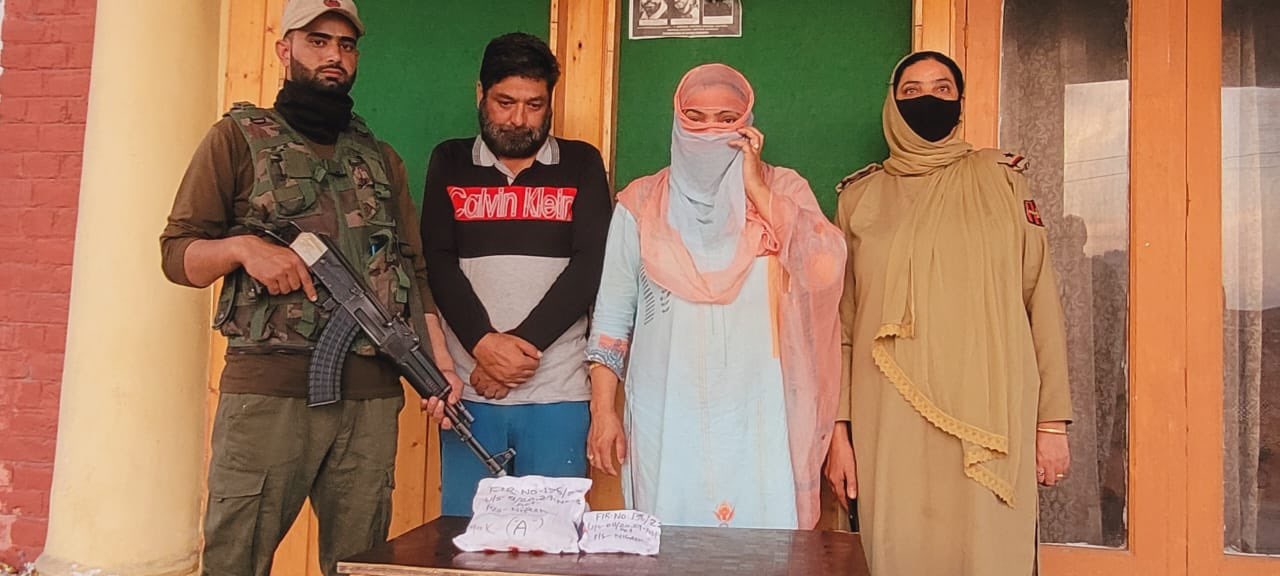
    Couple held for drug peddling in Hazratbal on September 30, 2022 by Jammu and Kashmir Police.

    Diagnosing drug addiction (substance use disorder) requires a thorough evaluation and often includes an assessment by a psychiatrist, a psychologist, or a licensed alcohol and drug counsellor. Although there’s no cure for drug addiction, treatment options can help you overcome an addiction and stay drug-free.

    The eradication of drug addiction needs a multi-pronged approach. There is an urgent need for legal, social and religious measures to prevent drug addiction.  Although the government has taken strict measures to eradicate the scourge of drugs, several serious measures are needed to eradicate this epidemic.  The laws that are in force for the prevention of drug abuse should be implemented in a better way and these laws should be enforced and made stricter.  The cultivation, sale and misuse of cannabis and opium should be completely banned.  It is necessary to have cooperation between the administration and the people.  Only then can our society get rid of this evil.

    Sahir Bilal
    Bilal Gani

    There is an urgent need for measures not only by the government but also by society to end this scourge. Civil society groups need to be mobilised to stop drug trafficking at the local level. Parents should monitor the activities of their children and protect them from getting addicted to drugs and falling into the clutches of drug addicts. Although there has been a lot of awareness among people about the harmful effects of drugs, this awareness needs to be spread to those areas and people who are unaware of it.

    Another aspect of drug abuse prevention is the rehabilitation of victims of this scourge. But recovery must be consistent and victim-focused. The rehabilitation centres should take proper care of the psychological and emotional needs of the victims so that they can fully recover and move towards a prosperous future.  These rehabilitation measures include preventive education and awareness building, capacity building, skill development, vocational training and livelihood support for ex-drug addicts, among other relevant measures to stop this epidemic before it is too late.

    (The author is pursuing his PhD from the Central University Kashmir in politics and international relations. The opinions expressed in this article are those of the author and do not purport to reflect the opinions or views of Kashmir Life.)

    [ad_2]
    #Society #Fight #Drug #Addiction

    ( With inputs from : kashmirlife.net )

  • ‘We need action’: Time runs out for Ukraine as allied countries debate sending tanks

    ‘We need action’: Time runs out for Ukraine as allied countries debate sending tanks

    [ad_1]

    gettyimages 1437048214

    Frustration with Germany is boiling over. Arming Ukraine “is not some kind of decision-making exercise,” Polish Foreign Minister Zbigniew Rau tweeted after the 50-nation Ukraine Defense Contact Group met in Ramstein, Germany, on Friday. “Ukrainian blood is shed for real. This is the price of hesitation over Leopard deliveries. We need action, now.”

    Estonian Defense Minister Hanno Pevkur agreed that the debates are hurting Ukraine’s prospects.

    “Any delay will have an [effect],” he said via text. “How big this [effect] could be is very difficult to predict.”

    The issue simmered throughout the week as world leaders gathered in Davos for the World Economic Forum.

    There, German Chancellor Olaf Scholz met privately with U.S. lawmakers and told them Germany won’t send their tanks unless the U.S. transfers their own first, as POLITICO reported.

    The matter came to a head during the meeting at Ramstein on Friday, where German Defense Minister Boris Pistorius told reporters that Berlin still hadn’t decided what it would do, but left the door open to approving the transfer.

    “None of us can yet say when a decision will be made and what the decision will look like,” he said, adding that he had instructed the German army to review the country’s inventory so it can move quickly if they decide to send the tanks.

    “We have been repeating that more tanks are necessary,” said an official from Eastern Europe, who asked not to be named in order to speak candidly. “Still we have hope.”

    Following the meeting, Defense Secretary Lloyd Austin said the U.S. and allies are “pushing hard to meet Ukraine’s requirements for tanks and other armored vehicles.” Yet he mostly sidestepped the intense debate over whether to send U.S. and German tanks.

    Austin also denied reports that sending U.S. tanks was a condition for Germany to send its own.

    The coming fight


    The fighting in Ukraine this spring will rely heavily on tanks on both sides of the line, and after a year of hard combat, Kyiv is desperate for more modern Western models to allow them to overwhelm the hundreds of Russian tanks and armored vehicles lying in wait.

    Getting that new equipment into the hands of Ukrainian soldiers quickly will go a long way in determining when Ukraine can launch its offensives this year, said Rob Lee, with the Foreign Policy Research Institute.

    “I think the delivery and training timeline will influence when Ukraine chooses to pursue its most ambitious offensives,” Lee said, adding that Leopards may be better than the M1 Abrams tanks that the U.S. has been resistant to offer. That’s because Leopards are less complicated to operate and maintain. “If Ukrainians can master the Leopards sooner than Abrams, they could play a greater role in offensives this summer.”

    Still, the vehicle donations so far have been significant. Over the past several weeks the U.S. has pledged to send Bradley Fighting Vehicles. Sweden announced it will donate CV90 armored vehicles, and Germany has promised to ship Marder vehicles. All three models are heavily armored, tracked vehicles featuring powerful autocannons that can chew through armor and absorb incoming fire.

    Those infantry carriers, along with Humvees, mine-resistant vehicles and Stryker infantry carriers from the U.S. would likely lead the vanguard of new armored units that are much more potent than anything Ukraine — or most nations — have been able to field. They’ll be supported by dozens of new mobile howitzers promised this week by the U.S., Denmark and Sweden to form a lethal combined arms punch.

    Speaking after the gathering in Ramstein Friday, Joint Chiefs Chair Gen Mark Milley said the new armor and artillery is equivalent to two U.S. combined arms maneuver brigades, or six mechanized infantry battalions.

    Training for Ukrainian troops on that equipment has already begun in Germany, an effort Milley saw firsthand this week during a visit to a U.S. training site. “That training in addition to the equipment will significantly increase Ukraine’s capability to defend itself from Russian attacks, and to go on the tactical and operational offensive to liberate the occupied areas,” Milley said.

    Ben Hodges, a former commander of U.S. Army Europe, said the new armored units will likely “be trained and prepared to serve as the breakthrough formation for the next major offensive phase of the campaign. I’d anticipate that it’ll be at least three months before they’re able to do that. It will be built around Ukrainian armor that they already have or have captured, but Western tanks [armored fighting vehicles and artillery] will help make it more lethal.”

    Hurry up and wait

    Even if Berlin decides to send its tanks, or approves other countries to send theirs, the shipment won’t happen right away.

    German arms manufacturer Rheinmetall said recently that it would likely take them until 2024 to deliver combat-ready Leopards to Ukraine, given the poor condition of many German tanks.

    Countries such as Poland, Finland, and Norway would likely be able to deliver their Leopards sooner, though one European defense official said it could take two months to fully train Ukrainian crews on the tanks.

    It also remains unclear when the 14 Challenger tanks promised by the U.K. will have trained crews ready to operate them.

    The U.S., meanwhile, is walking a fine line on encouraging Germany to act while noting this is that country’s decision.

    “These are sovereign decisions. We respect them. We welcome them,” National Security Council spokesperson John Kirby told reporters on Friday. “We do believe that there is a need for armored capability including tanks inside Ukraine, and the Leopard tank is a terrific system.”

    Ukrainian President Volodymyr Zelenskyy made it clear on Friday that the debate needs to end and empty platitudes aren’t enough.

    “Hundreds of ‘thank you’ are not hundreds of tanks,” he told the group in Ramstein via video address. “All of us can use thousands of words, but I can’t put words, instead of guns needed, against Russian artillery.”

    [ad_2]
    #action #Time #runs #Ukraine #allied #countries #debate #sending #tanks
    ( With inputs from : www.politico.com )