Hyderabad: Telangana BJP chief Bandi Sanjay Kumar on Tuesday called Bharat Rashtra Samithi’s (BRS) call to boycott President Droupadi Murmu’s address to the Parliament as being disrespectful to Dalit, Adivasi women.
“BRS couldn’t digest the fact that an Adivasi woman became the President of India. If BRS had issues with the speech, the party could have raised them when they get the chance to speak but need not boycott. They should immediately issue an apology,” Sanjay said.
The Bharat Rashtra Samithi (BRS) and Aam Aadmi Party (AAP) decided to boycott the Presidential address on Tuesday to highlight the failure of the Union Government, while Leader of Opposition (LoP) Mallikarjun Kharge and several Congress leaders are stuck at Srinagar airport due to bad weather.
Sanjay Singh of the AAP said that the address is a ‘bundle of lies’ and that the AAP will boycott it.
President Droupadi Murmu addressed the joint sitting of Parliament for the first time since being elected to the post. She outlayed the government’s vision for the current year.
In her first address to Parliament as President, Draupadi Murmu on Tuesday expressed her gratitude to citizens for electing a stable government for two consecutive terms and said that the Prime Minister Narendra Modi government has been identified as a decisive government.
“Wherever there is political instability anywhere in the world, those countries are surrounded by a massive crisis. But due to the decisions my government took in the national interest, India is in a better position as compared to other countries,” Murmu said.
Terming the government, a stable, fearless, and decisive one, “Murmu said, “My government is working towards realising the big dreams.”
“My government has worked for every section of society without any discrimination. As a result of the efforts of my government in the last few years, many basic facilities have either reached 100 per cent population or are very close to that target,” the President said.
Bhopal: At the function where Katni’s mayor (independent) joined the Bharatiya Janata Party on Monday, senior BJP leader and Madhya Pradesh Home Minister Narottam Mishra was seen playing the anchor’s role, which was indicative of a new task assigned to him ahead of the Assembly elections.
Sources told IANS that during the State Working Committee meeting, which concluded last week at the party’s headquarters in Bhopal, Mishra was unofficially assigned the task to bring back the rebels into the BJP. Mishra was also given the role of strengthening the BJP cadres especially in regions where the party had lost in the 2018 Assembly elections.
Katni’s mayor (Independent) Preeti Suri along with three independent municipal councillors joined the BJP in the presence of Chief Minister Shivraj Singh Chouhan and state BJP president V. D. Sharma on Monday. When Suri and the three councillors entered the BJP’s conference hall, they were guided by Narottam Mishra and Katni’s BJP MLA Sanjay Pathak.
The strong political friendship between Mishra and Pathak has been a matter of discussion in the state unit of the BJP, especially since the duo had played a prominent role in delivering a setback to the Congress government in March 2020. The presence of both Mishra and Pathak during the Katni mayor’s joining was a clear indication that the duo played a role in bringing back Suri to the party.
“Mishra’s presence during the independent mayor’s joining is clear evidence that he has started working on the task assigned to him. It is the first step, more such developments will happen soon. Several parties’ rebels will be joining the BJP soon,” said a source in the party.
Suri, who won the mayoral seat as an independent candidate from Katni in July last year, is an ex-BJP leader. She was suspended from the party for six years due to anti-party activities a few years back. “Even though she (Preeti Suri) was out of the BJP for the last few years, but her heart was always with the party. We welcome her rejoining the party,” Chief Minister Shivraj Singh Chouhan said.
With this, the BJP will now have 10 mayors out of the total 16 in Madhya Pradesh. In the mayoral elections held in July last year, the ruling BJP had won seven against the Congress’ five mayoral posts. One mayoral seat (Singrauli) was won by the debutant AAP.
Chennai: Tamil Nadu’s ruling DMK on Monday came out strongly against the BJP state President, K. Annamalai for sharing an “edited video” of party leader and former Union Minister T.R. Baalu’s speech.
DMK IT Wing Secretary and Baalu’s son, T.R.B. Raaja slammed Annamalai for the video.
Annamalai, sharing the video clip on Twitter, said: “DMK men take pride in demolishing 100-year-old Hindu temples. The very reason we want the HR&CE dissolved and want temples freed from the clutches of the government.”
As per the subtitles in the video shared by Annamalai, Baalu has allegedly said: “100 years old temple, I am the person who demolished it. In my home town, in my constituency Saraswathi temple and Lakshmi temple and whats the other god? Parvathy temple. These three temples are located in my constituency are located at the GST road. These three temples were demolished by me. I know that I wouldn’t get votes for it. But I also know how to get votes from the people.”
Raaja said that the BJP state chief was “resorting to cheap division-mongering in the name of religion and it was the only agenda of that party”.
“While cheap division-mongering in the name of religion is the only agenda of silly wannabe mushrooms. While we strive to engage in civil dialogue for the overall well-being of the state, it is sad to see the party which rules a nation give space to immature half baked attention seekers to use a chair occupied by some respectable individuals who fought the political fight based on ideology and programme implementation rather than wanting to feed of the impact of cheap# Fakenews& edited videos.”
Baalu had allegedly made the remarks while criticizing the BJP government for halting the Sethusamudram Ship Canal project.
The project, which proposes to connect the Gulf of Mannar with the Palk Straits, is considered a key to bringing economic prosperity to the state and the country.
The Sethusamudram Ship Canal project which commenced in 2005 was halted after the Sangh Parivar organisations had protested claiming that this would harm the ‘Ram Setu’ bridge, believed to have been built by Lord Rama to reach Sri Lanka.
Annamalai had posted a series of tweets voicing opposition to the Sethusamudram project.
He had said, “We at the BJP will not let this project proceed under alignment 4a (Destruction of Ram Setu will not be allowed for execution for this project)
“@CMOTamilNadu also ignored the advice of Tsunami expert Prof Tad S Murthy, who said the destruction of Ram Setu could cause a Tsunami in this region.”
The Jammu and Kashmir government’s campaign to retrieve the state land encroached upon by individuals, institutions and communities is at its peak. Even though the assurance has been around that the marginal and weaker sections would stay untouched, the campaign seemingly makes no distinction, reports Yawar Hussain
On a wintery morning of January 19, 2023, Sultan Ahmad Dar, living on top of a Karewa in the Kanidajan area of Budgam was glued to his mobile phone disseminating the statement of Lt Governor Manoj Sinha that poor people with small patches of state land would not be evicted in the ongoing drive to be completed by the end of January 2023.
Sinha’s statement, however, didn’t bring a smile to Sultan’s face as he has been already dispossessed of the three kanal land a week ago on which his grandfather Mohiuddin Dar in 1959 had started growing apple trees, an orchard which now is the family’s main source of income.
While Sultan watched the LG speak in one corner of Jammu and Kashmir, it was another man, Naresh Singh in Jammu’s Kathua, who also stood and watched in coldness the speech which might have saved his four kanal piece of land, only if the statement had come earlier. His family had been sowing rice on the land for close to a decade now.
While the LG spoke on the government’s intent to only go after the “big fish”, who have since 1947 “usurped” the state land using their power and position, the Srinagar district administration’s encroachment list also put the four odd kanals of the Raj Bhawan in Cheshmashahi under the “encroachment” tab. In summers, the highest seat of power the Bhawan has housed the families of all the Governors and now LG’s of Jammu and Kashmir including LG Sinha’s.
These patches of land, along with lakhs of other people across Jammu and Kashmir, came into question following Revenue Secretary, Vijay Kumar Bhiduri’s circular, which sets out a daily 4 pm deadline for revenue officers at the divisional and district level to update the government at on day’s evictions details.
In districts, the Deputy Commissioners have set out their own targets for the Tehsildars. Credit goes to the revenue officials across Jammu and Kashmir who have literally mapped every inch of the erstwhile state and offered fraction-wise details of the current status of the land resource. They have located every single unauthorised construction or possession, including that of the government itself. Interestingly, the UN office in Srinagar is also an encroachment. This voluminous data is going to be a huge digital resource for future use or abuse.
The fulfilment of daily set targets is visible on the ground where the locals are also seen resisting the officials who have come to evict them.
In the Payer village of Pulwama, scenes of people physically stopping officials, who are cutting their trees, have come to the fore. These subordinate officials on the ground are walking an extra mile in the line of duty, to implement the orders.
“We are following the orders from the top. We too live in the same district but are helpless. Seniors would initiate action,” a lower-rung Revenue department official said.. “Where will we plead our case in these times.”
The retracting statement of Bidhuri’s that only commercial land is being retrieved from encroachers coupled with LG’s assurances have fallen flat on the ground as the Revenue officials across Jammu and Kashmir are evicting all.
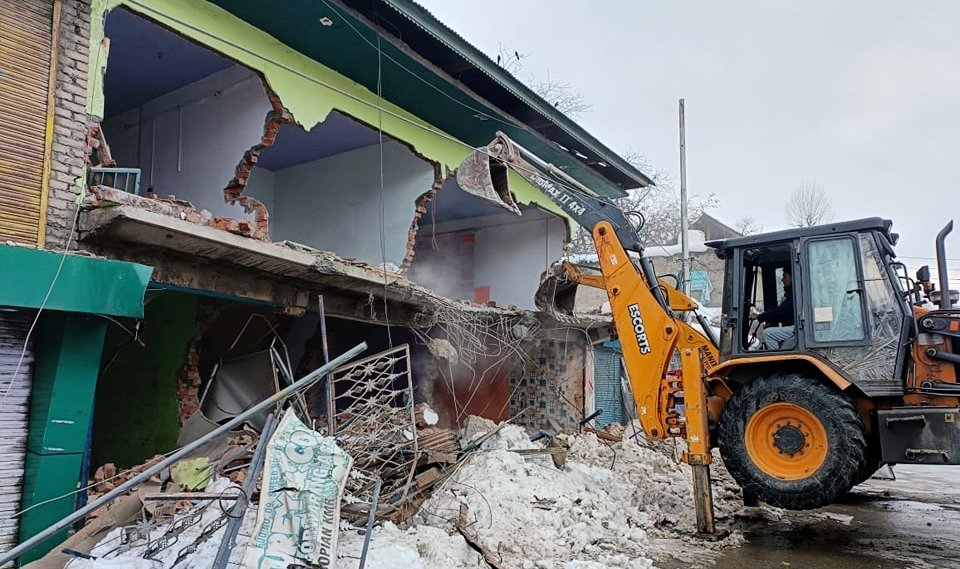
In January 2023, a bulldozer was in operation in Shopian where a shopping complex owned by an erstwhile minister was demolished. Authorities said it was illegal construction and the land was owned by the state.
Excluding Poor?
The J&K Bharatiya Janata Party Chief Ravinder Raina, whose party represents the Reasi district in the Lok Sabha, said that the people with less than 4 kanals of state land wouldn’t be troubled.
However, in Kalimasta village of Gool Gulabgarh in Reasi district, Ghulam Mohammad Chopan’s mountainous single-storey house with just two kanals of land around it has been declared as state land.
The officials, he said, came and wrote on a big stone at the border of “his piece of land” that it belonged to the state. “This land only fetched me vegetables and some fruit along with maize. The family survived on it. We couldn’t produce enough to sell.”
Chopans have been living on the land for over a century now. No subsequent government has troubled them. “People only remember us when they need votes,” Chopan said. “Officials seldom come here when we need any service. Today, they have come but only to make our lives more miserable.”
In Boniyar in north Kashmir’s Baramulla district, the Executive Magistrate 1st Class issued a warning to the people stating: “If any person fails to remove the encroachment, the department would swing into action and people have to pay the charges of the same.” Similar warning circulars have been issued in other districts too.
The land of Sultan, Singh and Chopan is registered as state land in revenue records, but under the laws applicable before August 5, 2019, when the state’s special status was watered down, the family had rights to cultivate it.
Land Distribution
A revenue settlement during the last Dogra ruler Hari Singh’s time was recorded as Shri Sarkar Dulatmandar meaning ‘our government is wealthy and rich’ as it has enough land and can utilise it for common purposes of its citizens.
This laid the foundation, if not the relief, for the common masses who after the 1950s Land to Tiller started reaping the benefits.
In 1947, Jammu and Kashmir was dominated by landlords who were around 13,000 in number.
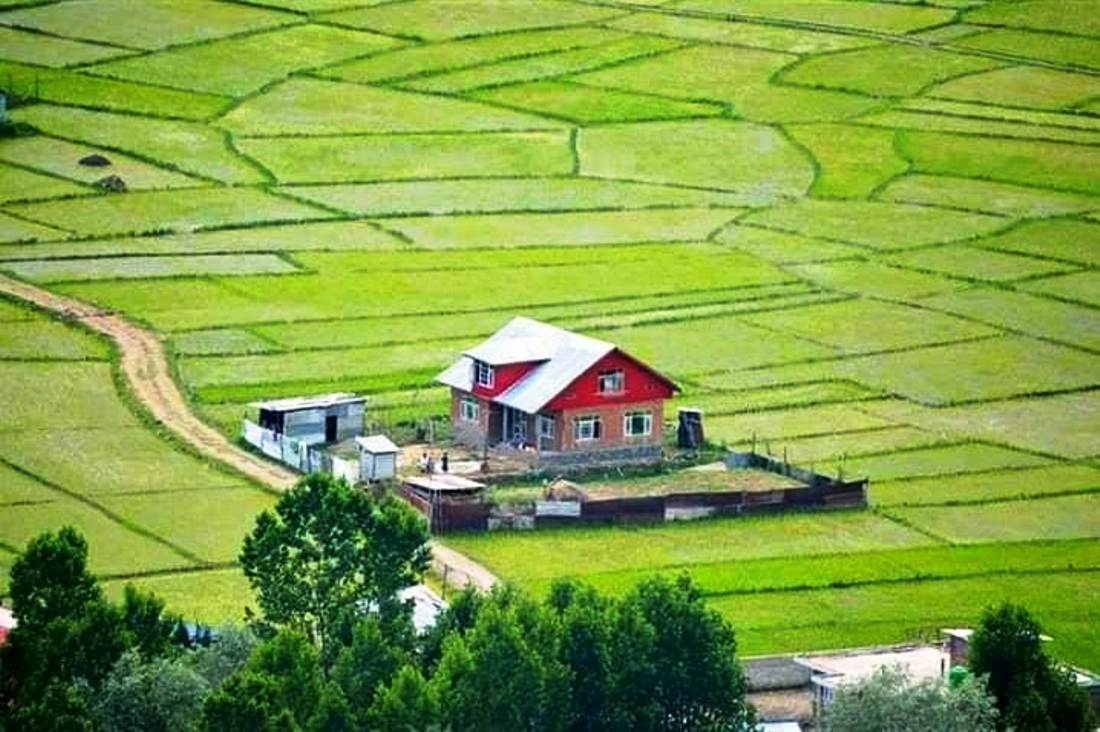
In the midst of a vast paddy field, a new concrete structure has emerged somewhere in the Kashmir periphery. The agricultural land is fast converted into orchards or housing units for the lack of adequate land for housing. Photograph: Social Media
Out of them, 396 were the biggest landlords, called jagirdars, to whom were alienated the land and other revenues. The area assigned to them was called jagir. The jagirdars were not owners of the land; they were, however, owners of the revenue of the areas assigned to them. Along with the alienation of land revenue, the state also transferred the people of the jagir to the control of the jagirdar.
The remaining 9000 landlords were owners of the land known as called chakdars, and the land owned by them was known as chak. All the villages suffixed Chak in their names were the Chak lands of yore. Besides the jagirdars and chakdars, there was also a class of cash grantees called mukarares, numbering 2,347. The number of landless peasants (called kashtkars) was around 300,000. Apart from this, 250,000 peasants cultivated a part of the land while the ownership rested with the jagirdars, maufidarschakdars.
It was these jagirdaris and chakdaris that the Jammu and Kashmir government ended from 1948 to 1950.
However, the land inherited by the State of Jammu and Kashmir from the Dogra Maharaja, whose family had bought the Kashmir valley from British under the infamous Treaty of Amritsar in 1846, became the property of the new government. The land came to be known as State land (Khalisa Sarkar, Nuzool and Shamilat), and Khacharie (Grazing land).
However, following the partition and subsequent accession of Jammu and Kashmir with the union of India, Evacuee property also became the property of the government of Jammu and Kashmir.
In the years leading up to ousting of the Dogra rule in Jammu and Kashmir and then partition’s migrations, the Evacuee property was encroached on in Jammu’s Kathua, Samba, Jammu, Udhampur and Rajouri districts.
In the succeeding years, the government under JK Evacuees (Administration) of Property Act came out with Order 578-C of 1954 read with order no 371 of 1971 declaring that 85 lakh kanals of evacuee land illegally occupied in the districts of Jammu, Udhampur, Kathua, Samba and Rajouri will not be disturbed and occupants thereof instead declared as local allottees, without any liability towards payment of rent let alone the premium.
Like evacuee land, state land too had been encroached upon by common peasants, who were still not completely out of the clutches of landlords to whom they were paying rent.
The state land encroached upon by the common masses was again given away by the government to poor people twice. Under LB-6 and LB-7 both dated 05.06.1958 and S-432 of 1967 the illegal occupants of state land were conferred initially with the rights of tenants-at-will followed by a grant of ownership rights.
Similarly, farmers took possession of state land and khacharie land under the agrarian reforms of 1950 and 1976, and a “Grow More Food Policy” under which cultivable wasteland was allotted to landless peasants with partial rights.
The Grow More Food Policy was introduced by the government to counter famines and fight the scarcity of food. The farmers were lured by the government of the time to cultivate the state land and use Khacharie land for grazing their cattle.
“The government back then and also the subsequent one’s assured our family that land wouldn’t be taken back but we were informed that we can’t sell the land. We never thought of it as our property but as a means of earning a livelihood,” Naresh Singh of Kathua said, adding that when the government can’t provide them jobs then why was it taking away their source of sustenance?
It is these promises of not ejecting people by the State of Jammu and Kashmir that are being undone in the current eviction drive.
The drive has the flip side too.
Former Law Secretary Muhammad Ashraf Mir said legally the land being taken away from the encroachers in the current drive is valid. “It is an issue where a humanitarian and compassionate view needs to be taken by the government. They aren’t bound by law,” he said.
The West Pakistan Refugees, who struggled for citizenship of Jammu and Kashmir since 1947, were elated on August 5, 2019, but now they too have been served notices by the government that the land held by them for cultivation is the state’s property. They have been asked not to cultivate the land after this season’s crop is harvested.
While the pathway for the current drive opened on August 5, 2019, the changes in land laws were affected a year later.
Changed Laws
In October 2020, the Jammu and Kashmir Reorganisation (Adaptation of Central Laws) Third Order and the Jammu and Kashmir Reorganisation (Adaptation of State Laws) Fifth Order, 2020, repealed 12 land laws that provided safeguards to farming communities.
Among them was the historic Big Land Estate Abolition Act 1950 (informally known as land to tiller), which paved the way for rural prosperity in the former state.
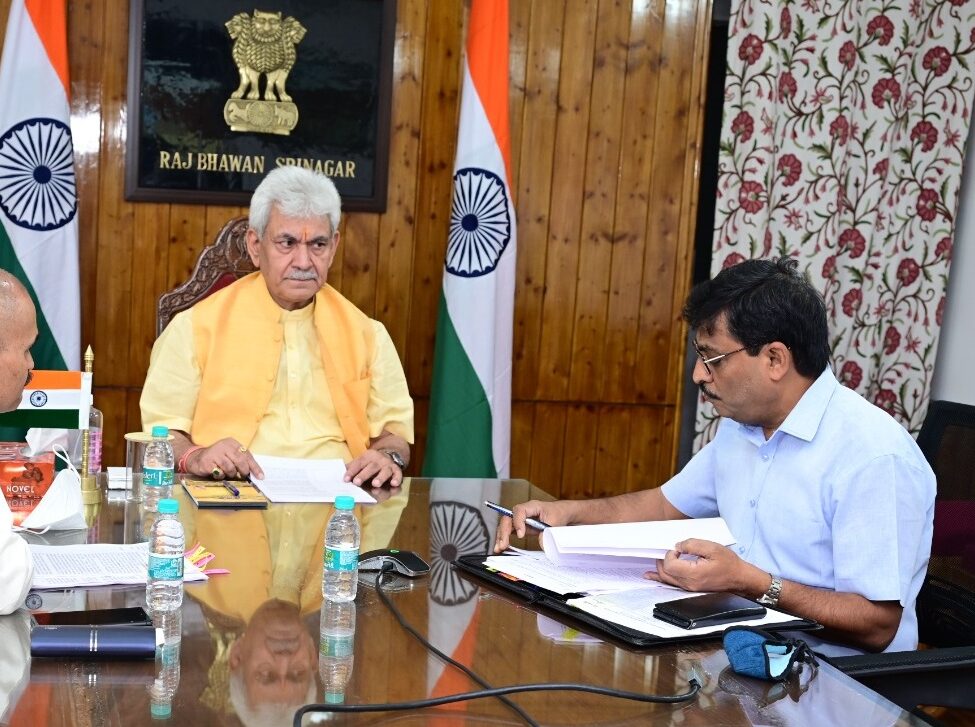
Lieutenant Governor, Manoj Sinha charing Administrative Council meeting at Srinagar on September 8,2022
The erstwhile Land to Tiller placed a ceiling of maximum of 22.75 acres on land holdings. Land that surpassed this limit was automatically transferred to the tiller, who was not required to pay any compensation to the ‘original’ owner.
These reforms were first envisioned and articulated in the Naya Kashmir (New Kashmir) Manifesto in 1944 by the National Conference under Shiekh Mohammad Abdullah.
According to research done by Dr Ashish Saxena in Jammu, during the 1950s-70s, out of the total surplus land of 672 kanals mainly taken away from Rajputs and Mahajans, 70.24 per cent was allotted to SC (Scheduled Caste) tenants predominantly Hindus. A radical inter-generational shift in the occupation pattern of the SCs in terms of landless agricultural labourers to land-owning peasants from grandfather’s generation (nil) to 47.1 per cent. The reforms also gave land to Muslim peasants in Kashmir where the jagirdaris of Kashmiri pandits and Dogra Hindus were ended.
Another significant law that was repealed in October 2020, was the Jammu and Kashmir Tenancy Act, 1980, which stayed all applications or proceedings relating to ejecting tenants.
The order also did away with the Jammu and Kashmir Common Lands (Regulation) Act, 1956, which regulated the rights of common land such as roads, streets, lanes, pathways, water channels, drains, wells, tanks or any other source of water supply to villagers.
The Jammu and Kashmir Alienation of Land Act, 1938 — a law related to the transfer of agricultural land for non-agricultural purposes —also ceased to operate.
The law that prohibited the conversion of land into orchards and existing orchard land for other uses, without prior government permission, termed the Jammu and Kashmir Prohibition on Conversion of Land and Alienation of Orchards Act, 1975, has also been repealed.
The other Acts that are no longer effective in are the Jammu and Kashmir Consolidation Of Holdings Act, 1962, the Jammu and Kashmir Flood Plain Zones (Regulation and Development) Act, the Jammu and Kashmir Land Improvement Schemes Act, the Jammu and Kashmir Prevention Of Fragmentation Of Agricultural Holdings Act, the Jammu and Kashmir Right Of Prior Purchase, Act, the Jammu and Kashmir Utilisation Of Lands Act and the Jammu and Kashmir Underground Public Utilities (Acquisition Of Rights Of User In Land) Act.
The government has also set up a new body called the J&K Industrial Development Corporation, under the Jammu and Kashmir Industrial Development Act, to speed up industrial development, invite investment, set up industrial units and promote corporate farming. The modified law permits the corporation to acquire land for setting up industrial units.
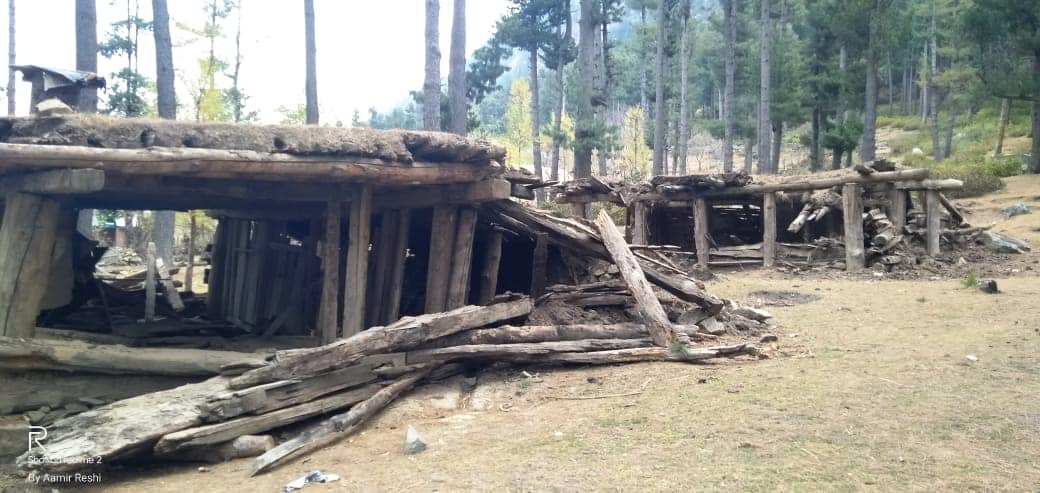
Gujjar hutments locally called Kotha’s demolition in interior Pahalgam. Some of these temporary structures predate partition. The photograph shows the credits of Aamir Reshi.
However, if it is unable to acquire the land by agreement, the government can order proceedings under the Right to Fair Compensation and Transparency in Land Acquisition Rehabilitation and Resettlement Act, 2013. Under this Act, a penalty is issued in case anyone obstructs any person with whom the corporation has entered into a contract.
Following this, JK State Industrial Development Corporation is retrieving 723 kanals of state land for new industrial clusters in the Buddhi area of Kathua which includes Barwal and Jandore villages.
“In adjoining Langate and Govindsar villages, many of the industrial units set up by SIDCO are inoperative. Clearly, the non-local investors are coming here to enjoy government subsidies and incentives,” Amrish Jasrotia, a local activist, said.
Also, the land being taken away in the current drive is in use for agriculture and horticulture.
Under the amended Jammu and Kashmir Land Revenue Act in 2020, the definition of agriculture and allied activities have been extended to raising crops including food and non-food crops, fodder or grass, fruits, vegetable, flowers, animal husbandry, dairy, poultry farming, stock breeding, fishery, and agro-processing related activities. The modified law disallows the sale as well as gift or exchange or mortgage of agricultural land to a non-agriculturist.
However, the law has carved out exemptions through which such a transfer can be permitted. A newly-formed revenue board will notify the detailed procedure, prescribe a form and fix the fee for conversion of agriculture to non-agricultural purposes.
The government can allow the transfer of agricultural land in favour of an eligible public trust established for charitable purposes and which is non-profitable in nature as well as for education and healthcare services.
It can also, via notification, allow the transfer of land to a person, institution or corporation, for industrial or commercial or housing purposes or agricultural purposes meant for the development of the UT. Non-agriculturists who have had the land transferred to them and intend to use it for non-agricultural purposes are required to now do so within five years.
Roshni Land
While lakhs of people encroached on the state and khacharie lands post the despotic rule, the legislature of Jammu and Kashmir in 2001 passed the Jammu and Kashmir State Land (Vesting of Ownership to the Occupants) Act 2001 which came to be known as the Roshni Act and more recently as the Roshni scam.
The law paved the way for transferring ownership of state land to its occupants for a fee with the objective of earning revenue to finance power projects.
High Court of Jammu and Kashmir
The law was a result of the Farooq Abdullah government’s failure to manage the financial closure of the ambitious Baglihar power project forcing the government to think of ideas that can generate capital locally. The Farooq-led government in 2001 decided to hand over rights to people occupying the state land in lieu of market costs. The capital would fund the power projects. The Roshni scheme continued and people started paying for the lands they held. In 2005, however, Ghulam Nabi Azad-led government decided to vest proprietary rights to anyone holding state land but without paying anything. In order to appease the land grabbers, Azad government made it mandatory for revenue officials to deliver the ownership papers on these lands to the people at their homes. It devoured the purpose from the scheme and reduced it to a historic racket. Comptroller and Auditor General did a scathing report on the scandal and eventually, in a series of petitions, the High Court found it to be in non-consonance with the principles of a fair law leading to the Act being declared null and void.
Subsequently, the revenue officials were directed to delete mutations in records done under the Roshni Act. The names of common people were deleted from revenue records and the land’s title again changed to state land.
Retrieving the encroached land started soon after the collapse of BJPDP government and the subsequent days witnessed the eviction drives taking place with vigour and consistency. In January 2022, the administration claimed to have retrieved 46,487.6 acres of state land, 13,814.4 acres of kacharai (grazing land), and 164.2 acres of common land from alleged encroachers across Jammu and Kashmir. The matter went to the Supreme Court, which stayed the evictions of former Roshni Act landholders. The government had also filed a review petition along with 70 other individual petitions.
Last year, the government through its Solicitor General informed the Apex Court that no “coercive” action would be taken against Roshni Act landholders till the court passes directions.
However, with vacations currently underway in court, the eviction drive was started targeting all the state land including Roshni and Khacharie lands. The petitioners filed a special leave petition in which the court didn’t stay the evictions but asked the UT counsel to verbally direct the administration to not demolish houses and also not disturb the Roshni Act landholders till the next hearing on January 31.
Retired Justice Muzafar Iqbal Khan, a petitioner in the Roshni case said that while a law passed by an assembly was declared null and void by a governor who had no authority, the government has been silent on paying back money to the people who got land regularised.
Cascading Effect
While the debates around legality and compassion rage on, Farooq Ahmad Ganie in the Rampora Rajpora area of Baramulla is worried about the financial loss he would have to bear after the three-kanal land has been taken away from his possession.
The land, part Khacharie and part state land, majorly housed hundreds of walnut trees he had sown which fetched him around Rs 7-8 lakhs every season.
Like Ganie, the majority of state and Khacharie landholders had employed the land for agriculture and horticulture, the mainstay of the Jammu and Kashmir economy.
With an estimated 30 lakh kanals of land being retrieved from the people, the Gross State Domestic Produce of Jammu and Kashmir is going to take a serious hit. Agriculture, interestingly, after remained stagnant for many years has started falling down as a contributor to GSDP.
Experts believe that the per capita income of Jammu and Kashmir is also going to be hit badly in the already volatile times kick-started by the August 5 and Covid-19-induced lockdowns.
Former J&K finance minister Haseeb Drabu in one of his write-ups post August 5, argues that the fact underlying Jammu and Kashmir’s better-than-national average human development indicators is that along with the land reforms, there was a massive debt write-off undertaken over a period of twenty years between 1951 and 1973. It is because of this that the incidence of indebtedness in Jammu and Kashmir is at the second lowest. Landless labour in the state is nearly absent and land ownership translating into economic empowerment has led to more than 25 per cent of the household earnings in Jammu and Kashmir coming from own cultivation. As a result, the incidence of poverty in the state is remarkably low with households living below the poverty line at 10 per cent against the all-India average of 22 per cent.
Reactions
National Conference vice president and former chief minister Omar Abdullah said that the government is trying to hide its failures under the pretext of land retrieval order, insisting the situation is going bad to worse with each passing day. “The retrieval of the land of Roshni scheme amounts to betrayal.”
Peoples Conference president Sajad Lone said the idea of retrieving state land in a rural setting is “dangerous”. Lone said that the administration cannot make people homeless and “when will these insane experiments backed by ugly muscularity end”. He added: “Occupation of State land in villages by inhabitants of a particular village is a generational practice and an irreversible reality. This practice is prevalent in the rest of the country. A sizeable percentage of the population is involved. You can’t make them homeless.”
While BJP President Ravinder Raina said the drive is a good step against land grabbers, his party colleague Yudhvir Sethi went all guns blazing against the government saying that they would hit roads and not allow the officials anywhere near the people’s lands.
The Democratic Progressive Azad Party, Jammu and Kashmir Apni Party and the Peoples Democratic Party have already hit the roads in protest along with protest marches by locals at a few places.
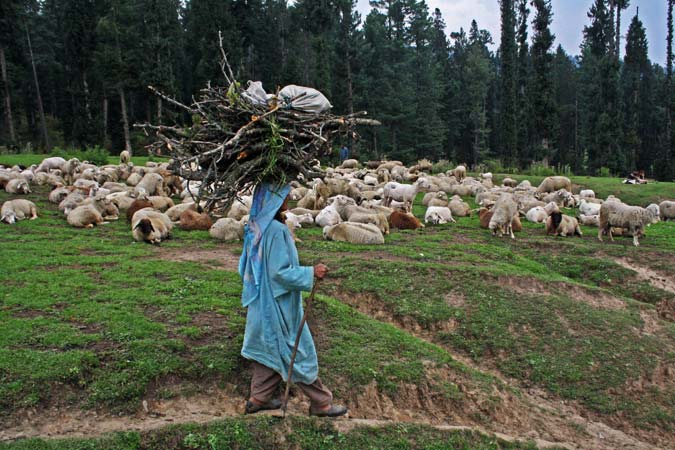
Herds grazing in Branwar. KL Image: Bilal Bahadur
PDP President and former chief minister Mehbooba Mufti said, “Laws are created for the welfare of the public, but in Jammu and Kashmir they are weaponised to dis-empower, humiliate and punish. This latest diktat was issued because despite the government of India misusing all the agencies at its disposal & unleashing draconian laws, aren’t getting the desired results,” she said. “The collective punishment & humiliation is this government’s way of keeping people of J&K on tenterhooks & fighting for mere survival so that they don’t have the energy to fight the onslaught against their identity.”
The District Development Council Ramban unanimously adopted a resolution to oppose the administration’s order to vacate “occupants” from the state land.
The resolution passed unanimously, appealed to the LG to issue directions to the concerned authorities for preventing any adverse action which is detrimental to the farmers/landless people residing in villages and are wholly and solely dependent on the state land which they were occupying for decades.
The DDC members, in their resolution, said, “Simply branding the occupants as land grabbers is not only unjustified but misleading as well. The historical aspect needs to be taken into consideration while deciding about such sensitive issues upon which the people have built the whole edifice of their lives and spent their hard-earned money over the years in constructing a shelter for their families.”
“The admin must prevent revenue authorities from demolishing or damaging all kinds of properties mentioned above. Also frame a policy to give ownerships to such occupants by charging reasonable amount depending upon the paying capacity,” reads the resolution.
New Delhi: The Delhi Police had told the Supreme Court that it is conducting a fair and unbiased investigation into the alleged hate speech made at a religious assembly in the national capital in 2021, and has examined Delhi BJP spokesperson, Sudarshan News editor-in-chief, Hindu Yuva Vahini members and others.
It added that the forensic science laboratory is scheduled to compare Sudarshan News editor’s specimen voice sample with the video from YouTube in March.
Delhi Police investigating officer, in an affidavit, said that Delhi BJP spokesperson Vikram Bidhuri, who was one of the participants has been examined, and Sudarshan News editor-in-chief Suresh Chavhanke was examined in the case on November 1, 2022 and “he was bound down u/s 41A CrPC”.
The affidavit added that the alleged hate speech video has been examined and the transcript has been prepared.
“Forensic Science Laboratory, Delhi has fixed March 17 for recording of specimen voice sample of Suresh Chavanke. Thereafter his specimen voice recording will be compared with the video/audio downloaded from YouTube…..effort is being made to obtain the details of the video of the speech made during the event and uploaded on YouTube, through the process of MLAT,” it said.
“That investigation of the case is being conducted fairly and without any bias.”
The police filed this affidavit in compliance with January 13 order passed by the apex court directing the investigating officer to place on record the steps which have been taken to pursue the investigation since the incident took place on December 19, 2021. The police have also requested Google Inc to trace the login-logout IP addresses of the video on YouTube from where the alleged video was uploaded.
“That in response to notice u/s 91 Cr.P.C., a reply dated November 18, 2022 was received on email from Google, LLC, Legal Investigations Support, informing that no records from the Google account holders, specified in the request, have been found,” added the affidavit.
The police have told the apex court that it has examined Hindu Yuva Vahini Delhi chief Rajiv Kumar, who booked the auditorium, General Secretary Sachin Vasisht, who organised the event, and Ashutosh Sharma who attended the meeting and uploaded the video on YouTube in the channel named as ‘Hishant Media’, besides several others.
“Some other participants who had attended the event have been identified and are yet to be examined,” added the affidavit
“A draft ‘final report’ has been prepared and was sent to the prosecution branch for scrutiny. However, some points have been raised by the public prosecutor and investigation on those points is being conducted.”
On January 13, the Supreme Court had pulled up the Delhi Police for registering FIR on the alleged hate speeches made at Dharam Sansad in Govindpuri in December 2021 after a lapse of five months and not making an arrest or filing a charge sheet till date. It had told the police that there was no palpable progress made in the investigation in the case.
A bench headed by Chief Justice of India D.Y. Chandrachud shot a volley of questions at Additional Solicitor General K.M. Nataraj after petitioner Tushar Gandhi said there was an explicit call for violence at the Dharam Sansad and in flagrant violation of the apex court judgment in Tehseen Poonawala directing expeditious action against hate-mongers, police have virtually not taken any action.
Gandhi’s counsel submitted that his client is not interested in contempt proceedings against the Delhi Police Commissioner but wants action to protect the secular fabric in the country.
The apex court is scheduled to hear the matter on Monday.
Raipur: As the state gears up for assembly elections, BJP happens to be in a difficult situation to put forth its Chief Ministerial face. The party appears to be the weakest in Chhattisgarh.
The state was ruled by BJP for a decade and a half, but in the last election, the party was completely wiped out. Now BJP is working up all strategies to return to power. While major changes have been introduced in the organisation, the system is being strengthened at the grassroots as well. Additionally, there is also an eye on the internal tussle of the Congress.
The BJP has failed to build a movement against the ruling Congress in Chhattisgarh, which was once the hallmark of the BJP. At the district level, there is are protests and agitations, but that is absent at the state level where the party is not able to succeed in creating a campaign, which in turn could create an atmosphere against the Congress in general public’s mind.
Chief Minister Bhupesh Baghel is not only announcing schemes for every section, but is also implementing them. After coming to power, Congress has taken steps towards strengthening its position by announcing farm loan waiver, campaigning to strengthen the rural economy and now assuring unemployment allowance in the election year.
The biggest challenge for the BJP in the state is to come up with a representation. Although the BJP government in the state has been under the leadership of Dr Raman Singh for a decade and a half, the picture of who will be the next Chief Minister is still unclear.
It is not clear whether the BJP will make a tribal or a non-tribal the CM. On the other hand, the Congress has already played the backward class card through Bhupesh Baghel, and is leaving no stone unturned to woo the Scheduled Tribes as well.
Political analysts believe that the path to power is not easy for BJP in Chhattisgarh because the organisation is not strong enough to challenge the Congress and the Bhupesh Baghel government. Besides, there is no clarity on who will be the next Chief Minister from BJP. Consequently, veteran leaders of the party are not seen active on the ground. On the other hand, the Congress is doing everything to build inroads and win the hearts of public.
Congress holds 71 of the state’s 90 assembly seats, while the BJP has 14 MLAs. Apart from this, Chhattisgarh Congress has three and Bahujan Samaj Party has two MLAs. Not only this, Congress is in control of all the 14 urban bodies of the state.
New Delhi: The BJP Saturday said the renaming of the iconic gardens in Rashtrapati Bhavan as ‘Amrit Udyan’ shreds yet another symbol of colonialism while the opposition parties advised the government to focus on creating jobs and controlling inflation instead.
The Congress did not officially react to the name change but the Trinamool Congress and CPI rubbished the move with the Left party terming it an “attempt to rewrite history”.
Rashtrapati Bhavan’s famed Mughal Gardens will now be known as ‘Amrit Udyan’. The resplendent gardens are open to the public once a year and people can visit from January 31 this time.
Union ministers and BJP leaders hailed the decision as a move towards a “new India”.
“Welcome and thank Hon’ble President Droupadi Murmu Ji for renaming the iconic gardens at the President House as ‘Amrit Udyan.’
“This new name not only shreds yet another symbol of a colonial relic but also reflects India’s aspirations for the Amrit Kaal,” Union Minister Dharmendra Pradhan said on Twitter.
Law Minister Kiren Rijiju, in a tweet, said, “Our Hon’ble President of India, Droupadi Murmu Ji sets an example by renaming the iconic gardens at the President House as ‘Amrit Udyan.’”
“A powerful symbol of our nation’s progress and a reflection of a brighter future for New India,” he said.
Union Minister Giriraj Singh welcomed the decision while Agriculture Minister Narendra Singh Tomar thanked the prime minister, saying, “My country is changing.”
The government had last year renamed Delhi’s famed Rajpath as “Kartavya Path”. The renaming of the stretch and other institutions is in line with the Centre’s effort to remove any trace of the colonial mindset, the government has maintained.
However, the opposition said the government should focus on job creation and controlling inflation instead.
“Who knows, they might now want to rename the Eden Gardens and call it Modi Gardens! They should focus on creating jobs, controlling inflation and protecting the precious resources of LIC and SBI,” Trinamool Congress’ Parliamentary party leader in the Rajya Sabha Derek O’Brien told PTI.
CPI general secretary D Raja said this name change has been going on for quite some time and “no one knows when it will end”.
“The RSS’ agenda is to rewrite Indian history and redefine nationhood. When we celebrate our Republic, it is for the people to stand up and safeguard our secular, democratic Indian Republic. India is not a theocracy, India is a democracy,” he said.
Congress’ Rajya Sabha MP Imran Pratapgarhi sarcastically said the move will “give relief” to people troubled by the falling Adani shares.
“Adani’s shares were falling and the credibility of the government too. Giving immediate relief to the troubled public, the government has changed the name of ‘Mughal Garden’ to ‘Amrit Udyan’,” he said in a tweet in Hindi.
Former Union Minister Rajyavardhan Rathore welcomed the decision to change the name, saying, “The country is changing! The new India of Amrit Kaal is highlighting the great colours of Indianness by removing the signs of slavery.”
“The Congress had imposed the name Mughal Garden on the world-famous garden of Rashtrapati Bhavan. Thank you Modi ji for erasing the name of the invading Mughals and making ‘Amrit Udyan’,” he said in a tweet in Hindi.
Supporting the move, BJP spokesperson Sambit Patra said on Twitter, “Another historic decision of the Modi government in ‘Amrit Kaal’ to come out of the mindset of slavery. Mughal Gardens in Rashtrapati Bhavan will be named Amrit Udyan now.”
Another BJP spokesperson Shehzad Poonawala said, “When a historic decision on naming Mughal Gardens as Amrit Udyan has been taken in a series of steps to rid Bharat of symbols of ‘gulami’, colonial past — true to its DNA, some leaders oppose it displaying they are prisoners of ‘Mughlai/votebank mindset’ (sic).”
President Droupadi Murmu will grace the opening of the gardens of Rashtrapati Bhavan — Udyan Utsav 2023 — on Sunday.
On the occasion of the celebrations of 75 years of Independence as Azadi ka Amrit Mahotsav’, the President of India is pleased to give a common name to the Rashtrapati Bhavan gardens as Amrit Udyan’, Navika Gupta, Deputy Press Secretary to the President, said in the statement.
Bhopal: Ahead of the Madhya Pradesh government’s likely announcement of a new liquor policy, BJP veteran Uma Bharti on Saturday reached a temple here where she would stay put till January 31 demanding the policy be made more stringent.
Bharti has been demanding appropriate amendments in liquor policy, which the state government releases every year, and incorporating more controls to promote de-addiction.
On Saturday afternoon, Bharti reached a temple located near a liquor shop in Ayodhya Nagar trisection and announced she will stay there till January 31 awaiting the liquor policy announcement. Bharti had earlier opposed the wine shop located near the temple.
The state government has not announced a date but a new liquor policy is generally announced in January end.
The former Union minister told reporters she had expressed a desire to tour various spots in Madhya Pradesh last November but the visit could not materialise for the lack of arrangements for her staff including security personnel.
“I have never demanded absolute prohibition. I said I would implement a total prohibition if it is in my control. I have full faith in Shivraj ji (MP Chief Minister Shivraj Singh Chouhan). I will wait for the decision about the liquor policy on January 31,” she said.
The former chief minister said she didn’t want the opposition Congress to benefit from her stand.
“If a controlled liquor policy, as I had told (to the BJP government), is implemented, the BJP will repeat its record victory like 2003,” she said.
The BJP had won 165 seats in the 230-member Assembly in the 2003 polls decimating Congress, which was in power at that time, to 58 seats. After that election, Bharti became the chief minister. She resigned after eight months.
The Assembly elections in MP are due in December this year.
Bengaluru: BJP national general secretary CT Ravi on Saturday condemned BBC for misleading the audience with its documentary ‘The Modi Question’ and called it an “international conspiracy”.
While speaking at a press conference in Bengaluru, the BJP leader accused BBC of presenting incomplete information in the documentary.
“The BBC documentary on Prime Minister Narendra Modi is nothing but an international conspiracy. After the 2002 riots, BJP won more than five times in Gujarat and a second time in the centre. He is a world-known and popular leader,” he said.
He stated that the documentary did not cover the Nanavati report which concluded that the Gujarat riots were devoid of any conspiracy.
Targeting the anti-government elements, he said that the documentary is a propaganda of the people who despise the Modi-led government.
He further exclaimed that the people should trust the verdict of the Supreme court which gave a clean chit to PM Modi and not the BBC documentary and English people who plundered India during the British rule.
“With ‘Anti-Modi gangs interviews’ BBC did not show the Nanavati report. Even SC in January 2022 order gave a clean chit and rejected the plea. What is the agenda for making such documentaries? Those who do not like the development of India, the anti-Modi gang and the frustrated lost parties created the conspiracy through the BBC documentary,” he said.
The general secretary slammed Congress and alleged the party’s link with the documentary.
He questioned BBC’s decision to make the documentary about the Gujarat riots 20 years after the incident and stated that the BJP has overcome such false narratives, while also mentioning that the documentary could have been made by presenting all the truthful facts.
“BBC interviewed only anti-modi people and did not consider the SC’s order. This is an agenda to create a bad image of the country and the PM,” he said.
Earlier, this month, the government denounced the BBC series ‘The Modi Question’, calling it a “propaganda piece designed to push a discredited narrative”.
The government also pulled down the series from various social media platforms, including Twitter and Youtube.
Hyderabad: BRS working president and Telangana IT minister KT Rama Rao on Saturday went after the BJP-led Centre and said that there are serious questions that need to be answered by the ‘NPA’ govt on findings of the Hindenburg Report.
“There are serious questions that need to be answered by the NPA Govt on #HindenburgReport Why do LIC & SBI have such large exposure ₹77,000 Cr & ₹80,000 Crore to Adani group stocks? Who pushed them to do so? Who was aiding & abetting them in this entire episode?” he asked on Twitter.
There are serious questions that need to be answered by the NPA Govt on #HindenburgReport
Why do LIC & SBI have such large exposure ₹77,000 Cr & ₹80,000 Crore to Adani group stocks? Who pushed them to do so?
Who was aiding & abetting them in this entire episode?
Along with the Adani Group share pummelling on Friday, with the group losing Rs 3.37 lakh crore in aggregate market capitalisation in a single day, Life Insurance Corporation (LIC), the single largest non-promoter domestic shareholder in five of the largest Adani Group companies by market capitalisation, lost Rs 16,627 crore due to a drop in the value of its Adani Group holdings.
Indeed, the value of LIC’s Adani Group assets fell from Rs 72,193 crore on Tuesday to Rs 55,565 crore on Friday, a 22% drop in only two days.
Meanwhile, LIC’s share price declined 3.5 percent during the day on Friday, falling 5.3 percent in the prior two days.
What is the Hindenburg report?
Hindenburg Research, a well-known short seller in the United States, disclosed short positions in the Adani Group on Wednesday, accusing the conglomerate of the improperly wide use of businesses established in offshore tax havens and expressing worry about excessive debt levels.
The revelation, which comes just days before Adani Enterprises’ (ADEL.NS) $2.5 billion share sale, sent Adani group businesses’ shares tumbling.
It also said that seven Adani listed firms had an 85% downside on a fundamental basis because to what it dubbed ‘sky-high valuations’.
The firm published an investigative document titled ‘Adani Group: How The World’s 3rd Richest Man Is Pulling The Largest Con In Corporate History‘ and revealed findings of their two-year investigation presenting evidence that the Rs 17.8 trillion worth Adani group has engaged in a brazen stock manipulation and accounting fraud scheme over the course of decades.
According to the report, Gautam Adani, the Adani Group’s founder, and chairman, has a net worth of about $120 billion, which he has increased by more than $100 billion in the last three years, primarily as a result of stock price growth in the group’s seven most important publicly traded companies, which have increased by an average of 819 percent during that time.
KT Rama Rao had also challenged the central investigative agencies including the Enforcement Directorate (ED), Central Bureau of Investigation (CBI), Income Tax Department (IT) and Securities and Exchange Board of India (SEBI) to probe into the Adani enterprise’s ‘scam’.
The challenge comes hours after US’s Hindenburg Research’s investigative document, alleging fraud in Adani Group’s dealings, surfaced.
KTR challenged the agencies to probe into the matter stating in a tweet “ED, CBI, IT & SEBI; Hain Dum probe Karne Ka👇??
KTR further went on to criticise mainstream and national media remarking on their ‘inefficiency’ to manifest such matters.
ED, CBI, IT & SEBI; Hain Dum probe Karne Ka👇??
I am sure NO mainstream National media will report/discuss this & even Social Media platforms will be coerced by NPA Govt into removing the report #NewIndia https://t.co/qpyBPsob5t