New Delhi: The Supreme Court on Tuesday issued a notice on a plea by the country’s seven top wrestlers seeking a direction for the registration of an FIR against Wrestling Federation of India (WFI) chief Brij Bhushan Sharan Singh.
A bench headed by Chief Justice of India D.Y. Chandrachud and comprising Justice P.S. Narasimha, said: “There are serious allegation in plea on behest of international wrestlers with regards to sexual harassment meted out to them. Issue notice returnable on Friday. Liberty to serve standing counsel NCT Delhi. The complaints which form an attachment in sealed cover and shall be again resealeda.”.
The plea was mentioned before the bench by senior advocates Kapil Sibal and Narendra Hooda, representing the wrestlers.
Sibal submitted that this is the wrestlers’ matter and they are sitting in dharna, and seven women have complained and one is a minor.
He stressed that an FIR has not been registered and added that the plea seeks one against Singh over alleged sexual harassment by women wrestlers.
During the hearing, Sibal argued that there is a committee report which has not been made public.
The Chief Justice asked Sibal to show the case papers.
Sibal said please see the complaint by the minor, the young girl had won a gold medal and added even the police personnel can be prosecuted for not registering an FIR.
He emphasized that the court should look at the allegations and the police are not acting.
After hearing submissions, the top court sought response from the Delhi Police.
According to the plea, the wrestlers have cited an inordinate delay in registration of FIR by the Delhi Police against the WFI President and urged the apex court to issue a direction to police to lodge a case.
The top court agreed with the petitioners to suppress their identity mentioned in the petition.
A record number of river barriers, including dams and weirs, were removed across Europe in 2022, with at least 325 taken down in 16 countries, allowing rivers to flow freely and migratory fish to reach breeding areas.
In its annual report, Dam Removal Europe said Spain led the way for the second year with 133 removals, followed by Sweden and France. The UK completed 29 removals, including Bowston Weir, which was built on the River Kent nearly 150 years ago for a paper mill. Its removal will help restore the health of the river, which is home to white-clawed crayfish, freshwater pearl mussels, and water crowfoot (an oxygenating aquatic plant).
“These numbers make me proud because we’re doing a lot to mainstream dam removal, and it works,” said Herman Wanningen, director of the World Fish Migration Foundation (WFMF) and founder of Dam Removal Europe. “It shows countries are picking up speed on implementing this river restoration tool.”
Across Europe, hundreds of rivers are blocked by dams, weirs, culverts and levees, with 15% considered obsolete, and many at risk of collapse.
A dam is removed on the Tromsa River in Norway. Photograph: Rob Kleinjans
In Norway, dynamite was used to destroy a seven-metre-high dam that had blocked the Tromsa River since 1916. But the year’s largest known project was the removal of La Roche qui Boit hydropower dam on the Sélune River in France.
Two countries – Latvia and Luxembourg – completed removals for the first time. “Sometimes the smallest projects make a difference for an entire country,” said Wanningen.
One of the more surprising removals was the obsolete Bayurivka dam in Ukraine, where WWF-Ukraine’s river restoration work continued, despite the war. Taking out the abandoned six-metre-high dam, in the Carpathian mountains of Verkhovyna national park, opened 27km of the Perkalaba River to migratory fish for the first time in 120 years and removed the risk of it collapsing.
“By removing Bayurivka, we hope the river has a chance to again become a biodiversity hotspot,” said Oksana Konovalenko, WWF-Ukraine’s freshwater practice lead. “Protected fish species, including brook trout, Danube salmon, and Ukrainian lamprey, are expected to return upstream and attract fish-eating animals, such as brown bear, otters and various bird species.”
Almost 75% of the barriers removed were weirs, followed by culverts and dams. At least 10 hydropower dams were dismantled in England, Finland, France, Norway, Spain and Sweden.
The number of removals was a 36% increase from the previous year when there were 239 removals.
“Removing barriers to restore rivers’ natural flow and connectivity brings many ecosystem service benefits, such as flood protection, water purification, and recreational opportunities,” said Wanningen.
San Prudentzio dam on the Deba River was one of 133 barriers removed in Spain in 2022. Photograph: Gipuzkoa Provincial Council
With an estimated 150,000 old and obsolete dams and weirs across Europe, there is still a long way to go. “Dam removals are still controversial,” said Wanningen. “Some countries haven’t even started yet, because the topic is too sensitive to talk about. Hydropower companies don’t like seeing their dams going down, though [they] weren’t economically viable any more. Local villagers are worried there will be more flooding, even though removing dams creates more space for flooding if done properly. It’s a matter of providing the right information and making sure politicians and citizens understand why unnecessary dams should be removed.”
The year-on-year increase in removals is expected to continue in 2023, as the argument for freeing rivers gathers momentum. “I hope the European Commission accepts the new Nature Restoration Law this summer, which will give a solid policy base for member states to implement dam removal to restore 25,000km of rivers and maybe more,” said Wanningen. “And I hope we can keep this amazing movement growing.”
Find more age of extinction coverage here, and follow biodiversity reporters Phoebe Weston and Patrick Greenfield on Twitter for all the latest news and features
[ad_2]
#Dam #fine #work #record #number #barrier #removals #helps #restore #rivers #Europe
( With inputs from : www.theguardian.com )
The best sex I’ve ever had was with a man with superb oral skills. He could talk about sex so intoxicatingly I ended up moving in with him – and I’m still with him to this day. Expressing your desires with words is an art, while technology – voicenotes, texts, emails, and calls – offers a multitude of ways to communicate more compellingly than actual nudes.
According to a UK poll by condom brand Durex, one in five sexually active women and one in four men find sexting uncomfortable, or would never do it. To that end, it’s important to understand that some words might excite one person but turn off another. “My partner told me never to use the word ‘damp’ when talking dirty,” a friend, James, 43, tells me. The wrong word can do more than spoil a mood, it can be triggering, cause offence or even trauma. Due to the influence of porn, it can be easy to assume that erotic talk can involve humiliation, when in fact using “whore” or “slut” are simply degrading.
Sex educator and tutor of the Dirty Talk and Consent in Conversation workshop, Lola Jean, suggests casually chatting about names you do/don’t like yourself and your body parts to be called, as well as physical and non-physical compliments you enjoy, before you venture into anything proper.
If that feels awkward, sending texts or even voicenotes can be a less intimidating way of starting a sultry conversation; you can take your time composing what you want to say, and simply delete and do over if it doesn’t land. Try opening a sext session with options, including an elegant opt-out: “Would you rather tell me what you’d do to me if I was with you right now – or make time to talk later?”
This puts both parties at ease, and the chat on ice if they’re with their boss/mum, and means you won’t risk feeling rebuffed, especially if it’s taken a lot of guts to press send in the first place. You’re just being rescheduled for when they can give you the full attention you deserve; and you’re respectfully showing that you don’t expect them to simply down tools there and then.
Once you’ve built up a repository of texts, sex blogger and audio erotica producer Girl on the Net recommends reading them aloud while you’re alone, to practise for face-to-face delivery. “Recite them in front of a mirror to perfect your sexy smile at the same time, to begin feeling more comfy and less silly about what’s coming out of your mouth,” she says.
Rosy Pendlebaby is director of Revolting Arts Club, which runs a variety of sex-focused classes. She thinks the issue is that many people feel insufficiently creative to invent imaginative storylines about heaving bosoms and thick thighs out of thin air, or to come up with complex roleplay characters then act them out. Voicing fantasies can also feel exposing and high stakes, if you’re worried that your dream of, say, going down on your partner in public will go down like the proverbial lead balloon. Instead, kicking things off by recounting shared past experiences – “Do you remember when we …” – can feel more accessible and less pressured.
“If you’re usually quiet in bed and new to in-person pillow talk, start off slowly and don’t expect to be able to weave masterpieces with your horny words from the off,” advises Girl on the Net. “Introduce speech with a few keywords, like ‘more’, ‘yes’, ‘please’, ‘that’s so good’; then build from there.”
You don’t need to keep up a constant stream of chatter. Moments of silence not only give you the chance to think, but can build tension and give an aura of power and control, if that’s a dynamic you’re into.
But above all, don’t take it too seriously. The idea of a partner laughing at something you intended to be sexy might seem horrifying. “But it’s OK for dirty talk to be playful and silly, nobody gets it right every time,” says Pendlebaby. “Correct slips with warmth and kindness, and get on with having fun.”
[ad_2]
#Choose #words #rehearse #pillow #talk
( With inputs from : www.theguardian.com )
Retrovolt Arcade in Calimesa. Through Bohbot’s lens, arcades open to the viewer like a tightly woven shortfilm, noire-esque even. There is a feeling of criminality within the photos, as if you’ve found your way into a speakeasy, where acts are taking place – hidden, fringe, and celebrated by those lucky few able to produce the password for the doorman. And in themidst of this are the machines themselves: grouped together in collections by those obsessed with them, tantalizing to touch, to play
[ad_2]
#Shoot #Californias #retro #games #arcades #pictures
( With inputs from : www.theguardian.com )
Washington: America-based news channel Fox News and its host Tucker Carlson agreed to part ways, Fox News said on Monday.
In a statement, Fox News said, “FOX News Media and Tucker Carlson have agreed to part ways. We thank him for his service to the network as a host and prior to that as a contributor.”
“Mr Carlson’s last program was Friday, April 21st. Fox News Tonight will air live at 8 PM/ET starting this evening as an interim show helmed by rotating FOX News personalities until a new host is named,” it added.
This announcement came after Fox News settled a monster defamation lawsuit with Dominion Voting Systems for USD 787.5 million over the network’s dissemination of election lies, according to CNN News.
Tucker Carlson was a key figure in Dominion Voting Systems’ mammoth defamation lawsuit against Fox News, which the parties settled last week on the brink of trial for a historic USD 787 million.
In some ways, Carlson played an outsized role in the litigation: Only one of the 20 allegedly defamatory Fox broadcasts mentioned in the lawsuit came from Carlson’s top-rated show. But, as CNN exclusively reported, he was set to be one of Dominion’s first witnesses to testify at trial. And his private text messages, which became public as part of the suit, reverberated nationwide.
Dominion got its hands on Carlson’s group chat with fellow Fox primetime stars Sean Hannity and Laura Ingraham, and a trove of other messages from around the 2020 presidential election.
These all communications revealed that Carlson had told confidants that he “passionately” hated former President Donald Trump and said that his tenure in the White House was a “disaster.” However, he took the interview with Trump recently.
Carlson’s departure at Fox News comes after the network also severed ties with right-wing supporter Dan Bongino, who had been a regular fixture on the network’s programming, in addition to hosting a weekend show, reported CNN.
“Folks, regretfully, last week was my last show on Fox News on the Fox News Channel,” Bongino said on Rumble, chalking up the exit to a contract dispute.
“So the show ending last week was tough. And I want you to know it’s not some big conspiracy. I promise you. There’s not, there’s no acrimony. This wasn’t some, like, WWE brawl that happened. We just couldn’t come to terms with an extension. And that’s really it.”
Fox News responded in a statement, “We thank Dan for his contributions and wish him success in his future endeavours,” according to CNN.
Mumbai: Superstar Shah Rukh Khan turned muse for his son Aryan Khan’s directorial ad.
Aryan got behind the camera for the ad of D’yavol X, which is being touted as a ‘limited release luxury streetwear’. On Monday, the young boy took to Instagram and shared the ad’s teaser which features none other than the ‘King Khan’.
In the teaser, a paintbrush is seen on the floor and presumably, Shah Rukh picks it up, although the camera’s angle changes before the face is revealed. Towards the end, SRK’s face appears for a split second.
Sharing the video, Aryan wrote, “ABCDEFGHIJKLMNOPQRSTUVW_YZ X will be here in 24 hours…Follow @dyavol.x for exclusive content.”
The clip garnered loads of likes and comments.
Aryan’s sister Suhana dropped a string of red heart emojis in the comment section.
“Best wishes to you Aryan,” a social media user commented.
A few months ago, Aryan announced on Instagram that he has completed the writing of his first project which he will also be directing.
Previously, in 2019, Shah Rukh appeared on David Letterman’s talk show, where he talked about his son Aryan’s career ambitions. On ‘My Next Guest Needs No Introduction With David Letterman’, Shah Rukh told the eponymous host that Aryan doesn’t want to be an actor.
Shah Rukh said though his son is a ‘good writer,’ he doesn’t have what it takes to be an actor.
“He (Aryan) doesn’t have what it takes to be an actor and he realises that too but he’s a good writer… I think wanting to be an actor has to come from within. Something you really need to do and find a set of skills that helps you do it and learn it. But I think I realised it from him when he said that to me,” Shah Rukh had said.
On the other hand, Suhana is following in her father’s footsteps. She is all set to make her acting debut with Zoya Akhtar’s film ‘The Archies’.
Based on the backdrop of the 1960s, the film also marks the debut of producer Boney Kapoor’s daughter Khushi Kapoor and megastar Amitabh Bachchan’s grandson Agastya Nanda.
The film will exclusively stream on Netflix. The film is the Indian adaptation of the iconic comics ‘The Archies’. Produced by Tiger Baby and Graphic India, ‘The Archies’ is a coming-of-age story that will introduce the teenagers of Riverdale to a new generation in India. The official release date of the film is still awaited.
Price: [price_with_discount] (as of [price_update_date] – Details)
[ad_1] Bathla products are built to last. Each is manufactured with care from the highest quality materials in state-of-the-art facilities. This product is covered by a 5-Year Bathla Trust Warranty that guarantees its exceptional quality. ALL WEATHER RESISTANT: Built with precision-engineered HDPE components and rust-proof, high-grade aluminium for ultimate corrosion resistance. Made to be used in all types of weather and climates. SURE-HINGE TECHNOLOGY: Bathla’s innovative Sure Hinge Technology features double-locking pivot joints for consistently flawless stability and wobble-free functioning. ANTI-SKID SHOES: Specially designed PVC shoes provide unrivalled stability while using the ladder. They are intended to improve safety by providing a firm grip even on wet surfaces. SLIP-PROOF STEPS WITH EDGE GUARDS: Every step is designed with rows of parallel ridges that give your feet a steady, slip-free surface during use. They also feature precision engineered edge guards to maximise safety.
New Delhi: Without naming Pakistan, External Affairs Minister S. Jaishankar said that it is difficult to engage with a neighbour which practices cross-border terrorism against India.
At the same time though, Jaishankar, who is currently in Panama as part of his four-nation tour of North and South America, expressed hope that one day a stage will arrive when Pakistan will deliver on its commitment to not sponsoring cross-border terrorism.
During a joint press briefing with his counterpart from Panama, the Minister said: “It is for us very difficult to engage with a neighbour who practices cross-border terrorism against us. We’ve always said that they have to deliver on the commitment to not sponsor and carry out cross-border terrorism.
“We continue to hope that one day we would reach that stage.”
As part of the visit, Jaishankar first visited Guyana, which was followed by Panama.
He is also scheduled to make stops in Colombia (April 25-27) and the Dominican Republic (April 27-29).
On 20 January this year, the Italian football association shocked fans throughout the world by docking 15 points from its most iconic club, Juventus, in the middle of the season. Juventus suddenly dropped seven places in the Serie A table. The club was accused of falsely inflating the value of players in transfer dealings and, in a separate case, of lying to shareholders. The Italian football association (FIGC) accused Juventus of “repeated violations of the principle of truth”.
In a country renowned for provincialism, Juventus is a uniquely national team. Based in the northern city of Turin, it has about 8 million supporters, far more than its nearest rivals Milan and Inter. But in the wake of repeated scandals, the club has also become a symbol for the downfall of Italian football.
At the centre of the club’s current crisis were a series of suspicious transfer deals. In 2021, the regulatory body overseeing Italian football had raised concerns with the FIGC about 62 player transfers between clubs in Italy and abroad; 42 of those involved Juventus. The club is accused of having relied on a system whereby two clubs swapped players for exactly the same amount and magically improved their balance sheets – without actually spending or banking any money. The value of the players being exchanged was allegedly inflated by both sides of the deal to show “plusvalenze” or capital gains (the profit on the sale of an asset).
The points deduction, which Juventus immediately challenged, was just the latest crisis to hit the club. Two months earlier, the entire board of directors, including the chairman, Andrea Agnelli, and the former player Pavel Nedvěd, had resigned because criminal charges were pending. There are now two on-going cases involving Juventus: one overseen by the sporting magistrature regarding capital gains, the other a criminal case in which Juventus is accused of false accounting, market manipulation, obstructing inspectors and fraudulent financial statements.
Meanwhile, a wider challenge looms. In 2022, Juventus’s revenues slumped 8%, while its operating costs increased 7.6%. In the past five years, the club has asked shareholders for cash injections of €700m (£619m) to cover losses of €612.9m. “It’s as if there’s been a sinkhole,” Giovanni Cobolli Gigli – chair of Juventus between 2006 and 2009 – told me. “There has been this continuous chasing of revenues when what they should have been doing was limiting the disproportionate and senseless costs.”
The plusvalenze scandal didn’t involve Juventus alone. The €70m transfer from Lille to Napoli of Victor Osimhen, the star of this season’s Serie A, is also mired in controversy: the four minor Napoli players traded for Osimhen are alleged to have been massively overvalued at €19.8m in order to offset the cost. Yet while Juventus wasn’t the only club moving players around like chess pieces merely for accounting purposes, the allegations, if proven, would show that the club took the practice to new levels. One Juventus executive, recorded by investigators looking into the club’s murky finances, said: “I feel as if I’m selling my soul.”
In the 1980s and 90s, Serie A was the richest and most glamorous league in the world, where players received the best salaries and fans enjoyed the best football. Now it has become the poor relation of the other major European leagues, with many clubs sinking into the quicksand of debt. According to the latest report from the FIGC, the accumulated debts of Italian football currently stand at €5.3bn.
In mid-April, Juventus’s 15 point deduction was rescinded, pending a retrial, and the club sprang back up the table to third place. But that judgment only added to the sense that Serie A is a creaking product, with the position of the league’s most famous club dependent on legal, not sporting, results. The Juventus scandals are a window into not just the wider crises in Italian football, but the rot at the heart of the sport.
To Italians, Juventus has long evoked both aristocratic glamour and a reputation for chicanery. It was founded in 1897 by a group of rich kids from Turin who gave the club its fancy Latin name (meaning “youth”) and a kit that featured pink shirts with black bow ties. It was seen as the team of the upper classes, whereas the workers tended to support the city’s other club, Torino. This image was sealed when Juventus was acquired in 1923 by Giovanni Agnelli, a businessman who had made a fortune through armaments, aviation, shipping, ball-bearings, textiles, cement, steel and retail stores. (By then, Juventus had swapped its pink shirts for its iconic vertical black-and-white stripes: there were links between the textile industries of Nottingham and Turin, and when players wrote to order a new kit from England, they received the Notts County strip with black and white stripes.)
For the past century, the story of Juventus has also been the story of the Agnellis. They have often been described as the Italian version of the Kennedy clan: a royal family within a republic whose name evokes mystique and tragedy. Edoardo Agnelli, who Giovanni had installed as Juve chair, was killed in a plane accident in 1935; his wife – mother to his seven children – died in a car crash in 1945. One of the couple’s sons died in a psychiatric unit in 1965; a grandchild died of cancer aged 33, another killed himself in 2000.
There was romance and success, too. Gianni Agnelli, Giovanni’s grandson, became Juventus chairman in 1947; he was described by Vanity Fair as the “godfather of style” and an “international playboy” who hung out with Prince Rainier of Monaco, Errol Flynn and Rita Hayworth. He also had an affair with Winston Churchill’s daughter-in-law Pamela. The family’s company, Fiat, dominated the industrial landscape of postwar Italy, and those who supported Juventus felt they were touched by that cosmopolitan Agnelli gold dust. It wasn’t just the team of the bosses, but of those who aspired to be like them.
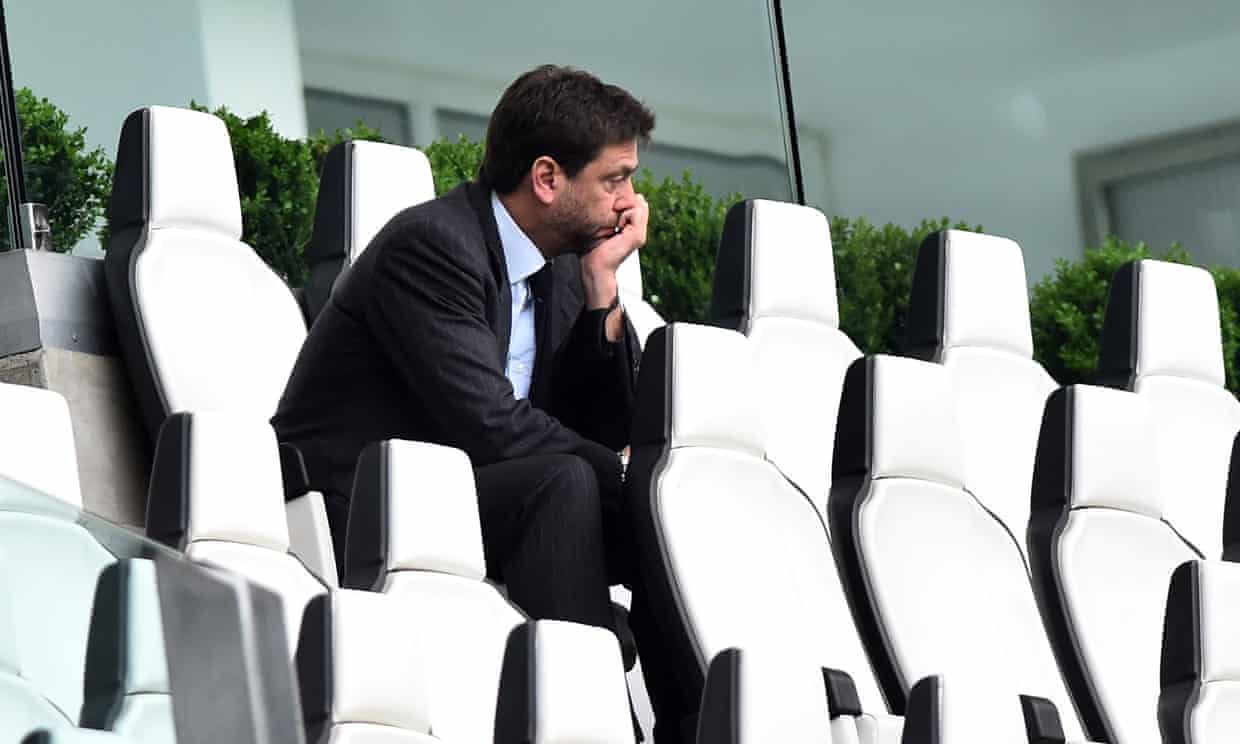
Andrea Agnelli at the Allianz Stadium in 2021. Photograph: Massimo Pinca/Reuters
To its detractors, the club’s unofficial motto sums up its dubious mentality: “Winning is not important; it’s the only thing that matters.” The slogan was coined by Giampiero Boniperti, a former Juve player who went on to become chairman. Between 1946 and 1961, Boniperti scored 178 goals for Juventus but, because of the Italy-wide cap on salaries, his pay packet didn’t reflect his true value. To circumvent the regulations, Gianni Agnelli offered to give Boniperti, the son of farmers, a cow for every goal he scored. One day, the farmer who sold the cows to Agnelli phoned him to complain: Boniperti always chose a cow that was in calf. Typical Juventus.
There have been many other crises and scandals. In 2004, the club doctor was found guilty of having supplied performance-enhancing drugs to players during the late 1990s, years in which the club was spectacularly successful (the conviction was overturned on appeal). In 2006, it was revealed that Juventus was the ringleader in a system of influencing referees that involved several top teams (a scandal known as Calciopoli). The club was duly relegated to Serie B. Ten years later, the suicide of the club’s supporter liaison officer, Ciccio Bucci, led to an investigation that revealed Juventus had been supplying tickets to hardcore fans, or ultras, despite their links to organised crime.
Italy is divided between those who see Juventus as arch-cheaters and those who believe the club is always singled out by resentful and biased magistrates. As Herbie Sykes writes in his book, Juve!: “Italian football is essentially binary, so there’s a Juventus version and an anti-Juventus version.” The debate was precisely summarised by an exchange I overheard in a bar in January, on the day the points deduction was announced.
“It wasn’t only Juventus,” said a fan, referring to the plusvalenze scandal.
“No,” his friend replied. “But it is always Juventus.”
After the Calciopoli scandal in 2006, Juventus fought their way back to Serie A. In May 2010, Andrea Agnelli, grandson of Edoardo, became chairman and he slowly took the club back to the summit of Italian football. Key to the club’s resurgence was Agnelli’s decision to hire Beppe Marotta as CEO and sporting director. Marotta arrived from stints at smaller Serie A clubs, where he’d gained a reputation for brilliance in the transfer market and in managing the interpersonal dressing room dynamics on which successful squads are built. Soon afterwards, Antonio Conte became manager and under his guidance, followed by that of Max Allegri, sporting triumphs ensued. Starting in the 2011-12 season, Juventus won Serie A nine times in a row.
Agnelli appeared even more successful on the financial side. A new stadium had been opened in 2011, with naming rights sold for €75m before construction had even begun, in 2008. (In 2017, naming rights were sold again to the German finance giant Allianz.) Agnelli believed that the club could bring in fresh sources of revenue if it reinvented itself as a lifestyle brand, whose signature would be the letter J. Near the stadium, the club built the J-Museum, the J-Medical and began further developments under the J-Village Property Fund, which oversaw a J-Hotel, the J-TC, a training centre, and so on. In 2012, Jeep became the club’s most important sponsor. In 2017, the club unveiled a distinctive new logo: two black lines on a white background forming a stylised J. During those heady years, supermarkets, school playgrounds and sports centres were full of J-slippers, J-backpacks and J-shorts.
Agnelli was also a rising political power in European football. In 2017, he became president of the European Club Association, an organisation representing 234 member-clubs across the continent. Among other things, the ECA was in constant negotiation with Uefa, the governing body of football in Europe, to wring out more cash for clubs involved in the Champions League. As Agnelli talked with his Uefa counterpart, the Slovenian Aleksander Čeferin, the two developed a friendship. They became so close that Agnelli asked Čeferin to be godfather at his daughter’s baptism in the Vatican.
But in the summer of 2018 Agnelli made a decision that would have catastrophic consequences for the finances of his club. In April, Juventus had lost at home to Real Madrid in the Champions League. Cristiano Ronaldo had scored two goals, one an overhead kick so gravity-defying it was applauded by the entire stadium. Juve had reached the Champions League final in 2015 and 2017, and Agnelli was fixated on winning it. He decided the only way was to bring Ronaldo to Juventus. He convinced himself that investing €116m to buy Ronaldo made both sporting and financial sense. Marotta, the man responsible for the club’s transfer policy, fiercely disagreed. He was wary of wages getting out of control and feared Ronaldo’s domineering personality would upset the dynamic in the changing room. Agnelli got his way. In July 2018, Ronaldo arrived at Juventus and, a few months later, Marotta left.
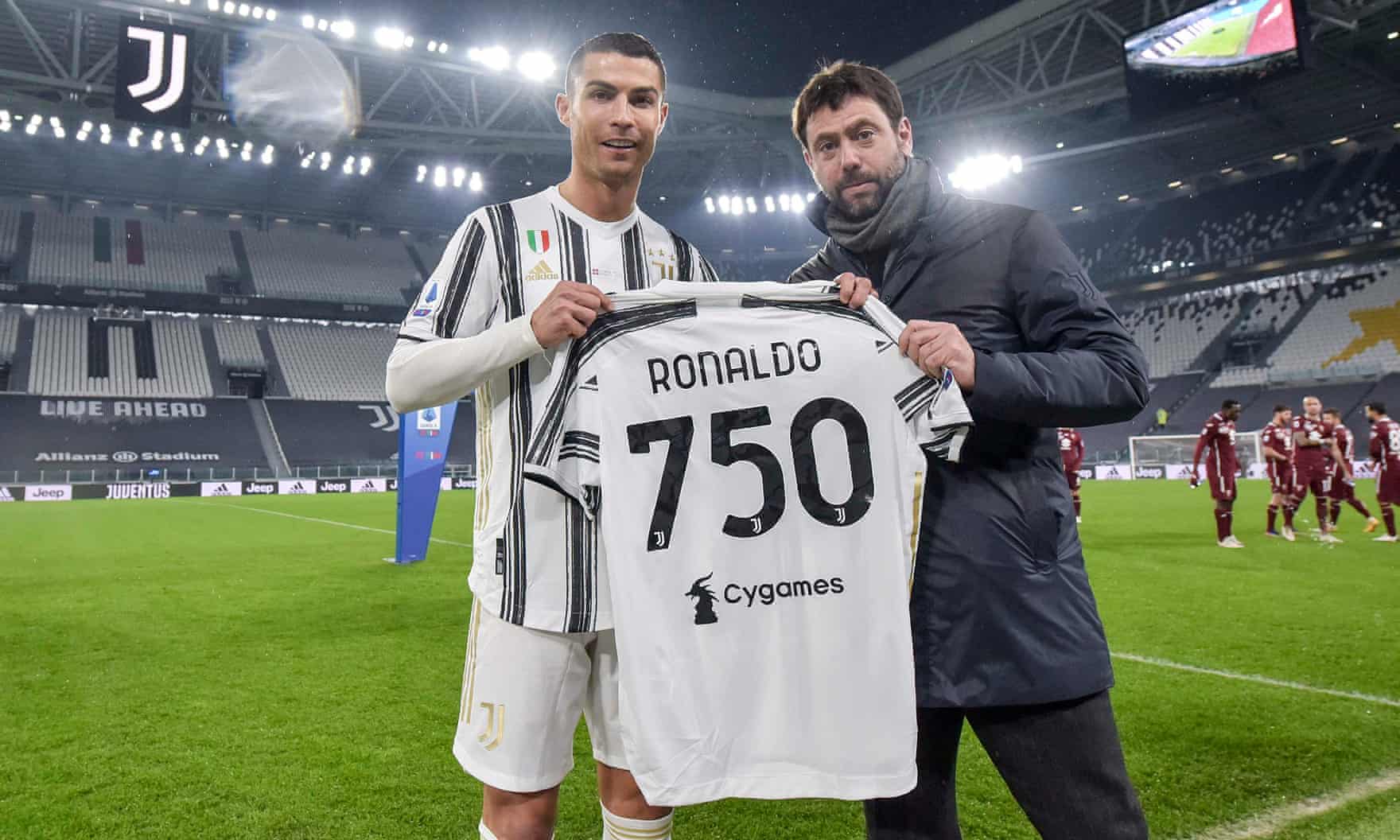
Agnelli gives Cristiano Ronaldo a T-shirt in December 2020 for the 750 goals of his playing career. Photograph: Daniele Badolato/Juventus FC/Getty Images
Ronaldo’s time at Juventus wasn’t unsuccessful: he scored 101 goals in 134 appearances, winning Serie A twice. But the Champions League remained elusive, and the financial effect on the club was devastating. “It was a huge error,” Cobolli Gigli told me. “An example of a system being drugged by money in order to chase sporting results, which are always subject to chance.”
“That was the sliding doors moment,” says an executive of an Italian football club who asked to remain anonymous. “There was an inflationary effect on wages.” Ronaldo’s gross salary cost Juventus €54.24m a year, a sum that surpassed the entire wage bill of many smaller Serie A clubs where players earn €1m-2m a year. The effect was exactly as Marotta had predicted. According to a report by Deloitte, the percentage of Juve’s revenue spent on wages shot up from 66% in 2018 to 84% in 2022. Another estimate, from the influential football-and-finance site Swiss Ramble, suggests that, by different calculations, that ratio is now as high as 92%.
“The biggest problem in football finances,” says Roger Mitchell, founding CEO of the Scottish Professional Football League and now a sports-brand consultant based in Italy, “isn’t the top line, it’s the cost line, the player-wages line. And 92% is at least 20% higher than where it should be.”
With revenues bound to fluctuate according to results and qualification for lucrative competitions like the Champions League, such a high wage bill was an obvious hostage to fortune. And when the pandemic arrived, Juventus was especially vulnerable.
“The pandemic was a tragedy for everyone,” Alessio Secco, a former Juventus sporting director, told me. “But for those who had toyed a little with fate, it created enormous difficulties. The knots,” he said, using a phrase that implies chickens coming home to roost, “came to the comb.”
In November 2018, Marotta’s protege had taken over as the club’s sporting director. Fabio Paratici had been an itinerant player in the lower leagues, starting out in the Piacenza youth team and eventually playing for 12 different clubs. He was a man who had endured adversity. In 1994, he suffered career-threatening injuries in a car crash but he recovered and continued to play for another decade.
But it was only after his playing career ended that Paratici’s football career took off. His luck turned in 2004, when he was appointed by Marotta to be head scout at Sampdoria. Surrounding himself with dozens of TVs that showed games from around the world, Paratici built a youth team that won “the triple” in the 2007-08 season: the youth-team Scudetto, the Italian Cup and the Supercup. In 2010, he moved to Juventus with Marotta, and when his mentor left in 2018, Paratici was the obvious successor. “He was very charismatic,” a Juventus insider told me, “very sociable. He was a fun guy, smiling all the time. You could tell he enjoyed the high life, being part of the glitterati, surrounded by beautiful women.”
The good times came to an end in the spring of 2020, when Covid struck. Between 9 March 2020 and 20 June there were no matches in Serie A, meaning no matchday revenue through ticket sales. Even worse from a financial point of view, broadcasters began demanding renegotiations, or rebates, on TV deals. With Juventus’s wages now devouring so much of the club’s dwindling revenue, Paratici asked players to take a pay cut. On 28 March 2020, Juventus formally announced that its playing staff had renounced four months of wages, implying a saving for the publicly quoted company of around €90m. But before the announcement was made, the club and its captain, Giorgio Chiellini, secretly signed an agreement whereby the club promised to pay in full three of those four months at a future date. In a bilingual message to the players’ WhatsApp chat, Chiellini explained this smoke-and-mirrors trick to his peers: “Juventus will make a press release where it will say that we are waiving four months’ salary to help the club, I reiterate to communicate only this in the press … For stock market legislative reasons … you’re asked not to speak in interviews about the details of this [private] agreement.”
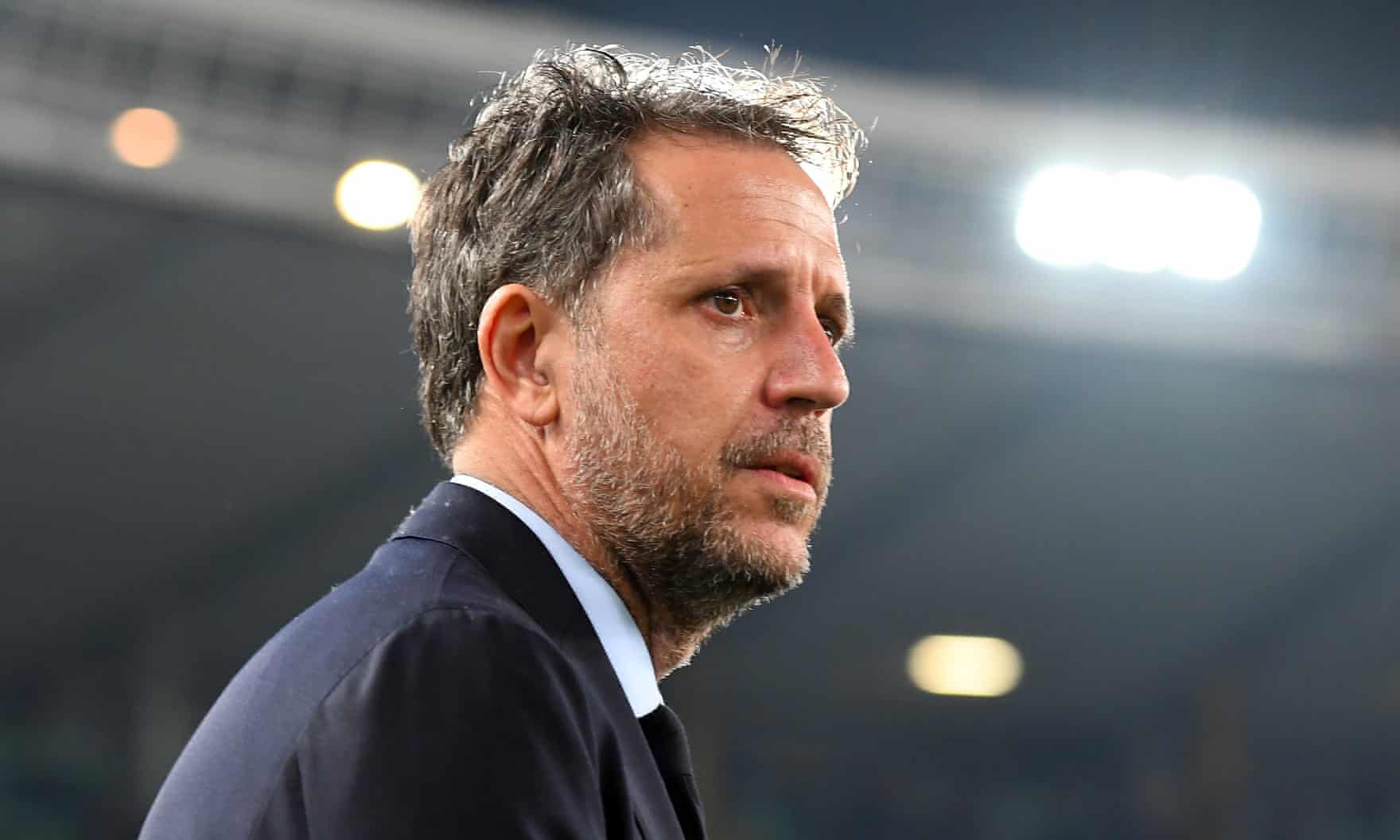
Fabio Paratici at a Juventus game in February 2020. Photograph: Alessandro Sabattini/Getty Images
Now that Covid had created a hole in the Juventus accounts, Paratici began systematically using player exchanges to increase the revenues of the company without actually receiving any money, an accounting technique called plusvalenze incrociate (exchanged or crossed capital gains). The system worked because, as with modern art, it’s notoriously difficult to put an accurate figure on the value of a football player. If two clubs could agree to sell to each other players that were officially, on the balance sheet, worth €1m for 10 times that amount (for €10m), each could record a capital gain of €9m, and add to their books a new asset reportedly worth €10m. It might have been questionable, but it wasn’t illegal: who was to say that a young player hadn’t increased in value ten-fold? After all, the market undervalues emerging players all the time.
Plusvalenze was not new – it had been a common practice throughout Italian football prior to Covid. In his book Il Calcio del Futuro (The Football of the Future), Carlo Diana, a former Juventus marketing manager, writes of Italian football being “close to declaring bankruptcy”, and describes how the industry “has been sustaining itself for years thanks only to plusvalenze”. The pressure to disguise losses through inflated capital gains seemed to have come from the very top: in an email to Paratici, and other colleagues, on 22 February 2020, Andrea Agnelli urged his staff to “contain losses” through “corrective actions”.
But after the Covid crisis, Paratici began incessantly swapping players with other clubs for allegedly inflated amounts. In the transfer window of the summer of 2020, the Bosnian midfielder Miralem Pjanić moved from Juventus to Barcelona for €60m, while the Brazilian midfielder Arthur Melo moved the other way for €72m. Both figures seemed to hugely overestimate the players’ value. These kinds of deals, of which there were many more, seemed to be win-win. As Paratici said in a wire-tapped phone call to the director general of Pisa in September 2021: “If all goes well, there will be loads of money for everyone.” The practice had become so embedded that, in wiretapped conversations, Juventus directors began asking their auditors advice about how to supercazzolare (befuddle) inspectors at the national Italian stock-exchange.
The transfers often seemed to have nothing to do with football. In some cases, Juventus are accused of having decided the value of capital gains required and only then chosen which player suited the sum. In the words of the FIGC’s initial judgment, Juventus “systematically planned the realisation of capital gains regardless of the identity of the subject to be exchanged, often indicated with a simple ‘X’ in place of the name of the Juventus player to be sold”. The judgment also recorded surprise that almost everyone at the club appears to have known about the practice.
In May 2021, the public prosecutor in Turin opened a secret investigation – known as Prisma – into the club’s finances. The investigation discovered that Juventus had undisclosed debts to various clubs, players and agents. One club executive admitted to investigators: “There’s €7m in debt with Atalanta that has never been entered in the balance sheet.” One agent was owed €400,000. The club’s debts to players who were owed months of salary became a form of “credit bondage” whereby the money owed could be used as an incentive to stay, with unpaid salaries being rewritten as a “loyalty bonus”. A secret document was unearthed in which Paratici, in July 2021, had written an IOU to Ronaldo for a figure believed to be €19.9m for another round of secretive salary payments during the 2020-21 season.
In response to a list of questions put to Juventus for this article, the club said that it would not be possible to interview Agnelli, and sent over links to its press releases on these matters. In a press release dated 12 April 2023, Juventus announced that “the company believes that it has correctly applied the relevant international accounting standards and that it has acted in full compliance with the principle of fair play”.
By 2021, it was clear that Juventus was struggling to keep afloat. For years the club had enjoyed cheap credit as interest rates were near zero, but as inflation and borrowing costs rose, the debt-ridden club found itself in ever-greater difficulty. There was, thought Agnelli, a quick fix: if Juventus and other European so-called super-clubs could create a “super league”, revenue might not only increase but actually be guaranteed. Instead of the exciting jeopardy of Champions League qualification, in a putative European Super League the 12 founding members – including six from England: Liverpool, Tottenham Hotspur, Manchester City, Manchester United, Arsenal and Chelsea – would never be knocked out. With a €3.5bn loan from JP Morgan to be shared among the clubs, the plan would have instantly blown away Juve’s cashflow problems.
News of the Super League broke in April 2021 and it quickly became a PR disaster for Agnelli, Juventus and just about everyone else involved. The secrecy of the plan made it seem sneaky, and the closed-shop nature of competition, albeit with six additional places up for grabs each year, made the clubs appear arrogant. “When you’re making change in sport,” says Roger Mitchell, “the trick is humility. You need to say you respect the past and so on. But with the Super League, the comms were horrible.”
Since the proposed Super League would have ended outright Uefa’s iconic competition, the Champions League, it was a direct assault on Uefa – and Čeferin felt personally wounded by his friend’s betrayal. In a hastily arranged press conference in April 2021, Čeferin denounced the “disgraceful, self-serving proposal” and talked about the clubs’ “greed, selfishness and narcissism”. He compared Agnelli to a “snake” and, later, a “vampire”.
The very public spat between Uefa and the Super League became a personal battle between their respective figureheads, Čeferin and Agnelli. The former had been brought up in humble surroundings in Slovenia. A lean strategist, Čeferin easily out-manoeuvred Agnelli, playing the part of the common man to perfection. “We will not allow them to take football away from us,” he said, encouraging fan protests across the continent. By contrast, Agnelli appeared privileged and elitist. “He looked like a trust-fund baby,” says Mitchell.
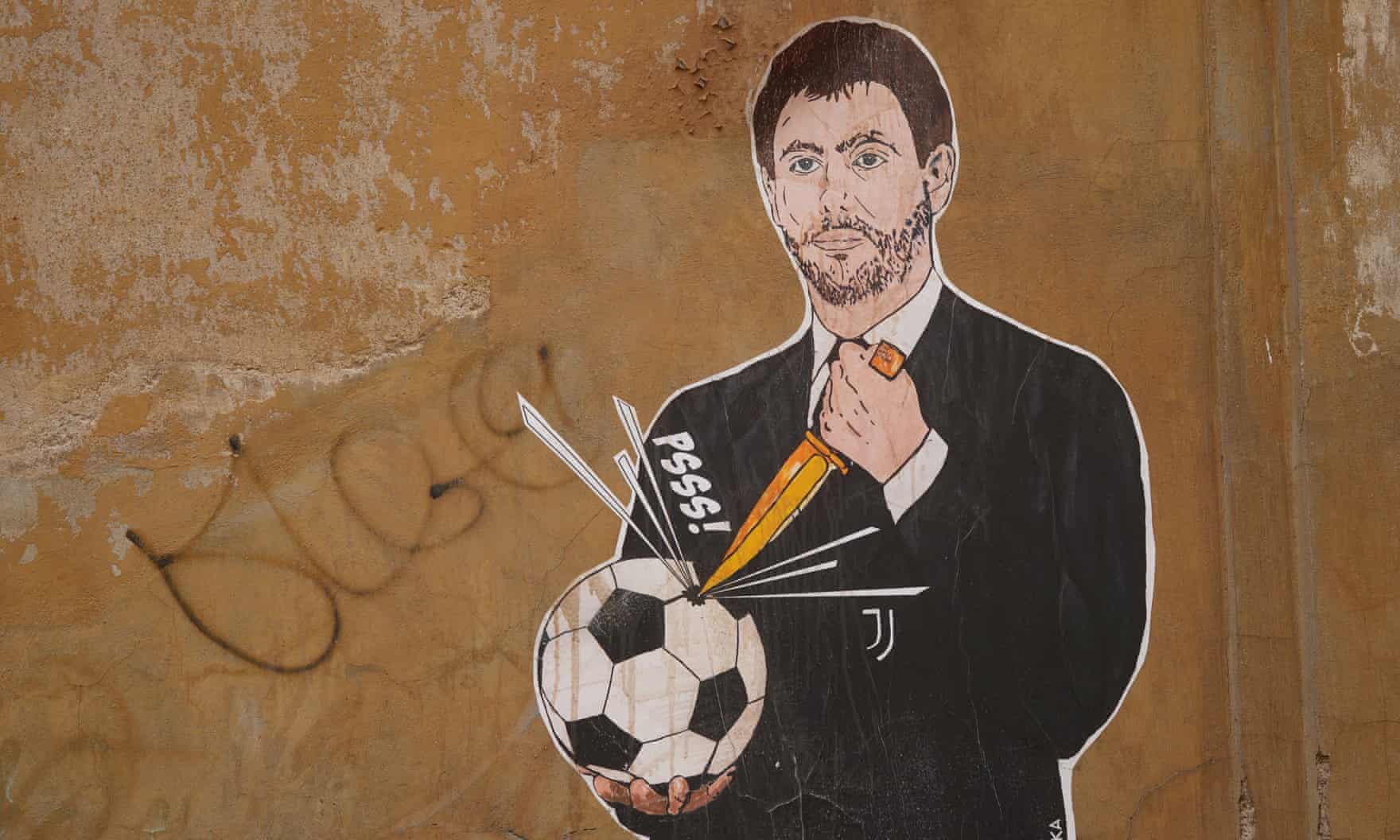
Within days of its midnight launch, the Super League brand had become toxic. Wavering clubs – Paris Saint-Germain and Bayern Munich – backed Uefa, and the English clubs began hastily withdrawing and apologising to their fans. For years Agnelli had exuded an aura of patrician professionalism, but now he appeared incompetent. A spray-painted picture of him stabbing and deflating a football in Rome was widely shared on social media: to his critics, he was the man who wanted to kill the sport.
A mural seen in Rome around the time of Juve’s links with the European Super League, depicting Agnelli stabbing a football. Photograph: Andrew Medichini/AP
For those who had worked at Juventus, the Super League fiasco was no surprise. According to various sources who spoke to me on condition of anonymity, the workplace was always dysfunctional. “Agnelli thinks he’s a visionary,” one former executive told me, “but he’s a sociopath. A complete control freak.”
With the prospect of Super League cash gone, Agnelli was desperately trying to find ways to generate income. In September 2021, he hosted a power-lunch for the bosses of the FIGC, Serie A and of various other clubs in an attempt to persuade them to create a media company to handle the broadcast rights for Serie A. “I hope something emerges from this,” he confided to the director general of Atalanta after the meeting, in a wiretapped conversation, “otherwise I don’t know what to do … we’re slowly going to crash.” Shortly afterwards, the club was forced to return to shareholders for a recapitalisation: having already sought a cash injection of €298m in December 2019, in December 2021 they raised a further €400m from shareholders.
There was also increasing disquiet within the club about plusvalenze. One executive was recorded by investigators saying: “I swear, I’ve had evenings in which I go home and I feel sick just thinking about it.” The practice of buying and selling players purely for bookkeeping reasons was taking its toll on the team, too. The team’s manager, Max Allegri, was furious at the incessant churn: “Last year’s transfers were only about plusvalenze, and so it was a fucked-up market,” he complained in a wiretapped conversation.
“With Fabio [Paratici] there’s no reasoning,” one executive said to a colleague in another recording. “For as long as Marotta was there he could put brakes on him, but once he left, Fabio had carte blanche. He could wake up in the morning and sign €20m without anyone saying anything.” Paratici, who declined to be interviewed for this article, eventually left Juventus in May 2021.
In the immediate aftermath of Agnelli’s resignation last November, Juventus announced that it had revised its accounts, admitting that it had underestimated losses for the 2020-21 year by €21m, bringing its official losses to €226.8m. “The financial statements of Juventus,” the FIGC wrote in its ruling against the club in January, “are simply not reliable.”
Agnelli was banned from involvement in Italian football for two years; Paratici, the man at the centre of the scandal, was banned for two and a half. Fifa, the governing body of global football, has since extended that ban worldwide. (After losing his appeal earlier this month, Paratici resigned from his role as managing director of football at Tottenham Hotspur, the club he joined in summer 2021.) Juventus has announced that the company“trusts it will be in a position to demonstrate the correctness of its conduct” at the plusvalenze retrial, which will take place at the end of May.
There is no possibility that Juventus will go bust: 63.8% of its shares are held by the financial giant Exor, which is owned by the Agnelli family and which enjoyed a net income in 2022 of €6.2bn. But the crisis is likely to become even more acute in the coming months. The next hearing into the criminal case will take place on 10 May and Uefa might also intervene, with powers to impose transfer embargos, financial penalties or even exclusion from Uefa competitions.
Those who defend Juventus point out that it is subject to far more scrutiny, not just because it is the country’s most famous club but because, as one of only two publicly listed companies in Serie A (the other being Lazio), it is subject to different rules and increased scrutiny. “It’s a real encumbrance to have to work in a publicly traded club,” said Secco. “All the other football clubs that are not publicly listed companies have a greater freedom of action, and a big advantage, compared to those that are.” Most observers feel it’s inevitable that Juventus will be delisted in coming months to avoid such restrictions and burdens; but buying out all other shareholders is likely to be an extremely expensive operation for Exor.
In February, Juventus supporters complaining of bias were given extra ammunition when footage emerged from 2019 in which Ciro Santoriello, who would go on to become one of the Prisma investigators, joked about being a Napoli fan who “hates Juventus”. “If the system wants to bring down a protagonist it can always create a scandal,” Carlo Diana, the former Juventus marketing manager, told me wearily.
Juventus’s club crest outside its stadium. Photograph: Massimo Pinca/Reuters
Many Juventus insiders believe that, although he came up with the wrong answers, Andrea Agnelli was actually asking the right question: how can Italian football increase revenue to make it competitive once more? Juve’s crisis lays bare the financial predicament in which most Italian football clubs now find themselves. There’s a vicious circle of low investment, which makes it hard to attract or retain the very best players, which makes it impossible to sell media rights at top rates, which means there is low investment, and on and on. “The product just looks awful,” says Mitchell. “The stadiums are dreadful, the empty stands look horrible, the football is two gears slower than in Spain or England.” A law that limits the sale of broadcast rights to short-term deals means that investors have no incentive to nurture the long-term development of the product.
The collapse of TV rights sales has brought many Italian clubs to the brink of bankruptcy. In the 2021-24 cycle, the foreign rights to Serie A were sold for $658m (£529m) compared with (in the 2022-25 period) the Premier League’s $6.55bn or (for the 2018-24 period) La Liga’s €4.48bn. With current income from foreign media rights now so low, Serie A clubs are exploring selling a share of future revenues to investors. In June 2022, Barcelona, another club caught up in the spending arms race and now €1.1bn in debt, sold 25% of the club’s TV rights until 2047 to an investment firm.
Football finance experts are aghast at the prospect, likening the move to taking out a second mortgage. “It’s always jam today, pay tomorrow,” says Mitchell. Like many others, he uses the language of addiction to describe clubs’ desperate search for cash. “These deals,” he wrote recently on his consultancy business’s website, “are like giving a junkie 10 bags of cash with the request that they go and get a hot meal. You know what is really going to happen.” Rather than investing in infrastructure, the money will go on players and agents in the never-ending quest for sporting success.
Secco, the former Juventus sporting director, points to subtle, almost anthropological reasons for the current crisis: “Football in Italy,” he says, “has always been a party, something that allowed you to escape the conditions of your life. Football was outside all the stipulations for other activities, it was never given to accounting rigour. It wasn’t even a business. Deals are still done in a hotel or a restaurant, and that’s part of the conviviality that is in Italians’ nature.” Until very recently, football teams in Italy were consciously un-businesslike: they were loss-making clubs subsidised by a local entrepreneur or, in Juventus’s case, a global one.
The Juventus crisis illustrates the fraught and evolving relationship between sport and finance. It was once a point of principle that all sport was amateur, “more Corinthian than capitalist”, as Mitchell says. Precisely what made sport appealing – its ludic scorn for worldly concerns, its relishing of risk and uncertainty and underdog surprises – rendered it unappealing to investors who demand predictable returns. The traditional European model – embodied by the Agnellis – was patrician largesse: when winning championships was “the only thing that matters”, no one cared how much money they lost. The most generous interpretation of Andrea Agnelli’s downfall is that, despite his best efforts, he remained an amateur in a sport that is now peopled by pros. A less generous one is that, like a profligate aristocrat, he never learned to cut his coat according to his cloth, and when he realised the scale of the problem he faced, his solutions only led his club further into the mire.
[ad_2]
#feel #selling #soul #crisis #Juventus
( With inputs from : www.theguardian.com )
Annette Herfkens and her fiance, Willem van der Pas, had been together for 13 years when he booked them on to a flight from Ho Chi Minh City to the Vietnamese coast. After six months of working in different countries, it was meant to be a romantic break. Van der Pas was a banker, Herfkens a trader. The plane was tiny, just 25 passengers and six crew. Being claustrophobic, Herfkens initially refused to board. To placate her, Van der Pas – “Pasje” as he was to her – fibbed that it was only a 20-minute flight. But 40 minutes had gone by when the plane dropped sharply. Van der Pas looked at her. “This I don’t like,” he said nervously. The plane dropped again. He grabbed her hand – and everything went black.
When Herfkens came to, the sounds of the Vietnamese jungle were coming through a jagged hole in the fuselage. The plane had crashed into a mountain ridge. A stranger lay dead upon her. Pasje, a little way off, lay back in his seat, also dead, a smile upon his lips.
“That’s where you have fight or flight,” says Herfkens. “I definitely chose flight.”
The next thing she knew, she was outside in the jungle. She still doesn’t know exactly how she escaped the plane, remembering the experience mostly in pictures, an instinctive sensory edit – she has worked hard to forget the smells.
Annette Herfkens with Willem van der Pas in Peru, 1983.
She sounds matter-of-fact, but she has had time to become analytical about her behaviour: the crash happened 30 years ago, in November 1992. “That’s probably self-protection,” she says now. She is speaking on a video call from her holiday home in the Netherlands (she is Dutch, but usually lives in New York). “It must have been excruciating pain to get out of there.” First there was “the emotional pain of seeing Pasje dead”, and then the physical pain: 12 broken bones in her hip and knee alone; her jaw was hanging; one lung had collapsed. “So I must have crawled out of the plane and lifted myself down. And then I must have crawled another 30 yards” – away from the wreckage.
The most vivid image from the hours that followed the crash, and from the subsequent eight days Herfkens spent in the jungle with the moans and cries of her fellow survivors slowly silencing,was of being “surrounded by leaves”. Green and golden, sequinned with dew, sunlit through her eyelashes. Time and again, Herfkens turned her focus on them, their light, their colours, movements, away from the man beside her, now dead, away from the white worm crawling out of his eyeball and the leeches on her own skin.
“If you accept what’s not there, then you see what is there,” she says. She calls this idea the “elevator pitch” for her book, Turbulence: A True Story of Survival, as well as the film or TV series she is writing. (A famous actor wanted to make the film before Covid, but the project stalled in the pandemic.) “I accepted that I was not with my fiance on the beach … Once I accepted that, I saw what was there – and it was this beautiful jungle,” she says.
Beautiful? Did she really see it that way? Far from fearing the jungle, Herfkens says that since her escape she has sought it out in her mind. For three decades, it has been her “safe place”, somewhere to will herself back to at times of stress and emotional need or even in transcendent moments of meditation. But how could the very place her life had crumbled around her – her partner dead, along with the future they envisaged together – shift from being a place of peril to a haven?
For Herfkens, the transformation began in the hours immediately after the crash. While she lay injured and thirsty, waiting to be rescued, she thought of the bond markets. She had been working for Santander in Madrid, and had been the only woman on the trading floor. She also thought of her mother back in The Hague. It seems incredible, given that she had no food or water, but while she waited for the rescue party, who eventually carried her down the mountain on a hammock, what Herfkens did not think was that she was going to die.
“I stayed in the moment,” she says. “I trusted that they were going to find me … I did not think: ‘What if a tiger comes?’ I thought: ‘I’ll deal with it when the tiger comes.’ I did not think: ‘What if I die?’ I thought: ‘I will see about it when I die.’” She describes this experience of “moment after moment after moment” as mindfulness before its time, before we all knew the word for it.
In some ways, this mindfulness was foisted upon her by her body. When, after a couple of days, the man who had been beside her died, Herfkens realised she was alone in the jungle. “And I had never been so entirely alone. I panicked.” Her collapsed lung made it hard to get the air in. She had to breathe intentionally. “And by breathing, I got back into the moment, back into the now.”
Herfkens, who now works as an inspirational speaker, has often thought about what enabled her to survive – why was she the only one to make it? Did her innate qualities somehow equip her? Over the years, she has come up with lots of explanations. “I was the youngest child – I grew up with a lot of love – but I was left alone. I didn’t have parents telling me what I should do and feel. So I developed instincts.”
‘That’s where you have fight or flight. I definitely chose flight’ … Annette Herfkens in hospital after the crash.
Herfkens thinks that she probably has attention deficit disorder and that if she were a child now “they definitely would have diagnosed me”. Growing up, she was reckless and forgetful, routinely mislaying her hockey stick. She learned to be “inventive and charming” and thinks that if she had “had Ritalin as a kid, I would never have developed the qualities I had for surviving the jungle”. (She has experience in this department, because her son, Max, 23, is autistic. Both of them tried Ritalin, but found it inhibited their sense of humour.)
Years later – after Herfkens married her colleague Jaime Lupa, moved to New York and had two children – friends of her daughter, Joosje, and their parents quizzed her on her experience in Vietnam. At dinner parties, she was a prized guest. Some – mostly the dads – pressed books about survival into her hands. Reading them, she realised that in the jungle, her behaviour had been textbook. “I did all the right things,” she says.
She knew she needed water, for instance, so she made a plan. “That’s what they always say – make a plan. I divided it into achievable steps.” From where she lay, she could see the aeroplane’s broken wing, and thought that the insulation material “could work like a sponge”. She propelled her body along on her elbows, damaging them so badly that they would later need a skin graft, until she could reach the tufty fibres. The pain was so great that she fainted. But by then she had eight little balls of the stuff. She needed only to “wait until it rained … and the little balls would fill up with water … Every two hours I would take a sip.” And then – a pattern she follows to this day – “I congratulated myself”, she says. “And that also makes you survive.”
When Herfkens came to write her book and pitch her film, she realised she didn’t only want to write about her own experience in the jungle. She also wanted to write about the people who helped her, the victims of the crash and about her son. “I went to Hollywood and they said: ‘It has to be all about you,’” she says. It felt counter to the qualities that saved her: “I really think that why I survived is because I got over myself,” she says. “You get over your little self, then you get your instinct to work, then you get to connect with other people and then you achieve stuff.”
When her son was diagnosed with autism at two, she found it helpful to apply what she had learned in the jungle to her life in New York. Herfkens felt the news as “a cold hand around my heart”, having read about some people’s experiences of autism – “the aggression … that you’ll never be able to connect to your child”.
“I went through the steps of mourning,” she says. “Because Maxi was typical. He was typical until 18 months. And then I started losing him. So he could say words, and he was very warm. He was very sweet. And then he was gone.” Bit by bit, he unlearned to talk; she felt him “slipping away”, and a very different child emerged from the one she thought she knew. “You have to mourn what’s not there,” she says. “But focus on what is there. With my son, that’s what I did.”
She connected with other parents who had children with autism, and began to see the world around her differently. She noticed groups of volunteers gathering at the corner of Central Park to run with people with disabilities. “It’s this little world. And you pass it. And you don’t give it a second thought. And then all of a sudden you are in this community.”
Remnants of the 1992 crash.
With her daughter’s friends’ families, conversation revolved around Upper East Side schooling and the best universities. “Then I was in this other world at the same time.” Her circle widened, diversified. “There were many black autistic boys in our circle, and it was so important to the mothers to teach them that when the police came, they had to keep their hands out of their pockets.” The stakes felt frighteningly high. She took Max on dry runs to the police station, drilled him on how to behave if he was arrested. She began to feel greater compassion for the other parents she met, and more connected.
In the months after the crash, Herfkens, who was then 31, bounced back fast. Within three months, she flew back to her office in Madrid. But the legacy of the crash, the losses and traumas, have shaped the decades since. She clutches a water bottle wherever she goes, and still finds the taste of water “better than anything else”. When she flies, she tries to always sit in the front row, because the sight of another seatback reminds her of the weight of the dead body that landed on top of her. Small moments of trauma, such as a friend ordering Vietnamese food, sometimes ambush her.
Herfkens had specialised in developing markets, with a particular talent for “the most imaginative debt-cancelling transactions”, and it’s clear that this specialism helped her in what she calls properly “taking a loss”. She applied this approach in the jungle, to Pasje, and then later in relation to three miscarriages, to Max’s diagnosis and her divorce from Lupa, who died of cancer in 2021 on the anniversary of Van der Pas’s death. But what does she mean exactly? “It’s really feeling it. Really thoroughly taking it,” she says. “You learn from taking losses. It’s painful, and you do it.”
In trading, many people hold on to their positions even while the losses increase, she says. Say you buy shares at £10 and their value drops to £6. “On paper, you don’t feel the loss. But if you sell, instead of £10, you only have £6, so it hurts.” But then you can use the money to buy new shares that will rise beyond the initial £10. “You see? It takes an effort to actually accept the loss. It’s much easier to pretend that it didn’t happen. That’s very human. It’s the same with mourning. You cannot accept it if you don’t feel it … Be aware of it. Not just step over it.”
For Herfkens, survival is an ongoing process. These days, as well as writing her script and giving motivational speeches, she is a carer to Max. Mourning Pasje is “an everyday thing”, stitched into the fabric of daily life. She still uses his method to keep her T-shirts tidy, taking the whole pile out to take one out so they get less messy. “Those little things, you know?”
She has internalised him, her loss of him, and that too is a form of connection. Each year, she marks the anniversary of his death – now also the anniversary of her late ex-husband’s death – and counts each day for the next eight days, each sip of water, too. And then she buys herself a present. “I like treating myself,” she says. “I’m good at that.”
[ad_2]
#survive #sole #survivor #plane #crash
( With inputs from : www.theguardian.com )