Smokey Robinson’s first collection of new songs in 14 years is gorgeous, tender and utterly filthy – a concept album about sex called Gasms. Robinson, 83, admits he thought the title would be good for business. “When people think of gasms, they think of orgasms first and foremost … I tell everybody: ‘Whatever your gasm is, that’s exactly what I’m talking about.’” He bursts out laughing. Within seconds of meeting him, you can tell this is a man who’s done a hell of a lot of laughing, loving and living.
On the title track, Robinson sings about eyegasms, eargasms, the whole gamut of gasms. If there is any danger of missing the point, he throws in double entendres that verge on the single. He sings with the silky falsetto of yesteryear, the words perfectly phrased as ever. The album ranges from the exultant (“We’re each other’s ecstasy”) on Roll Around to the biological (“If you got an inner vacancy / Baby, then make it a place for me”) on I Fit in There.
It’s important for him to show that older people are still sexual beings, he says. “When I hear of grandfathers and grandmothers who are 60 years old being talked about as if you’re counting them out and putting them out to pasture, I think it’s ridiculous. This is a new era of life. I feel 50.” He has no intention of turning into an old man, whatever his age.
Smokey Robinson (front) and the Miracles, circa 1963. Photograph: Michael Ochs Archives/Getty Images
Has his attitude towards sex changed since he was a teenager? “I still feel the same way, only I’m wiser with it. When you’re young and you have those exploratory feelings about sex, you haven’t lived long enough to know the value of it. So yes, I have a different attitude to it, but I still feel sexual. And I hope I’ll always feel like that. OK, chronologically, I’m 83, but it’s not really my age.”
We are chatting on a video call. Robinson lives in Los Angeles with his second wife, Frances Glandney, a successful interior designer. But today he is in New York publicising Gasms. His hair is jet black, his eyes golden-green, his skin taut, his teeth Alpine white. The look might not be 100% natural, but it works. Even if he allowed his hair to grey, his teeth to yellow and his skin to sag, Robinson would be youthful – possibly more so. The voice, the energy, the enthusiasm and the smarts all make him young.
It’s impossible to overstate Robinson’s influence on soul music. He was part of the team at the launch of Motown (then Tamla Records) in 1959, with his great friend Berry Gordy, the founder of the Detroit label. Motown’s first No 1 on the Billboard Hot 100, Mary Wells’s My Guy, in 1964, was written and produced by Robinson. He has written numerous hits for other artists – The Way You Do (the Things You Do), Since I Lost My Baby, Get Ready and My Girl for the Temptations, Ain’t That Peculiar for Marvin Gaye, Don’t Mess With Bill for the Marvelettes, to name a few. Then there are the classics with his group the Miracles, including The Tears of a Clown (written with Stevie Wonder and Hank Cosby), The Tracks of My Tears (written with Warren Moore and Marvin Tarplin), I Second That Emotion (written with Al Cleveland). And the solo hits, such as Cruisin’ and Being With You. He is said to have written more than 4,000 songs. Oh yes, and he was vice-president of Motown.
Smokey and his second wife, Frances Glandney, at Elton John Aids Foundation’s academy awards party in March 2023. Photograph: Michael Kovac/Getty Images for Elton John Aids Foundation
Nobody wrote about love and desire like Robinson. You’ve Really Got a Hold on Me has one of music’s greatest first lines (“I don’t like you, but I love you”), while the lyrics to The Tears of a Clown (“Now if I appear to be carefree / It’s only to camouflage my sadness / And honey to shield my pride I try / To cover this hurt with a show of gladness”) show why Bob Dylan called him “America’s greatest living poet”.
William Robinson Jr was born in Detroit to working-class parents who had little money but plenty of love. His two sisters were born to the same mother, but different fathers. Although his parents divorced when he was three, they remained united as parents. “My mom used to say: ‘You’re going to have to take care of him after I’m gone, so you love him.’ I don’t know how she knew that. And my dad would say: ‘You gotta love your mom because she’s a great woman.’ Even though they couldn’t stay in the same room for five minutes together, they still promoted each other to me.”
By the age of four, his Uncle Claude had nicknamed him Smokey Joe. “If you asked me what my name was, I’d say Smokey Joe because I’m a cowboy. Even my teachers called me it.” Smokey Joe stuck till the Joe became surplus. When he was 10, his mother died. His older sister, Geraldine, and her husband, who had 10 children, moved into the family home and looked after him as if he was No 11, while his father lived upstairs. He was a bright, conscientious boy who planned to study dentistry until he discovered you had to dissect animals. That didn’t appeal, so he changed to electrical engineering.
His real dream was to become a singer. But, back then, he believed people from his background didn’t do that kind of thing.
‘I’m not as close to any man on earth as I am to Berry’: Smokey Robinson with Motown records founder Berry Gordy in LA, 1981. Photograph: Joan Adlen Photography/Getty Images
A couple of blocks away lived Aretha Franklin and her brother Cecil, another of his closest friends. When Robinson was 10, Diana Ross moved into his street with her family. He says his childhood was wonderful. “It’s beautiful to know we were kids playing together. And these people are some of the most famous people in the world now. We had such joy. I grew up in the hood, baby. And I mean the hood.”Franklin had a more privileged background. “Right in the middle of the ghetto there were two plush blocks, Boston Boulevard and Arden Park,that had lawns and big homes. Aretha lived on Boston Boulevard ’cos her father had money – he was one of the biggest preachers in the country. But it wasn’t like they were the rich kids. No, we just all played together. We stayed lifelong friends.”
They had singing competitions on the Franklins’ back porch, which Aretha and her sister Erma invariably won: “Erma was a helluva singer, too.” Most of his friends from then have died, too many when they were young – through drugs or violence. “When Aretha passed, in 2018, she was my longest friend I had who was still alive. I’d known Aretha since I was eight.”
One day, young Robinson went with his band, the Miracles, to see the managers of his hero, Jackie Wilson. They told him the band didn’t have a chance because he sang high, as did the Miracles’ female singer (Claudette Rogers, Robinson’s girlfriend, who went on to be his first wife and the mother of two of his three children), so their sound was too similar to that of the Platters, the world’s most popular band at the time, who also had a female singer and a male singer who sang high. But Berry Gordy happened to be there and he liked what he heard. He started to mentor Robinson and the Miracles, and they recorded a single, Got a Job.
Robinson started college. One day in class, he was listening to his radio when their single came on. “I went apeshit. I jumped up and ran out of class, and that was it for me. I said to Dad: ‘I want to quit college and try music,’ and he surprised me. He said: ‘You’re only 17 years old – you’ve got time to fail. If it doesn’t work out, you can go back to school.’”
Less than two years later, Motown was formed. “Berry sat us down and said: ‘I’m going to start my own record company. I’ve borrowed $800 from my family. We’re not going to just make black music – we’re going to make music for the world. We’re going to have great beats and great stories.’ As far as I’m concerned, there had never been anything like Motown before that time, and there will never, ever be anything like Motown again.” He’s got a point.
By the age of 19, he and Claudette were married. They remained so for 27 years, although he had affairs along the way. Were he and Franklin an item at one point? “No, just friends.” He smiles. “I do admit when I was about 15 I had a crush on her.” Who wouldn’t, I say. “Hehehe! Yeah, she was fine!” Did he and Ross have a thing? He pauses. “Yes, we did.” How long for? “About a year. I was married at the time. We were working together and it just happened. But it was beautiful. She’s a beautiful lady, and I love her right till today. She’s one of my closest people. She was young and trying to get her career together. I was trying to help her. I brought her to Motown, in fact. I wasn’t going after her and she wasn’t going after me. It just happened.”
Smokey with Mary Wilson, Diana Ross and Florence Ballard of the Supremes, 1965. Photograph: Michael Ochs Archives/Getty Images
What happened to them? “After we’d been seeing each other for a while, Diana said to me she couldn’t do that because she knew Claudette, and she knew I still loved my wife. And I did. I loved my wife very much.”
He looks at me and says this is what he was talking about earlier – understanding love. “You asked me what happened when we get older, and we get wisdom in life. I learned that we are capable of loving more than one person at the same time. And it has been made taboo by us. By people. It’s not because one person isn’t worthy or they don’t live up to what you expect – it has to do with feelings. If we could control love, nobody would love anybody. Nobody would take that chance. Why would you put your heart out there for somebody to be able to hurt you like that and make you able to have those feelings?”
I ask if he has heard the rumour about him and Ross. There is a story, I say, that you two are the real parents of Michael Jackson. “They say I’m the baby daddy?” His voice rises an octave.“Hehehehe! Hooohooho! They say Diana Ross and I had Michael?” Yes. “Oh my God! I never heard that one, man! That’s pretty good. That’s funny! That’s funny!”
I wonder if she has heard it. “I’m gonna call her and ask her.” He is still laughing. “That’s funny!”
Robinson has examined the complexities of love beautifully in his songs. But his understanding is by no means confined to sexual love. He talks about his love for his father; the brother-in-law who became his second dad; Aretha’s brother Cecil, who died at 50; Sam Cooke, who was 33; and Marvin Gaye, who was killed in 1984 by his father, aged 44. “I do miss them. I wonder what they would have been like were they alive today. Especially Marvin, man. Marvin and I were brothers, man. We hung out almost every day of our lives. To lose him at that age was a real blow … The last thing I ever expected to see him was dead.” And such a violent death? “Yes, exactly. He’d got into trouble with drugs when he died.”
Robinson also succumbed to addiction. Was he in trouble when Gaye was? “It was during and afterwards. My most dramatic bout with it was afterwards. During, we did it together. I just never got strung out. I was never a cocaine person then. I got involved with that after he died. And it took me out. It was the worst time of my life – a life experience I will never forget, but I will never do again.”
Had he been as close to Gaye as to Gordy? “No, I’m not as close to any man on Earth as I am to Berry. Berry is still my best friend. It was another kind of relationship. It was different because Berry’s never done drugs. Marvin and I had a different relationship – we were promiscuous, the same age. With Berry, you didn’t take any drugs around him. We all respected him. He was our leader, our boss. He just happened to be my best friend, too.
“Berry calls it a bromance,” he says. “We have a love for each other, man; we’re there for each other. When I was going through my heaviest part with the drugs, for two years I was damn near dead. It wiped me out. But Berry, man, during that time he’d bring me up to his house and lock me up there for a week or two. He’d just keep me there so I couldn’t keep doing what I was doing to myself. He looked after me.”
Robinson tells me that one night he walked into a church, met the minister and told her everything. He went in an addict and came out free from drugs. It was a miracle, he says. “That was May 1986 and I’ve never touched drugs since.”
One of his greatest Motown memories is Martin Luther King’s visit. “You know what he said to us? He said: ‘I want to do my “I have a dream” speech on Motown because you guys are doing with music what I’m trying to do politically – bring people together. You have united the races and the world with music.’”
In their earliest days, Robinson says, Motown’s acts played to segregated audiences – black kids on one side, white kids on the other. “We went back a year later and they were all dancing together. White boys had black girlfriends, black boys had white girlfriends, and it was all because of the music. We gave them a common love. So I’m really, really, really, really, really proud of that. About a year after we started Motown, we started getting letters from white kids in those areas: ‘Hey, man, we got your music, we luuurv your music, but our parents don’t know we have it because if they knew we had it they might make us throw it away.’ A year or so later, we got letters from the parents. ‘Hey, we found out our kids were listening to your music. We were curious, so we started listening to it. We luuurv your music. We’re glad the kids have it.’” He tells the story with such vim, but he looks emotional. “I’m so proud we started to break down barriers.”
Does he ever look back and wish he had become a dentist? He laughs. “No! I also had aspirations of playing baseball. I think about that all the time. I think I could have been the greatest player in the history of baseball and my career would have been over 50 years ago. If I’d been the greatest dentist in the world I’d have been retired for 20 years by now! But I was blessed enough to be in music, which gives you longevity if you love it, if you respect it.”
It’s all about keeping perspective, he says. “You’ve got to understand you didn’t start it and you ain’t gonna finish it and you don’t go getting a big head ’cos you’ve got a record out or people recognise you: ‘Oh, boy, I’m hot shit.’ ’Cos you’re not: you’re just a person who’s blessed enough to have your dream of being in showbusiness come true. I tell young people all the time: ‘Don’t go getting hoity-toity ’cos you’ve got a hit record, because this started way, way, way before your great-grandmother was born and it’s going to go on way, way, way after you. So you better know that!’”
Was there any danger of him getting hoity-toity? “No, I had a better upbringing than that. I was always taught that I’m human and that’s the best you can be. You don’t get no bigger than that on our planet.”
I ask a final question. What is his favourite gasm? “I guess if you’re gonna start at the world, you’d have to say God is my favourite gasm, but other than that, love is my favourite gasm. I wish love on the world.” And with that, the global minister for love leaves me brimming with the stuff.
Gasms is releasedon 28 April. For more information, go to smokeyrobinson.com
[ad_2]
#feel #sexual #Smokey #Robinson #love #joy #drugs #Motown #affair #Diana #Ross
( With inputs from : www.theguardian.com )
Maya Jones* was only 13 when she first walked through the door of Courtney’s House, a drop-in centre for victims of child sex trafficking in Washington DC. “She was so young, but she was already so broken by what she’d been through,” says Tina Frundt, the founder of Courtney’s House. Frundt, one of Washington DC’s most prominent specialists in countering child trafficking, has worked with hundreds of young people who have suffered terrible exploitation at the hands of adults, but when Maya eventually opened up about what she had been through, Frundt was shaken.
Maya told Frundt that when she was 12, she had started receiving direct messages on Instagram from a man she didn’t know.She said the man, who was 28, told her she was really pretty. According to Frundt, Maya told her that after she started chatting with the man, he asked her to send him naked photos. She told Frundt that he said he would pay her $40 for each one. He seemed kind and he kept giving Maya compliments, which made her feel special. She decided to meet him in person.
Then came his next request: “Can you help me make some money?” According to Frundt, Mayaexplained that the man asked her to pose naked for photos, and to give him her Instagram password so that he could upload the photos to her profile. Frundt says Maya told her that the man, who was now calling himself a pimp, was using her Instagram profile to advertise her for sex. Before long, sex buyers started sending direct messages to her account, wanting to make a date. Maya told Frundt that she had watched, frozen, what was taking place on her account, as the pimp negotiated prices and logistics for meetings in motels around DC. She didn’t know how to say no to this adult who had been so nice to her. Maya told Frundt that she hated having sex with these strangers but wanted to keep the pimp happy.
One morning three months after she first met the man, Frundt says that Maya was found by a passerby lying crumpled on a street in south-east DC, half-naked and confused. The night before, Maya told her, a sex buyer had taken her somewhere against her will, and she later recalled being gang-raped there for hours before being dumped on the street. “She was traumatised, and blamed herself for what happened. I had to work with her a lot to help her realise this was not her fault,” said Frundt when we visited Courtney’s House last summer.
Frundt, who has helped hundreds of children like Maya since she opened Courtney’s House in 2008, says that the first thing she now does when a young person is referred to her is to ask for their Instagram handle. Other social media platforms are also used to exploit the young people in her care, but she says Instagram is the one that comes up most often.
In the 20 years since the birth of social media, child sexual exploitation has become one of the biggest challenges facing tech companies. According to the United Nations Office on Drugs and Crime (UNODC), the internet is used by human traffickers as “digital hunting fields”, allowing them access to both customers and potential victims, with children being targeted by traffickers on social media platforms. The biggest of these, Facebook, is owned by Meta, the tech giant whose platforms, which also include Instagram, are used by more than 3 billion people worldwide. In 2020, according to a report by US-based not-for-profit the Human Trafficking Institute, Facebook was the platform most used to groom and recruit children by sex traffickers (65%), based on an analysis of 105 federal child sex trafficking cases that year. The HTI analysis ranked Instagram second most prevalent, with Snapchat third.
Grooming and child sex trafficking, though often researched and discussed together, are distinct acts. “Grooming” refers to the period of manipulation of a victim prior to their exploitation for sex or for other purposes. “Child sex trafficking” is the sexual exploitation of a child specifically as part of a commercial transaction. When the pimp was flattering and chatting with Maya, he was grooming her; when he was selling her to other adults for sex,he was trafficking.
Though people often think of “trafficking” as the movement of victims across or within borders, under international law the term refers to the use of force, fraud or coercion to obtain labour, or in the buying and selling of non-consensual sex acts, whether or not travel is involved. Because, under international law, children cannot legally consent to any kind of sex act, anyone who profits from or pays for a sex act from a child – including profiting from or paying for photographs depicting sexual exploitation – is considered a human trafficker.
Tina Frundt, the founder of Courtney’s House. Photograph: Melissa Lyttle/The Guardian
Meta has numerous policies in place to try to prevent sex trafficking on its platforms. “It’s very important to me that everything we build is safe and good for kids,” Mark Zuckerberg, Meta’s founder, wrote in a memo to staff in 2021. In a statement responding to a detailed list of the allegations in this piece, a Meta spokesperson said: “The exploitation of children is a horrific crime – we don’t allow it and we work aggressively to fight it on and off our platforms. We proactively aid law enforcement in arresting and prosecuting the criminals who perpetrate these grotesque offences. When we are made aware that a victim is in harm’s way, and we have data that could help save a life, we process an emergency request immediately.” The statement cited the group director of intelligence at the charity Stop the Traffik, who is former deputy director of the UK’s Serious Organised Crime Agency, who has said “millions are safer and traffickers are increasingly frustrated” because of their work with Meta.
But over the past two years, through interviews, survivor testimonies, US court documents and human trafficking reporting data, we have heard repeated claims that Facebook and Instagram have become major sales platforms for child trafficking. We have interviewed more than 70 sources, including survivors and their relatives, prosecutors, child protection professionals and content moderators across the US in order to understand how sex traffickers are using Facebook and Instagram, and why Meta is able to deny legal responsibility for the trafficking that takes place on its platforms.
While Meta says it is doing all it can, we have seen evidence that suggests it is failing to report or even detect the full extent of what is happening, and many of those we interviewed said they felt powerless to get the company to act.
The survivors
Courtney’s House sits on a quiet residential street on the outskirts of Washington DC. Inside, Frundt and her team have tried to make the modest two-storey house feel like a family home, with comfortable sofas and photos on the mantlepiece. Frundt, who was herself trafficked as a child in the 1980s and 90s, is now one of Washington DC’s most experienced and respected anti-trafficking advocates. Warm and ferociously protective of the children in her care, she is contracted by the city’s child protection services to identify trafficked children going through the court system, and she regularly attends court hearings for the youth in her care. She also helps train the FBI and local law enforcement sex-trafficking units on how to spot traffickers on online platforms, including Instagram. “When I was trafficked long ago I was advertised in the classified sections of freesheet newspapers,” Frundt told us. “Now my youth here are trafficked on Instagram. It’s exactly the same business model but you just don’t have to pay to place an ad.”
The children who are referred to Frundt, usually by the police or social services, have been sexually exploited and controlled: by a boyfriend, a pimp, a family member. Some of them are as young as nine. Almost without exception, they have childhoods scarred by sexual abuse, poverty and violence. This makes them perfect targets for sexual predators. “They are all looking for love and affirmation and a sense that they mean something,” said Frundt.
Almost all the young people who come to Courtney’s House are children of colour. They are, Frundt said, battling stereotypes that pressure them to become sexualised too early and make them vulnerable to traffickers. A 2017 study by the Georgetown Law Center on Poverty and Inequality found that adults typically regard Black girls as less innocent and more knowledgable about sex than their white peers. The same study showed that Black girls are often perceived to be older than they are.
Most of the time, Frundt says, the children who come to Courtney’s House are still being trafficked when they walk through the door. Even in cases where they have escaped their exploiters, she said, explicit videos and photos of them often continue to circulate online. Traffickers will lock victims out of their accounts, preventing them from taking down images posted to their profiles.
When we asked Frundt if she could show us examples of young people in her care who she says are currently being trafficked on Instagram, she pulled out her phone and scrolled through post after post of explicit images and videos of girls as young as 14 or 15. Most of the photos and videos seemed to have been taken by someone else. Frundt said that these posts were being used as a way of advertising the girls for potential sex buyers, who would send a direct message to buy explicit content or to arrange a meet up.
At one point, our conversation was interrupted by the arrival of five teenage girls. They had come back from school, and they gathered around the kitchen table, chatting and playing music on their phones while Frundt served them casserole. After they had eaten, we asked if we could talk to them about their experiences: had any of them been sexually exploited on social media or had explicit videos or pictures posted of them?
They glanced at each other and burst out laughing. Yes, they said, of course. All the time. One girl said she felt that “nobody at Instagram cares, they don’t care what’s posted. They don’t care shit about us.”
Frundt claims that she is constantly asking Instagram to close accounts and take down exploitative content of kids in her care. “I even have law enforcement calling me up asking, ‘Tina, can you get Instagram to do something?’. If Ican’t get Instagram to act, what hope is there for anyone else?”
When we put these concerns to Meta, a spokesperson said: “We take all allegations and reports of content involving children extremely seriously and have diligently responded to requests from Courtney’s House. Our ability to remove content or delete accounts requires sufficient information to determine that the content or user violates our policies.”
Frundt says that in 2020 and 2021 she had discussions with Instagram about conducting staff training to help prevent child trafficking on its platforms. She says the training didn’t go ahead as, after a long back and forth, on a video call Instagram executives said that they wouldn’t pay Frundt her standard fee of $3,000, instead allegedly offering $300. When we put this to Meta, they did not deny it.
The court documents and the prosecutors
What makes social media platforms so powerful as a tool for traffickers – far more powerful than the back pages of a newspaper in which Frundt was advertised as a teenager – is the way that they make it possible to identify and cultivate relationships with both victims and potential sex buyers. Traffickers can advertise and negotiate deals by using different features of the same platform: sellers sometimes post publicly about the girls they have available, and then switch to private direct messages to discuss prices and locations with buyers.
US court documents provide a graphic insight into how these platforms can be used. In one case prosecuted in Arizona in 2019, Mauro Veliz, a 31-year-old who was convicted of conspiracy to commit sex trafficking of a child, exchanged messages on Facebook Messenger with Miesha Tolliver, who also received jail time for sex trafficking. Tolliver told Veliz that she had one girl available for sex, and photographs of two more, before saying that the girls were aged 17, 16 and 14.
Veliz: “How much is it for all of them?”
Tolliver: “The 14 [year-old] will cost the most … a couple of hundred for her but [$] 150 for the rest”
The 14-year-old, Tolliver told Veliz, was “new to the sex game”.
Tolliver: “The 1 on the right … is 16 with a fat ass … the other [is] 15 with huge tits”
The court transcripts then state that multiple sexually explicit images of the girls were sent to Veliz.
Tolliver: “do you want me to bring 1 of the girls with me so you guys can fuck?”
[ … ]
Veliz: “is your girl nervous? Or have you told her yet?”
Tolliver: “… shes still young and doesn’t understand how ppl like it”
Tolliver and Veliz exchanged more messages, arranging for Veliz to meet the girl in a hotel in California two days later.
The final message submitted to the court was from Veliz to Tolliver. “We’re finished she’s in the restroom,” it said.
Luke Goldworm, a former assistant district attorney in Boston, Massachusetts, who has investigated and prosecuted human trafficking cases for years, says that he has encountered numerous exchanges like this one. From 2019 until he left the job in October 2022, he said, his department’s caseload of child-trafficking crimes on social media platforms increased by about 30% each year. “We’re seeing more and more people with significant criminal records move into this area. It’s incredibly lucrative,” he said. A trafficker can make up to $1,000 a night. Many of the victims he saw were just 11 or 12, he said, and most of them were Black, Latinx or LGBTQI+.
According to Goldworm, while his investigations involved every social media platform, Meta platforms were the ones he encountered most often. Six other prosecutors in several different states told us that, in their experience, Facebook and Instagram are being widely used to groom children and traffick children. Five of these prosecutors spoke of their anger over what they felt were Meta’s unnecessary delays in complying with judge-signed warrants and subpoenas needed to gather evidence on sex trafficking cases. “We get a higher rate of rejected warrants from Facebook than any other electronic service provider,” claimed Gary Ernsdorff, senior deputy prosecuting attorney for King County, Washington state. “What I find frustrating is that the exchange can delay rescuing a victim by a month.”
Three of these prosecutors described experiences where they say the company would cite technicalities, picking faults with wording and format, and slowing down investigations. In response, the company said that these claims were “false”, adding that between January and June last year, it “provided data in nearly 88% of requests from the US government”.
The responsibility for reporting
Meta acknowledges that human traffickers use its platforms, but insists that it is doing everything in its power to stop them. By law, the company is required to report any child sexual abuse imagery shared over its platforms to the National Center for Missing & Exploited Children (NCMEC), which receives federal funding to act as a nationwide clearing house for leads about child abuse. Meta is a major funder of NCMEC, and holds a seat on the company’s board.
From January to September 2022, Facebook reported more than 73.3m pieces of content under “child nudity and physical abuse” and “child sexual exploitation” and Instagram reported 6.1m. “Meta leads the industry in using the most sophisticated technology to detect both known and previously unknown child exploitation content,” said a company spokesperson. Of the 34m pieces of child sexual exploitation content removed from Facebook and Instagram in the final three months of 2022, 98% was detected by Meta itself.
But the vast majority of the content that Meta reports falls under child sexual abuse materials (CSAM) – which includes photos and videos of pornographic content – rather than sex trafficking. Unlike with child sexual abuse imagery, there is no legal requirement to report child sex trafficking, so NCMEC must rely on all social media companies to be proactive in searching for and reporting it. This legal inconsistency – the fact that child sexual abuse imagery must be reported, but reporting child sex trafficking is not legally required – is a major problem, says Staca Shehan, vice-president of the analytical services division at NCMEC. “It’s concerning across the board how little trafficking is being reported,” Shehan says. Social media companies “are prioritising what’s [legally] required”.
“I think everyone could do more,” Shehan says. “The volume of child sexual abuse material (CSAM) and volume of trafficking [being reported] is like apples and oranges.” According to Shehan, one further reason for this disparity, beyond the differing legal requirements, is technological. “Child sexual abuse material is that much easier to detect. There are so many technology tools that have been developed that allow for the automated detection of that crime.”
A NCMEC spokesperson told us that if social media companies are not reporting child sex trafficking, it allows this crime to thrive online. Reporting trafficking, they emphasised, is crucial for rescuing victims and punishing offenders.
Between 2009 and 2019, Meta reported just three cases as suspected child sex trafficking in the US to NCMEC, according to records disclosed in a subpoena request seen by the Guardian.
Meta founder Mark Zuckerberg in Washington DC in 2019. Photograph: Michael Reynolds/EPA
A spokesperson for NCMEC confirmed this figure, but clarified that a number of child trafficking cases during the same time period were reported by Meta under other “incident types”, such as child pornography or enticement. “I think one of the things to be aware of is that is that there’s sort of a singular tag that’s used for reporting,” Antigone Davis, head of global safety at Meta, emphasised to us in a recent interview. “And so just because something isn’t tagged as sex trafficking doesn’t mean that it isn’t being reported.”
A Meta spokesperson claimed that over the past decade, the company had reported “tens of thousands of accounts which violated our policies against child sex trafficking and commercial child sexual abuse material to NCMEC.” When we put these claims to NCMEC, it said that it had not received “tens of thousands” of reports of child trafficking from Meta, but had received that number related to child abuse imagery.
Hany Farid is a professor at the University of California, Berkeley who helped invent the PhotoDNA technology that Meta uses to identify harmful content. He believes Meta, which is currently valued at more than $500bn, could do more to combat child trafficking. It could, for instance, be investing more to develop better tools to “flag suspicious words and phrases on unencrypted parts of the platform – including coded language around grooming,” he said. “This is, fundamentally, not a technological problem, but one of corporate priorities.” (There is a separate debate about how to handle encryption. Meta’s plans to encrypt direct messages on Facebook Messenger and Instagram has recently drawn criticism from law enforcement agencies, including the FBI and Interpol.)
In response to Farid’s claims and further questions from the Guardian, Meta did not specify how much money it has invested in technologies to detect child sex trafficking, but said that it had “focused on using AI and machine learning on non-private, unencrypted parts of its platforms to identify harmful content and accounts and make it easier for people to report messages to the company so we can take action, including referrals to law enforcement”. Davis also emphasised that Meta constantly works with partners to improve its anti-trafficking safeguards. For instance, she mentioned that “we’ve been able to identify the kinds of searches that people do when they’re searching for trafficking content, so that when people search for that, we will pop up with information to divert them or to let them know that what they’re doing is illegal activity”.
These efforts have failed to satisfy some of Meta’s own investors. In March, several pension and investment funds that own Meta stock launched legal action against the company in Delaware over its alleged failure to act on “systemic evidence” that its platforms are facilitating sex trafficking and child sexual exploitation. By offering insufficient explanation of how it is tackling these crimes, the complaint says, the board has failed to protect the interests of the company. Meta has rejected the basis for the lawsuit. “Our goal is to prevent people who seek to exploit others from using our platform,” the company said.
The moderators
As well as software, Meta uses teams of human moderators to identify cases of child grooming and sex trafficking. Until recently, Anna Walker* worked the night shift in an office of a Meta subcontractor. She would start each shift filled with dread. “We were just, like, shoved in a dark room to look at the stuff,” she said.
Walker’s job was to review interactions between adults and children on Facebook Messenger and Instagram direct messenger that had been flagged as suspicious by Meta’s AI software. Walker claims she and her team struggled to keep pace with the huge backlog of cases. She says she saw cases of adults grooming children and then making plans to meet them for sex, as well as discussions about payment in exchange for sex.
Walker’s managers would pass on such cases to Meta to decide if action should be taken against the user. In some cases, Walker claims: “Months would pass and then the automatic bot would send me an email saying it was closing this case, because nobody’s taken action on it.” She added: “I would cry to my manager about [the children I saw] and how I want to help. But it felt like nobody would pay attention to these horrible things.”
We talked to six other moderators who worked for companies that Meta subcontracted between 2016 and 2022. All made similar claims to Walker. Their efforts to flag and escalate possible child trafficking on Meta platforms often went nowhere, they said. “On one post I reviewed, there was a picture of this girl that looked about 12, wearing the smallest lingerie you could imagine,” said one former moderator. “It listed prices for different things explicitly, like, a blowjob is this much. It was obvious that it was trafficking,” she told us. She claims that her supervisor later told her no further action had been taken in this case.
When we put these claims to Meta, a spokesperson said that moderators such as Walker do not typically get feedback on whether their flagged content has been escalated. They stressed that if a moderator does not hear back about a flagged case, that does not mean no action has been taken.
Five of the moderators claimed that it was harder to get cases escalated or content taken down if it was posted on closed Facebook groups or Facebook Messenger. Meta “would be less stringent about something taking place behind ‘closed doors’,” claimed one team leader. “With Messenger, we really couldn’t make any moves unless the language and content was really obvious. If it was four guys who trusted each other and it was in a group it could just live on for ever.” Meta said these allegations “appear to be misleading and inaccurate” and said it uses technology to find child sexualisation content in private Facebook groups and on Messenger.
Former Facebook data scientist Frances Haugen speaking at a Senate hearing on consumer protection, product safety and data security in Washington DC in 2021. Photograph: Alex Brandon/AP
In 2021, former Facebook employee and whistleblower Frances Haugen leaked internal documents that seem to support the moderators’ claims. These documents, which numbered thousands of pages, detailed how the company managed harmful content. In one memo from the Haugen leak, the company states that “Messenger groups with less than 32 people should be treated with a full expectation of privacy”.
Matias Cruz*, who worked as a content moderator from 2018 to 2020, reviewing Spanish-language posts on Facebook, believes that the criteria that Meta was using to recognise trafficking was too narrow to keep up with traffickers, who would constantly switch codewords to avoid detection. According to Cruz, traffickers would say: “‘I have this cabra [Spanish for goat] for sale,’ and it’d be some really ridiculous price. Sometimes they would just outright say [the price] for a night or two, or ‘an hour’.” It was obvious what was going on, said Cruz, but “the managers would claim it was too vague, so in the end they would just leave it up”.
Cruz and three other moderators we spoke to claimed that in examples like this, where their managers felt there was insufficient evidence to escalate the case, moderators could receive lower accuracy scores, which in turn would affect their performance assessments. “We would take negative hits on their accuracy scores to try to get some help to these people,” Cruz said.
The limits of the law
While the law requires Meta to report any child exploitation imagery detected on its platforms, the company is not legally responsible for crimes that occur on its platform, because of a law created almost three decades ago, in the early days of the internet. In 1996, the US Congress passed the Communications Decency Act, which was primarily intended to ensure online pornographic content was regulated. But section 230 of the act states that providers of “interactive computer services” – which includes the owners of social media platforms and website hosts – should not be treated as the publisher of material posted by users. This section was included in the act to ensure the free flow of information while protecting the growing tech industry from being crushed by litigation.
Whereas a newspaper, say, must legally defend what it publishes, section 230 means that a company like Meta, which hosts the content of others, may not be held liable for what appears on its platforms. Section 230 therefore positions internet service providers as fundamentally neutral: offering forums in which illegal, harmful or false content may be posted and circulated, but ultimately not responsible for that content. Since the passing of the act, tech companies such as Meta have argued successfully in courts across the US that section 230 provides them with complete immunity from prosecution for any illegal content published on their platforms, as long as they are unaware of that content’s existence.
The debate around section 230 has become highly polarised. Those who want section 230 amended say that the legal safe harbour it has provided for internet companies means they have no incentive to root out illegal content on their sites. In an op-ed published in the Wall Street Journal in January, President Biden spoke out in favour of the section’s reform. “I’ve long said we must fundamentally reform section 230,” he wrote, calling for “bipartisan action by Congress to hold big tech accountable.”
However, tech companies, along with internet freedom groups, argue that changes to section 230 could lead to censorship and an erosion of privacy, particularly for private, encrypted content. These arguments over section 230 are being put to the test in a landmark case that has reached the US supreme court, which focuses on how far YouTube can be considered culpable for the videos it recommends to its users. A ruling is due by the end of June.
The consequences
Kyle Robinson is one year into serving a 10-year sentence at a federal prison in Massachusetts for sex trafficking two teenagers, one only 14 years old. We spoke to him in January over the muffled line of the prison’s payphone, our conversation interrupted by prison staff monitoring the call. Referring to himself as a pimp, Robinson described how he sought out damaged girls from care homes and on social media as a way to make money.
Instagram, he said, was his platform of choice. “I find the girls that have pride in themselves, but maybe don’t have the confidence, the self-esteem,” he claimed. “I make her feel special. I give her validation, social skills, her ‘hotential’, if you know what I mean.”
Once he had identified his targets, Robinson claimed that he would “coach” them and advertise them on their Instagram accounts and his own. He would talk to potential buyers through direct messages, offering to send video snippets of the girls in return for “a small deposit” – about $20 – so that the buyers could see what they would be getting. If a buyer decided to meet a girl, he would pay her the rest of the money later, via CashApp, he said. Robinson would then take most of that money.
To crack down on such cases of child sexual exploitation, last June Meta announced new policies including age verification software that will require users under 18 to provide proof of age through uploading an ID, recording a video selfie, or asking mutual friends on Facebook to confirm their age. When we asked Tina Frundt about these new measures, she was sceptical. The kids she works with had already found workarounds; a 14-year-old, for example, might use a video selfie made by her 18-year-old friend, and pretend that it’s her own.
Tina Frundt in Washington DC. Photograph: Melissa Lyttle/The Guardian
Even after children have been referred to Courtney’s House, they continue to be vulnerable to traffickers. One night in June 2021, Frundt says she got a call from Maya, telling her she had arrived home safe. Frundt was relieved: she knew that Maya had spent the evening with a 43-year-old man who had been contacting her on Instagram.
Frundt says that Maya, now 15, was in a fragile state: over the previous few months, her mental health had been in sharp decline and she had told Frundt she’d been feeling suicidal. Photos and explicit videos taken by a pimp showing her having sex were being circulated and sold on Instagram. Sex buyers were contacting her relentlessly through her direct messages. “She didn’t know how to make it stop or how to say no,” Frundt recalled.
That night, on the phone, Frundt told Maya that she loved her and that they would talk in the morning. “That’s the last time I ever spoke to her,” said Frundt. The older man had given Maya drugs. When Maya’s mother went to wake her daughter the next morning, she found her dead.
A picture of Maya that still hangs on the wall of Courtney’s House shows a baby-faced teenage girl with brown curls and a huge smile. Two years after her death, Frundt continues to grieve for her caring “girly girl” who loved makeup, board games and dancing to her favourite Megan Thee Stallion songs. “Losing one of our youth, it changes you for ever. You can never forgive yourself,” she said.
Before Maya died, Frundt claims she spoke to Instagram on a video call, asking them to remove the exploitative content her trafficker had circulated. Frundt says that when Maya died, the videos of her being exploited were still on the platform.
In July 2021, a representative from an anti-trafficking organisation sent an email to Instagram’s head of youth policy, informing her of Maya’s death. Frundt was copied in on the email. It asked why Meta’s tools designed to detect grooming had not flagged a 43-year-old man contacting a young girl. Four days later, the company sent a brief reply. If Instagram was provided with details about the alleged trafficker’s account, it would investigate.
But Frundt says that it was too late. “She had already passed,” she says. “They could have done something to help her but they didn’t. She was gone.”
Names marked with an asterisk have been changed to preserve anonymity.
[ad_2]
#Facebook #Instagram #marketplaces #child #sex #trafficking
( With inputs from : www.theguardian.com )
Direct ancestors of King Charles III and the royal family bought and exploited enslaved people on tobacco plantations in Virginia, according to new research shared with the Guardian.
A document discovered in archives reveals that a direct ancestor of the king was involved in buying at least 200 enslaved people from the Royal African Company (RAC) in 1686.
Frances Bowes-Lyon, Countess of Strathmore and Kinghorne Photograph: Creative Commons
The document instructs a ship’s captain to deliver the enslaved Africans to Edward Porteus, a tobacco plantation owner in Virginia, and two other men. Porteus’s son, Robert, inherited his father’s estate before moving his family to England, in 1720. Later a direct descendant, Frances Smith, married the aristocrat Claude Bowes-Lyon. Their granddaughter was Elizabeth Bowes-Lyon, the late queen mother.
The documents establishing these royal roots were found by the researcher Desirée Baptiste, while investigating links between the Church of England and enslavers in Virginia, for a play she has written.
The revelation follows the Guardian’s publication of a document earlier this month that linked the slave trader Edward Colston to the British monarchy. The latest discovery, which Baptiste made deep in the RAC archives, reveals a direct line up the Windsor family tree to the trafficking of enslaved Africans.
The RAC, which traded almost 180,000 enslaved people, was granted royal charters by successive English kings. In the newly published document, senior RAC officials, describing themselves as “your loving friends”, instructed the captain of a ship to deliver “negroes” to Edward Porteus.
Graphic
“You are with your first opportunity of wind and weather that God shall send after receipt hereof to sett sail out of the River of Thames on the Shipp of Speedwell and make the best of your way to James Island on the River of Gambia,” the instruction stated. It added: “ … our said Agent to put aboard the Shipp Two Hundred Negroes and as many more as he shall get ready and the ship can conveniently carry … and then proceed … to Potomac River in Maryland, and deliver them to Mr Edward Porteus, Mr Christopher Robinson and Mr Richard Gardiner.”
The will of Edward Porteus, another document examined by Baptiste, referred to “negroes”, whom he left to his son Robert. Edward Porteus also left to his wife, Margaret, “my negroe girl Cumbo”.
Virginia is a landmark state in the history of US slavery, because of an infamous landing of enslaved African people at Jamestown in 1619. Laws developed in the state to maintain slavery and crush uprisings included whipping, and dismembering people by cutting off a foot. A study of these laws states that: “A slave giving false evidence would … receive his 39 lashes and then have his ears nailed to the pillory for half an hour, after which they would be cut off.”
An uprising by enslaved people in 1663 in Gloucester County, where Porteus was based, was mercilessly put down, according to an account by the Colonial Willamsburg Foundation: “Several bloody heads dangled from local chimney tops as a gruesome warning to others.”
Earlier this month, in response to the Guardian’s reporting, Charles signalled for the first time his support for research into the links between the British monarchy and the transatlantic slave trade.
A Buckingham Palace spokesperson said at the time that Charles took “profoundly seriously” the issue of slavery, which he has described as an “appalling atrocity”. Support for the research was part of Charles’s process of deepening his understanding of “slavery’s enduring impact”, the spokesperson said, which had “continued with vigour and determination” since his accession.
Race equality and reparations campaigners told the Guardian that while they mostly welcomed the support for research, they believed Charles must go further, and acknowledge the established history now.
A palace spokesperson said in response to questions about the Windsor family’s heritage in Virginia that they were unable to comment until after the coronation. A spokesperson explained that the media operation was under “intense pressure” dealing with global interest in the coronation.
Frances Bowes-Lyon. Photograph: National Portrait Gallery London
However, last week the bishop of London, Sarah Mullally, issued an apology relating to the same Virginia family. A son of Robert Porteus by a second marriage, a lineage separate from the royal family, was Beilby Porteus, who was bishop of London for 22 years from 1787. In January, Fulham Palace Trust, which maintains the historic London bishops’ residence, published research on the Porteus plantations. It acknowledged that Bishop Porteus and a brother inherited their father’s large Virginia estate, and continued to profit from it as “absentee plantation owners and enslavers”.
Mullally marked the opening of a new Fulham Palace exhibition on transatlantic slavery and resistance by issuing an apology relating in part to Porteus. “I am profoundly sorry for the harm that was inflicted by my predecessors through their involvement with the transatlantic slave trade,” Mullally said in a statement. “It continues to be a source of great shame to us as a diocese.”
Quick Guide
What is Cost of the crown?
Show
Cost of the crown is an investigation into royal wealth and finances. The series, published ahead of the coronation of King Charles III, is seeking to overcome centuries of secrecy to better understand how the royal family is funded, the extent to which individual members have profited from their public roles, and the dubious origins of some of their wealth. The Guardian believes it is in the public interest to clarify what can legitimately be called private wealth, what belongs to the British people, and what, as so often is the case, straddles the two.
• Read more about the investigation
• Fund Guardian investigative journalism that uncovers the secrets of the powerful that we all need to know
Photograph: Universal History Archive/Universal Images Group Editorial
In the play that Baptiste developed from her historical research, the lead character calls on Charles to apologise for the monarchy’s institutional and family involvement in transatlantic slavery.
“The Royal African Company document shows the current king’s direct ancestor trafficking newly arrived Africans, and profiting from the confiscated lives of enslaved people, like the ‘Negroe girl Cumbo’ left in Edward’s will,” Baptiste said. “This means the royal links to slavery are more than just institutional, they are in their family heritage.”
Prof Trevor Burnard, the director of the Wilberforce Institute for the Study of Slavery and Emancipation at the University of Hull, said: “Charles has given an encouraging response to further research, and this new information shows that further research should be done, showing how extensive the links are of the royal family, aristocracy and all parts of Britain, to slavery.”
Do you have information about this story? Email investigations@theguardian.com, or use Signal or WhatsApp to message (UK) +44 7584 640566 or (US) +1 646 886 8761.
A staged reading of Desirée Baptiste’s play, Incidents in the Life of an Anglican Slave, Written by Herself, will be performed at Lambeth Palace Library on 27 April.
[ad_2]
#Direct #ancestors #King #Charles #owned #slave #plantations #documents #reveal
( With inputs from : www.theguardian.com )
A Pizza Express in Woking. The inability to sweat. A tendency to be “too honourable”. Prince Andrew’s 2019 Newsnight interview was a bonanza of bizarre excuses – in which he disastrously tried to defend himself from allegations that he had sex with a 17-year-old girl trafficked by his friend Jeffrey Epstein. Greeted with a riot of disbelief, anger and meme-making by the public, it was the most explosive royal interview of the decade. But how on Earth did it happen in the first place?
A new documentary, airing as part of Channel 4’s alternative coronation coverage, is lifting the lid on this remarkably misguided interview. But Andrew: The Problem Prince kicks off with an entirely different TV appearance. It’s 1985 and the prince is primarily known as a pin-up, playboy and the Falklands hero who risked his life for his country. He is also known as Randy Andy, a nickname referenced by his interviewer on this occasion, a giggling Selina Scott. Andrew shrugs it off with remarkably easy charm and humour. The audience howls in approval. “It was a badge of honour then – the idea of this young prince cutting a swathe through the aristocratic women of London was something to be admired,” says James Goldston, former president of ABC News and one of the documentary’s producers. “There was zero conversation at the time about: are there ethical or moral issues involved in this?”
Fast-forward three decades and Sam McAlister, a guest booker on Newsnight, receives an email from a PR company offering an interview with Prince Andrew about his charity work. She declines on the grounds that it sounds like a puff piece, but the exchange prompts months of negotiations about a more wide-ranging interview, which is again rejected by McAlister because the palace has a single stipulation: all questions about convicted paedophile and financier Jeffrey Epstein are off the table.
But then Epstein is found dead in his New York prison cell. Until that point, the man Newsnight’s Emily Maitlis describes as “America’s Jimmy Savile” had been a peripheral figure in the public consciousness: now he is centre stage, and the prince’s friendship with him is under the media’s microscope. Eventually, Andrew’s team change their minds. McAlister – whose book Scoops: The BBC’s Most Shocking Interviews from Steven Seagal to Prince Andrew, was the inspiration for this documentary – can barely believe her luck.
Emily Maitlis. Photograph: Channel 4
It only gets weirder from there. Andrew brings his daughter Beatrice to a meeting with McAlister and Maitlis. He seems delighted after the interview, inviting the Newsnight team to stick around for a cinema night at Buckingham Palace. It’s only when the Queen receives the transcript, and Andrew receives a “tap on the shoulder” from the palace (according to Maitlis), that the catastrophe becomes clear to him. The interview then prompts Virginia Giuffre – who claims the prince had sex with her on several occasions when she was 17 – to pursue Andrew legally. The lawyers interviewed for the documentary “are very specific”, says Goldston. “What he said opened the door to bringing that legal action which ultimately destroyed him.” In 2022, Andrew settled out of court.
Andrew: The Problem Prince is expressly not a “hatchet job”, says Sheldon Lazarus, another of the programme’s producers. Instead, it’s an attempt to anchor Andrew’s behaviour and decisions within the broader context of his life: despite his status and knack for making headlines, Lazarus believes there has never been an in-depth documentary about him before. We hear how the Queen indulged him as a child, and how Andrew’s finances meant he could never afford the lavish life he had become accustomed to. While Charles had an annual income of £20m, Andrew had to make do with a yearly allowance of £249,000 from the Queen. “By most standards that’s a lot of money, but to live a royal lifestyle, it’s obviously not enough. You feel that he’s being set up for failure,” says Goldston.
Queen Elizabeth II with her sons: Prince Edward next to her, and Prince Charles and Prince Andrew behind, in 1976. Photograph: Anwar Hussein/Getty Images
One of the most notorious moments in the Newsnight interview sees Maitlis ask Andrew whether he regrets consorting with Epstein. No, he replies, because the opportunities he got from it “were actually very useful”. According to Lazarus, the producers found themselves asking a question: “If he had been wealthier, would he have made better decisions, and not got into this crowd in order to keep up with the Joneses – or the Windsors?”
Tonally, the documentary team had to tread carefully. While the Newsnight interview was inescapably comic in content, its subject was a set of extremely serious and disturbing crimes. “I think you can use humour in the most serious of circumstances, as long as it’s done appropriately,” says Goldston, whose other job at the time was overseeing the coverage of the January 6 committee hearings in Washington DC.
skip past newsletter promotion
after newsletter promotion
After all, much of what goes on with the royals veers between farce and something far more troubling. One of the standout moments from the documentary is an interview with the former – yet still palpably annoyed – deputy British ambassador in Bahrain, who recounts Andrew’s freewheeling and ultimately very damaging input as a trade envoy in the early 2000s. “I love the line that ultimately his boss is the Queen – there was just no accountability,” says Lazarus. The diplomat also tells of how the prince refused to stay in ambassadorial residences, instead hiring out luxury hotels to house his thank-you letter-writer and valet.
The Problem Prince isn’t just about the titular royal, however. It’s “a celebration of the power of journalism,” says Goldston, who admits to feeling “kind of jealous” about the Newsnight scoop at the time. It’s also an insight into a rather mysterious job: that of the celebrity booker. “I’ve worked in journalism for 30 years and been involved in a lot of big gets: presidents, prime ministers, celebrities,” he says. “The art of the booking has always fascinated me – how does that happen?” Goldston ran Good Morning America “at the height of the morning wars and watched these bookers go after these things every day. It’s a phenomenal feat of endurance.”
It’s a world Lazarus is also familiar with, having started his career booking guests for Paula Yates’s On the Bed segment on Channel 4’s The Big Breakfast – a job he admits wasn’t beholden to the same journalistic ethics as Newsnight. “I definitely wouldn’t have said no to Andrew,” he says. “He could have come and juggled – he could have done whatever he wanted!”
The documentary provides an intimate insight into the big-name interview, but its headline question – why Andrew decided to appear on Newsnight in the first place – is ultimately left unanswered. Maitlis suggests it may have been an attempt to clear his name for his daughters’ sake, while Goldston thinks the media pressure meant “he was going to have to confront it head on and that’s how they end up saying yes”. That, however, doesn’t explain why he went against the guidance of trusted advisers, including media lawyer Paul Tweed, who claims in the documentary that he warned Andrew not to do it.
Instead, you come away with the sense that it was driven by a heady cocktail of yes-men-powered delusion and extreme naivety (he was “not intellectual”, according to royal biographer Andrew Lownie, while Tina Brown’s The Palace Papers claims that Epstein called the prince “an idiot”). Yet this cluelessness wasn’t limited to Andrew himself. Goldston recalls McAlister telling him that as the interview concluded, a member of the prince’s staff leaned over to her and muttered, “‘Isn’t he marvellous?’ That lack of understanding of what had just happened was pretty profound.”
The documentary ends with a portrait of an underemployed Andrew living in the shadows. And yet Tweed, who appears in the documentary with the blessing of the prince and his family, suggests something that seems currently unthinkable: the idea that the prince might make a return to public life. Is there any world in which this could happen?
“I think they live in hope that they can still turn this round, which is actually a very interesting idea,” says Goldston. “[Tweed] has seen a lot of these cases. Who knows?” Never say never, but if the royal family wants to survive until the next coronation, it seems that Andrew – utterly tone-deaf, entitled beyond belief and morally dubious, at best – is everything it must leave behind.
[ad_2]
#Set #failure #wild #story #car #crash #interview #destroyed #Prince #Andrew
( With inputs from : www.theguardian.com )
Vijayawada: A special court here has sentenced to life imprisonment a suspended Telugu Desam Party (TDP) leader for sexually harassing a 14-year-old girl and abetment of suicide.
The POCSO Special Court awarded the sentence to 50-year-old Vinod Kumar Jain on Wednesday.
Special Court Judge S. Rajini also imposed a fine of Rs 3 lakh on him. Out of this fine amount, Rs 2.4 lakh will be paid to the girl’s family.
Unable to bear the sexual harassment, the girl had committed suicide by jumping from a five-storey apartment building on January 29, 2022.
In a suicide note, which police later recovered from her bedroom, the student of class 9 wrote that she was ending her life due to sexual harassment by Vinod Jain, who resides in the same building.
On a complaint by the girl’s grandfather, police had registered a case against Vinod Jain under sections 305, 306, 354, 509 and 506 of the Indian Penal Code (IPC) and Section 8 and of Protection Of Children from Sexual Offences (POCSO) Act and arrested him.
Following the incident, TDP suspended Vinod Jain, who had contested in Vijayawada municipal elections on the party ticket.
Police investigation into the case had revealed that the accused had been sexually harassing the girl by inappropriately touching her for two months. The girl wrote in her suicide note that Vinod Jain was resorting to harassment everyday in the apartment premises.
The victim wrote that she did not reveal this to her parents due to fear and shame.
The accused has remained in jail since February 2022. Police said 20 witnesses recorded their statements in the case and based on the evidence and after examining the witnesses, the court found him guilty.
Vinod Jain has been sentenced for life under IPC section 305 (abetment of suicide of child) and fined for Rs 1 lakh. The court also sentenced him for seven years and imposed fine of Rs 50,000 under POCSO section 9 (L) and 10, three years imprisonment and Rs 50,000 fine under section 12 of POCSO, five years imprisonment and Rs 50,000 fine under IPC section 354 and three years imprisonment and Rs 50,000 fine under IPC section 509.
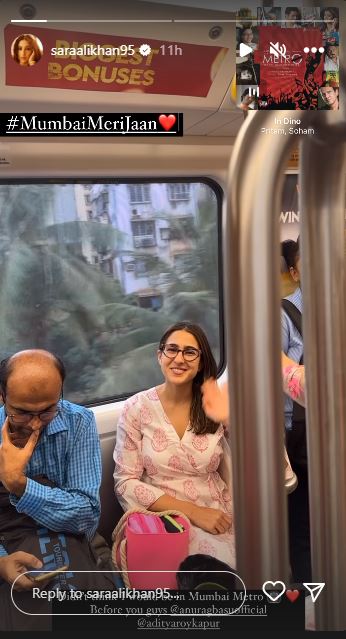
Mumbai: Actress Sara Ali Khan recently took a Metro ride in Mumbai. Taking to Instagram Story, Sara dropped a video, which shows her seated in the Metro.
Dressed in a white kurta and spectacles, Sara waved at the camera while smiling widely. “Mumbai meri jaan… Didn’t think I would be in Mumbai metro before you guys,” she captioned the post, tagging her ‘Metro In Dino’ co-star Aditya Roy Kapoor and director Anurag Basu.
Seems like Sara has started shooting for ‘Metro In Dino’, a film that apparently draws its title from the popular song ‘In Dino’ from ‘Life in a… Metro’.
The project will showcase bittersweet tales of human relationships based in contemporary times. Billed as an anthology, it will also feature Konkona Sen Sharma, Pankaj Tripathi, Fatima Sana Shaikh, Anupam Kher, Ali Fazal and Neena Gupta in the lead roles.
Sharing more details about the film, Anurag Basu had earlier said, “Metro…In Dino is a tale of the people and for the people! It has been a while since I am working on this one and I am glad to be collaborating with a powerhouse like Bhushan Kumar yet again who has always been like a pillar to me!”
He added, “The storyline is very fresh and relevant as I look forward to collaborating with amazing artists who bring that essence of contemporary aura with them. As the music plays a very important role in any film, I couldn’t be happier to be collaborating with my dear friend Pritam who has literally added life to the characters and story with his work.”
United Nations: Pressing its case for reforming the UN Security Council, India has said that either the veto rights should be abolished or be given also to new permanent members in a reformed Council.ha
“Either all nations are treated equally in the context of voting rights or else the new permanent members must also be given the veto,” Pratik Mathur, a counsellor at India’s UN Mission said on Wednesday at the General Assembly.
“Extension of veto to new members, in our view, will have no adverse impact on the effectiveness of an enlarged Council,” he said countering arguments made by some countries against expanding permanent membership.
A singular privilege to address the 68th Plenary Meeting of the @UN General Assembly on behalf of 🇮🇳 on “Use of Veto”.
We remain strongly supportive of comprehensive reforms that leads to a #UNSC which better reflects today’s 🌎!
He said that the question of veto should be addressed as part of a comprehensive reform of the Council through clearly defined timelines in the Inter-Governmental Negotiations (IGN) for reforms.
The IGN has virtually stalled because a small group of countries have manipulated the process to prevent progress.
Mathur was speaking at an Assembly debate held on the first anniversary of the landmark resolution requiring a discussion by the Assembly within ten days of a veto being cast in the Council.
While the Assembly cannot override a veto in the Council, by having a discussion it hopes to bring moral pressure on the vetoers or expose them to the world.
Mathur said that the veto resolution adopted by consensus “unfortunately, reflected a piecemeal approach to UNSC reform, thereby highlighting one aspect, ignoring root cause of the problem”.
The root cause in the view of India and many countries is the architecture of the Council that reflects the post-World War II scenario and gives veto-wielding permanent seats to the five victorious allies, Britain, China, France, the US and Russia, which hold the seat originally given to the Soviet Union.
Mathur said: “As rightly called out by our African brothers, it goes against the concept of sovereign equality of states and only perpetuates the mindset of the Second World War, ‘To the victor belongs the spoils’.
“Let me flag what our African Brothers have repeatedly stated in the IGN: ‘The veto as a matter of principle should be abolished. However, as a matter of common justice, it should be extended to new permanent members so long as it continues to exist’.”
During the debate, Kenya’s Deputy Permanent Representative Michael Kiboino reaffirmed the same point citing the Common African Position on Council reform.
“If the pursuit of the purposes of the UN Charter is based on the principle of sovereign equality of states, then the veto is a contradiction that should be abolished.
“But if it is to be retained in a reformed Security Council, it must be extended to new permanent members with all its attributes, including the prerogatives and privileges of permanent membership,” Kiboino declared.
The most vigorous push for Council reform comes from the 54 nations of Africa, a continent without any permanent members on the Council where the majority of actions relate to it.
South Africa’s Permanent Representative Mathu Joyini said that the Assembly’s veto resolution requiring discussions of it “should not be seen as an interim or ad-hoc solution to the need for urgent Security Council reform, which will address the structural challenges within the Council itself”.
“We must continue our efforts for urgent Council reform and the revitalisation of the General Assembly. Ultimately, focus should be on giving greater momentum to the reform of the Security Council itself,” she added.
The Assembly’s resolution in April 2022 on holding debates on vetoes was adopted after the Council was paralysed by Russia’s veto of a resolution in February last year condemning its invasion of Ukraine.
Russia vetoed another resolution in September condemning its referendums in areas of Ukraine it had annexed.
Last year, Moscow also vetoed a resolution on border crossings for sending aid to rebel-held areas of Syria and joined China to shoot down a resolution condemning North Korea’s intercontinental and other ballistic missile tests.
The Assembly held debates on those three vetoes.
Assembly President Csaba Korosi called the veto resolution, “a breakthrough, a gamechanger” that “opened the door for a new form of collaboration and accountability” between the Assembly and Council.
While India has insisted on veto rights for all permanent members in a reformed Council, it had also offered to forgo the veto power temporarily as compromise.
During an IGN meeting in 2016, Syed Akbaruddin, who was then India’s permanent representative, said: “Our own national position has been and remains that the veto should, as long as it exists, be extended to new permanent members. As a measure of flexibility and willingness for compromise, the use of the veto can be deferred till the Review Conference.”
The UN Charter provides for a conference to review and amend the veto rights but such a meeting has never taken place.
Kishtwar: A teenager was killed after a massive boulder rolled down a hill during a rain-triggered landslide and hit his house in Jammu and Kashmir’s Kishtwar district early Thursday, officials said.
Two people were trapped under the debris of the house. While 19-year-old Arshad was killed in the incident, Rashid (17) was rescued, they said.
The officials said the other occupants of the house are safe. The incident took place between 3:30 am and 4 am in the district’s Thakuria area.
Loyedhar Sarpanch Mohd Rafi Shah said the village is located at the foot of the hill and there is always the threat of boulders rolling down during a landslide
There was a major incident some years ago and now again there has been one, he said and demanded that the government take some measures for the safety of people.
New Delhi: Amazon has shuttered its health-focused Halo division and discontinued Halo Band, Halo View, and Halo Rise devices which are no longer available on its website. The company has also laid off employees from the Halo team.
The company said in a blog post late on Wednesday that beginning on August 1, Amazon Halo devices, and the Amazon Halo app, will no longer function.
“We recently made the very difficult decision to stop supporting Amazon Halo effective July 31, 2023. We notified impacted employees in the US and Canada today. In other regions, we are following local processes, which may include time for consultation with employee representative bodies and possibly result in longer timelines to communicate with impacted employees,” said Amazon.
For employees who are impacted by this decision, Amazon is providing packages that include a separation payment, transitional health insurance benefits, and external job placement support.
In the coming weeks, Amazon will fully refund purchases made in the preceding 12 months of Amazon Halo View, Amazon Halo Band, Amazon Halo Rise, and Amazon Halo accessory bands.
“In addition, any unused prepaid Halo subscriptions fees will be refunded to your original payment method. If you have a paid subscription, as of today you will no longer be charged the monthly subscription fee. You do not need to take any additional steps,” said the e-commerce giant.
Amazon launched the original Halo Band in 2020.
The company said it encourages users to recycle Amazon Halo devices and accessories through the Amazon Recycling Programme.
Delhi: “It was like we were on a deathbed,” recalled a relieved Sukhvinder Singh from Haryana as he arrived at the Delhi airport from Saudi Arabia on Wednesday night after being evacuated from strife-torn Sudan.
In his mid-40s, the engineer was among the first batch of 360 Indian nationals who returned home under India’s ‘Operation Kaveri’ evacuation mission.
Singh, a native of Faridabad in Haryana, recalled his ordeal in Sudan and said he was “still very scared”.
VIDEO | First batch of Indians evacuated from Sudan arrive at Delhi Airport. At least 534 Indian nationals have been evacuated from the strife-torn African nation so far. pic.twitter.com/R0AqCQZTD1
“We were living in one area, confined to one room. It was like we were on a deathbed,” he told PTI before making his way home.
India has evacuated at least 670 Indian nationals from Sudan and is looking to rescue more of its citizens from the strife-torn African nation before the end of a tenuous ceasefire between the regular army and a paramilitary force.
Chhotu, a factory worker who hails from Kushinagar in Uttar Pradesh, was in a state of disbelief and exclaimed, “‘Marke wapas aa gaya (have returned after almost dying)’.”
“Now, I will never return to Sudan. I will do anything in this country but won’t go back,” he told PTI shortly after landing at the Indira Gandhi International Airport’s Terminal 3.
External Affairs Minister S Jaishankar took to Twitter to share images of the evacuees after their arrival at the Delhi airport.
“India welcomes back its own. Operation Kaveri brings 360 Indian nationals to the homeland as first flight reaches New Delhi,” he tweeted.
At the airport’s Terminal 3, as people deboarded the aircraft of Saudia — a Saudi Arabian airline — and slowly streamed on to the arrivals lounge area, smiles could be seen on the faces of many who went through tense moments over the past few days.
Many waved emphatically, displaying a visible sign of relief, while others shook hands on the skybridge as they were welcomed on their return.
Several were seen carrying their luggage, accompanied by children. They also obliged a few photographers with pictures upon their safe return.
Tasmer Singh (60), an evacuee who hails from Hoshiarpur in Punjab, described his experience during the ongoing strife as horrifying.
“We were like a dead body, roaming in a small house without power, water. We never imagined that we will face this kind of a situation in our lives but thank God, we are alive,” he said.
Sudan has been witnessing deadly fighting between the country’s army and a paramilitary group for the last 12 days that has reportedly left around 400 people dead.
India stepped up its efforts to evacuate the Indians from Sudan after a 72-hour truce was agreed between the Sudanese army and the paramilitary Rapid Support Forces following intense negotiations.
The batch of Indian nationals evacuated from Sudan who landed in Delhi heaved a sigh of relief after returning to their homeland.
Among the evacuees who reached Delhi airport in the Saudia flight, 19 are from Kerala, state government officials said.
Under ‘Operation Kaveri’, India is taking the evacuees to the Saudi Arabian city of Jeddah from where they are returning home.
India has set up a transit facility in Jeddah and Union Minister of State for External Affairs V Muraleedharan is overseeing the evacuation mission from the Saudi Arabian city.
Sukhwinder Singh, the engineer, also narrated how difficult it was to travel during the strife in Sudan.
“We contacted the Indian embassy and buses for around 200 people were arranged. A road trip was very risky. Only God knows how we reached Port Sudan,” he said.
He said the warring groups can shoot anybody “depending on their mood”.
“It depends on the mood of the individual. If we say we are Indians, they let us go,” the Faridabad native said.
Meanwhile, IndiGo said it has offered services for charter flights to Jeddah under ‘Operation Kaveri’.
“We are still awaiting details from the ministry to launch these flights, nothing has been confirmed as of yet,” the airline said in a statement.
The Indian Air Force’s transport aircraft brought to Jeddah 392 Indians from Port Sudan on Wednesday, a day after an Indian Navy ship rescued 278 citizens from that country.
The total number of Indians evacuated so far from Sudan stands at 670, according to official data.
The first batch of 278 Indians was evacuated from Port Sudan by the Indian Navy’s frontline ship INS Sumedha on Tuesday.
Several states have opened help desks and announced assistance such as free travel and lodging for Indians evacuated from Sudan once they arrive in the country.
The Kerala government said it would make necessary arrangements to bring Malayalis evacuated from Sudan by the Centre to the state.
The Uttar Pradesh government on Wednesday opened a help desk at the resident commissioner’s office in Delhi for people from the state trapped in Sudan, a senior official said in Lucknow.
The Rajasthan government has decided to bear the transportation expense of all migrants from the state after they land in Delhi.
The government will also arrange for boarding and lodging for the returnees, officials said.