SRINAGAR: A man died while his brother was injured in a mysterious blast in Chatroo village of Kishtwar district on Wednesday.
Quoting a senior police official, KNO reported that a mysterious blast took place in Symbol locality of Chatroo village.
He said initial reports suggest that the blast took place in the home of one Mohammadd Abaas Naik in Symbol village.
He said the two brothers had gone to a nearby forest area for collection of some herbs during which they found a rusted rod-like object.
“They brought the same to their home and tried to fiddle with it. The object exploded, resulting in on spot death to one person and injuries to the other,” he said.
The official said investigation has been started to ascertain facts and nature of the blast.
SRINAGAR: The five-year term of urban local bodies in Jammu and Kashmir would end in October- November this year, officials said.
Quoting an official, KNO reported that Srinagar Municipal Corporation, Jammu Municipal Corporation, Municipal Councils and Committees of the Union Territory would complete their five-year term later this year.
“The Srinagar Municipal Corporation would complete its term on November 05, 2023 while Jammu Municipal Corporation’s term would end on November 14, 2023,” he said, adding that the five year term of an ULB is counted from the day of their first meeting.
The first meeting of SMC was held on November 6, 2018 and that of JMC on November 15, 2018. Juniad Azim Mattu and Chander Mohan Sharma were elected as mayors of SMC and JMC after ULB elections, respectively.
According to the official, the five-year term of municipal Councils and Committees would also come to end in October- November this year.
The last urban local bodies polls were held in four phases in October 2018 during Governor’s rule in the erstwhile state of Jammu & Kashmir. While voter turnout remained impressive in Jammu region, only 3.1 percent of the eligible electorate exercised their voting rights in Kashmir.
Only 31541 votes were polled in the valley against the total electorate of 1032498.
SRINAGAR: National Conference General Secretary Ali Muhammad Sagar on Tuesday said that people in Kashmir are grappling with one of the worst power crises in years and that the government claims have fallen flat.
While expressing dismay over the failure of the government in rising upto the expectations of the people, Sagar said, “People across the valley are complaining of unscheduled power cuts throughout days especially during Sehri and Iftar times. Before the onset of the holy month, the government had made tall promises about ensuring steady supply of electricity to consumers. It was claimed that enduring uninterrupted power supply during Sehri and Iftar will be a priority by the Power Development Department (PDD).”
Power bills have gone up from Rs 700 to Rs 1100 but the scenario of electricity hasn’t changed, Sagar rued adding, “Most of the city areas were reeling under darkness even during the Shab-e-Qadr observance. Had the government told people to brace for prolonged power cuts, they would have made up their mind for the predicaments. For the past one week the scenario has taken an ugly turn with the outages touching 12 hours a day. The situation in upper reaches and far-flung areas is much worse. This is the everyday story now. There are frequent power cuts throughout the day and night. Situation is the same in both metered as well as non-metered areas. It is unfortunate that the electricity is unavailable when people need it the most. All the tall claims of the government have fallen flat.” (GNS)
SRINAGAR: Deputy Commissioner Poonch Inder Jeet (JKAS) on Wednesday placed under suspension 14 employees for remaining absent from their legitimate duties without any authorization. Moreover, show cause notices have been issued to 21 employees including some gazetted officers of Jal Shakti, PMGSY and Floriculture Departments.
Acting on complaints received from common citizens, PRIs and various other quarters, Deputy Commissioner Poonch formed a committee of officers headed by Additional Deputy Commissioner Poonch Tahir Mustafa Malik(JKAS) to conduct surprise inspections across all the government offices in a phased manner.
ADC poonch with his team inspected several offices including Jal Shakti, PMGSY etc and found several employees absent. Notably, they said, absent employees neither had sanctioned leave in their favour nor maintained any movement register for field visits. Moreover some HODs holding important offices were unaware of whereabouts of their immediate staff as well as field staff. Further some HODs were themselves found absent during office hours, they said.
Subsequently, ADC Poonch recommended action against employees including HODs. Acting on the recommendations of committee, Deputy Commissioner Poonch placed under suspension 14 more employees and issued show cause notices to 21 others. (GNS)
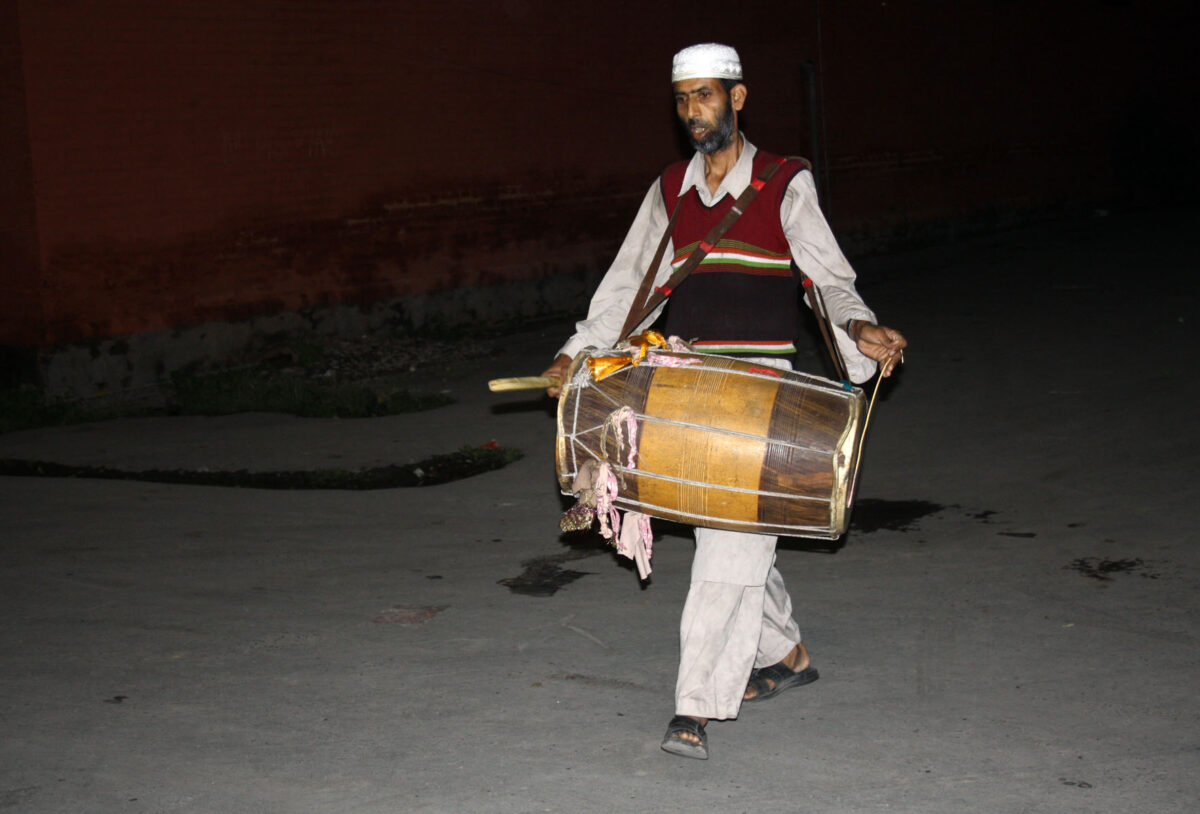
The digitized twenty-first century has bestowed almost everything upon the cell phone to the extent that it has replaced more than 50 things. While the Ramzan drummers were competing with the mosque loudspeakers, the mobile phone alarms have led to their decline in Kashmir villages and towns, reports Raashid Andrabi
Asked what he misses during Ramzan, the month of fasting, in comparison to his childhood, Ishfaq Ahmad, 50, a Ganderbal resident said, Waqt-e-Sehar. “There were drummers who used to wake people at Sehri and it was an interesting tradition that is no more around,” the resident said. “Now everybody has alarm bells at home.”
Muslims in Ramzan fast for a long day after having Sehri, the pre-dawn meal. They breakfast at Iftaar, the exact dusk when the Mouzin, the man who calls for prayers, invites the faithful to Magrib prayers from the mosque.
Getting people up from their beds when they are in deep slumber is a heady task. Various civilisations have had human alarms deployed to wake-up people early, mostly for work. It was a common sight in parts of industrial Britain till the alarm clocks were perfected and made cheap for commoners that knockers-up (also called knockers-uppers) were engaged in waking up people early for pre-dawn shifts in the factories.
These knocker-ups would use batons or short, heavy bamboo sticks to reach windows on higher floors. Some would use pea-shooter or snuffer outers to make people get up from their beds. These people were either hired by the factories or the workers would pay from their own earnings.
Following the Muazin
However, Islam’s knockers-up preceded the industrial revolution. Muslim historians see Bilal-e-Habshi, actually Bilal bin Rabah, Islam’s first Muazin, as the first-ever Mesaharthi, an Arabic word meaning the person who wakes up people during early hours.
Apart from calling Azaan, Bilal would be accompanied by Ibn Umm Maktoum to wake up people for Sehri (actually Suhoor) in the month of fasting. Their exercise was informal.
A drummer (Seharkhaan) who wakes up people for sehri durimg the night
Gradually it emerged as a voluntary exercise for people and by the time, the Fatimids started ruling, soldiers would wake up people at Sehri.
The Mesaharati origins, however, remain disputed.
“Historian Abdelmajid Abdul Aziz said mesaharati first appeared in Egypt during the Fatimid dynasty, arguably the most decorated period for Ramadan celebrations,” Saudi newspaper Arab News reported from Coiro. “According to 15th-century Egyptian historian Mohammed bin Iyas, the profession began in the days of the Caliph Bi’amr Allah, who commanded citizens to sleep immediately after the Taraweeh prayer.”
The Caliph, the newspaper said would then send out his soldiers in the early hours, knocking on doors and shouting before dawn prayers began, to wake people for suhoor.
“Abdul Aziz said that the Egyptian Governor Ibn Ishaq was the first to individually perform the task professionally in 832 AH (1432 CE). He would walk from the city of Fustat to the mosque at Amr ibn Al-Aas, and call out “O worshipers of Allah, eat. Suhoor is a blessing.” Fustat was the capital of Egypt during the Fatamid period.
In certain societies, the rulers would use cannons at Sehri and Iftaar time.
Diverse Tools
The mesaharati’s use different tools to wake the people from their slumber. Mostly they use a drum because it has a louder voice. In Egypt, they use Baza, a tumbakhnari-style small drum.
In various other parts of the Muslim world, diverse musical instruments are used. It is a flute in certain areas but mostly it is a different form of drum. In various societies, certain families are working as mesaharati’s for generations on a voluntary basis. Dalal Abdel Kader, an Egyptian female mehsaharati’s was asked why she is doing it when alarm clocks do it better, she said: “The mesaharati reminds you that it’s Ramadan and people love this.”
The Sehr Khwans
Given the fact that Islam came to Kashmir through Central Asia, it brought with it cultural influences. In Kashmir and most of South Asia, the Ramzan drummers are called Sehr Khwan. It is Persian which means a person who recites at Sehr. Quran Khwan is the person who recites the Quran.
There are no records of the Kashmiri mesaharati’s. However, it is being said that earlier groups of men would move around streets, reciting the Quran in high-pitch. Later, they started using drums and gong bells.
Unlike towns, the responsibility of waking people would be with a well-to-family that could own a bell and had the means of knowing the exact timing. While Kashmir has used the erstwhile Radio Kashmir Srinagar’s evening broadcast to have Iftaar, the Sehri timing, however, was to be managed locally without any radio support.
Loudspeakers came as a huge relief as one person would somehow reach the mosque and make the announcement. Even today, the mosque continues to be a contributor in getting up people for pre-dawn meals and announcing the breakfast as well.
Declining Numbers
With the arrival of the cell phone, however, the mesaharatis have started disappearing from the streets. It is as true for Sudan as it is for Kashmir. A lot of people rely on alarm clocks to wake up early for Sehri.
In Kashmir, villages have technically given up the Sehar Khwan tradition. They use the mosque loudspeakers instead, in addition to the alarm clocks. Conflict and militancy played a key role in undoing the tradition in villages. The impact of conflict on this job can be gauged by the fact that some of the Ramzan drummers wake up and beat the drum within their own home premises and not moving around. It is only the major towns and the city where the tradition survives.
In 2018, it was a Sikh who became the news for being the Sehr Khwan in a Pulwama village. It was in fact a video that went viral and fetched him praise for the communal harmony. He used to say: “Allah Rasool de pyaaro, jannat de talabgaro, utho roza rakho (The beloved of Allah and his messenger, the seekers of paradise, wake up to start your fast).
The Srinagar City may have the highest number of active mesaharatis. Mostly equipped with drums, they recite hymens and ask people to get up and have sehri. Usually, they roam the streets almost an hour ahead of the Sehri time.
Most of these sehr khawns are non-natives, mostly from the north Kashmir periphery. Some of them are already working in Srinagar as mosque managers or doing other jobs. A few of them actually move to Srinagar for the month to operate as the sehr khwan because it fetches a good income.
“I have been working as Sehr Khawn for many years now,” Wali Mohammad, who operates in an uptown locality of Srinagar, said. “I live in the locality and I already work within the locality including managing the Hamams of people and other things.”
Most of Srinagar’s localities have their own mesaharati. Though most of them are professionals, a few of them say they are doing it as part of their spiritual well-being.
In anticipation of Eid, these mesaharati’s picked up their drum and move from one house to another, getting blessings and money. People usually liberally try to compensate them because they know they are more than the push button alarms. There have been cases when the localities were on fast without Sehri as Sehr Khawn was indisposed and overslept.
SRINAGAR: As the Kashmir received incessant rainfall since yesterday, the authorities on Wednesday said that there is no alarming flood-like situation in the Valley and people need not to panic.
Chief Engineer Irrigation and Flood Control Department, Naresh Kumar said that there is not an alarming situation in the Valley as of now.
“The alert level at Sangam is well below the danger mark and same is in Ram Munshi Bagh. There is no alarming flood like situation as of now and people also need not to panic,” he said.
He also said that the weather is likely to improve in the afternoon, so for now there is no need to panic.
Kashmir Valley witnessed incessant rainfall since yesterday, while the weatherman has predicted more rain showers as the day progresses.
An independent weatherman predicted that the higher reaches of Jammu and Kashmir will receive good amount of snow, while plains may get moderate to heavy rain.
He further said that more showers are expected till Friday, while maximum temperature will stay below normal by 4 to 13 Degree Celsius at most places. (KNO)
SRINAGAR: In a distressing event, the Jammu and Kashmir police have apprehended a Sarpanch from the Baramulla district in North Kashmir on charges of sexual assault against a woman.
According to sources, a young woman whose identity has been withheld was allegedly victimized by the Sarpanch, who operates under the jurisdiction of the Dangiwacha Rafiabad police station.
The report further states that the accused Sarpanch was taken into custody after the victim’s relatives submitted a written application to the Sopore police.
A police official has confirmed the occurrence to the news agency and stated that a case has been registered under FIR no 26/ 2023, citing sections 376, 506, and 109 of the Indian Penal Code, at a local police station.
SRINAGAR: In a distressing event, the Jammu and Kashmir police have apprehended a Sarpanch from the Baramulla district in North Kashmir on charges of sexual assault against a woman. The Sarpanch is affiliated with Bhartiya Janta Party (BJP).
An official said that Ali Mohammed Dar son of Abdul Ahad Dar,Sarpanch of Rawoocha village of Rafiabad was arrested for allegedly raping a woman.
He was arrested following a complaint by a woman that she was raped and impregnated by the Sarpanch, he said.
The official said a case FIR No 26/2023 u/s 376, 506, 109 IPC has been registered at Police Station Dangiwacha and further investigation has been set into motion.
Notably, Dar was earlier arrested for being a militant associate in 2017 and was later released. (KNO)
SRINAGAR: Rains continued to lash Jammu and Kashmir even as the weather department here on Wednesday modified its forecast, predicting intermittent rainfall to continue till April 22.
Quoting a meteorological department official, GNS reported that intermittent light to moderate rain was likely to continue at most places of Kashmir and at scattered places of Jammu. However, he said, a significant decrease in rainfall was expected from this evening.
On April 20-22, MeT forecast intermittent light to moderate rain at scattered places. From April 23-25, he said, the mainly dry weather was expected.
Regarding rainfall in last 48 hours till 0830 hours today, Anantnag received 31mm, Kulgam 15mm, Pulwama 29mm Shopian 35mm, Qazigund 50mm, Pahalgam 63.4mm, Kokernag 37.8mm, Srinagar 22.9mm, Gulmarg 51.7mm, Banihal 66.4mm, Batote 29mm, Udhampur 15.8mm, Jammu 17.1mm, Katra 22.2mm, and Kathua 3.4mm.
Regarding temperature, the official said that Srinagar recorded a low of 10.3°C against 11.0°C on the previous night and it was 2.4°C below normal for the summer capital.
Qazigund, he said, recorded a low of 9.2°C against 9.8°C on the previous night and it was 2.7°C above normal for the gateway town of Kashmir.
Pahalgam, he said, recorded a low of 5.4°C against 5.6°C on the previous night and it was 2.0°C above normal for the famous tourist resort in south Kashmir’s Anantnag district.
Kokernag recorded a low of 8.3°C against 9.3°C on the previous night and it was 1.8°C above normal for the place, the officials said.
Gulmarg recorded a low of 2.0°C against 3.6°C on the previous night and it was 0.3°C below normal for the world famous skiing resort in north Kashmir’s Baramulla district, he said.
In Kupwara town, he said, the mercury settled at 7.1°C against 8.6°C on the previous night and it was 0.3°C above normal for the north Kashmir area.
Jammu recorded a low of 17.4°C against 20.0°C on the previous night. It was 2.5°C below normal for J&K’s winter capital, he said.
Banihal, he said, recorded a low of 10.2°C (above normal by 1.8°C), Batote 10.1°C (below normal by 1.3°C), Katra 16.0°C (1.1°C below normal) and Bhadarwah 11.9°C (4.7°C above normal). Ladakh’s Leh and Kargil recorded a low of 1.6°C and 3.3°C respectively, he said.
SRINAGAR: A student from National Institute of Technology (NIT) Srinagar has earned 1.23 lakh profit from his investment in the share market during the past one week and has decided to donate the entire amount among marginalized sections of society.
Tabrez Alam, 8th-semester student from the Department of Information Technology is all set to donate his profit of investments among marginalized sections of society including students.
In his message, Director NIT Srinagar Prof Rakesh Sehgal appreciated Tabrez Alam for the noble initiative. Donations can provide essential support to individuals and communities who are struggling with poverty, illness, or other challenges, he said.
“By donating, individuals can inspire others to give and contribute to creating a culture of generosity and compassion,” Prof. Sehgal said, adding that NIT Srinagar students should become a ray of hope for the society.
Institute’s Registrar, Prof. Syed Kaiser Bukhari said donation is a powerful tool for creating positive change in the world and helping those in need. By giving to others, we can make a difference in their lives and contribute to building a better future for all, he said.
Prof. Bukhari said helping society at the time of need is essential for building a strong and resilient community. Addressing systemic issues that contribute to social and economic inequality requires sustained limitless efforts. Such things are the need of the hour, he said.
Hailing from Dhaka Champaran district of Bihar, Tabrez stated that he had invested around 5 lakh in the share market. Now has decided to share his entire profit among the marginalized sections of society including poor students, he said.
“I want to help people who are suffering in our society. Although it is a small contribution, I am trying my best to do my part,” he said.